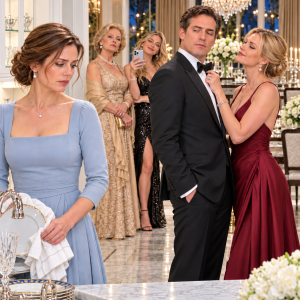
His expression tightened before he forced a smile.
“I’ll get a towel.”
The moment he left, I poured the remaining tea into a clean cosmetic bottle hidden in my purse. When he returned, I apologized again and pretended to drift into an uneasy sleep.
Tessa arranged for a trusted colleague to collect the sample from a concealed location near the back gate. Before evening, she called with the results.
The tea contained a prescription sleep aid in an amount capable of clouding judgment, particularly if administered repeatedly.
There was something else. The prescription was connected to Martin Voss, but he was not a physician. He was a consultant who specialized in disputed estates, conservatorship petitions, and cases involving adults considered unable to manage their own finances.
Suddenly every detail aligned: the witnesses, the false memories, the call to my doctor, the staged concern, the mysterious tablets, and Caleb’s repeated suggestion that I should remain inside the house.
They did not merely want me to sign a document. They wanted other people to doubt my ability to make any decision at all.
Tessa’s voice became firm.
“You are leaving tonight.”
This time, I agreed.
I packed my passport, laptop, jewelry, financial documents, and the copy of the property deed I had brought with me. I also transferred the recordings to several secure locations and sent one copy to Graham Bellamy, the longtime trustee who had helped my father organize his estate.
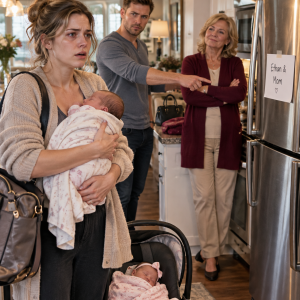
Shortly after eight, I carried my suitcase downstairs.
“I’m going home,” I announced.
Caleb rose from the sofa.
“I’ll drive you.”
“I need to go alone.”
Diane appeared behind him.
“That may not be wise. You haven’t seemed like yourself lately.”
“I feel clearer than I have in months.”
Something in my voice changed the room.
Caleb stepped between me and the front door.
“Let’s talk before you make an impulsive decision.”
“Move.”
“Nora, you’ve been confused. You told us you were hearing voices.”
“I lied.”
Silence settled across the room.
Diane’s face lost its color.
“I wanted to see how pleased you would be when you thought your plan was working,” I continued.
Caleb took one step backward.
I named the staged stain, the photograph of me sleeping, the false conversation with my aunt, the call to my physician, the recording beneath the bed, and the substance in my tea.
The warmth disappeared from Diane’s expression. For the first time, she stopped pretending to be a concerned mother and allowed me to see the woman underneath.
“You foolish little girl,” she said.
Caleb turned sharply toward her.
“Mom, stop.”
“She knows everything.”
“I can handle this.”
“No, you can’t. You’ve already ruined it.”
Their alliance began collapsing in front of me, yet Caleb still reached toward my purse.
“Give me your phone.”
I stepped back.
“Don’t touch me.”
He closed his hand around my wrist.
“Nora, give it to me.”
Before he could pull me closer, headlights swept across the windows. Three vehicles turned into the driveway, their beams moving across the walls and wedding photographs.
Caleb released me.
Tessa stepped from the first vehicle. Two county officers emerged from the second, and Graham Bellamy climbed out of the third carrying a leather document case.
Diane stared through the curtain.
“What have you done?”
I looked at the woman who had mistaken politeness for weakness and trust for blindness.
“I finally stopped trying to keep your family comfortable.”
The Protection My Father Built
Everything moved quickly once the officers entered the house. Caleb’s phone was collected, the tea sample was documented, and my recording played through the kitchen speakers while Diane sat at the table with her arms crossed.
Caleb immediately claimed that his mother had pressured him. Diane responded that her son had created the entire plan and used her concern for him to gain cooperation. Their loyalty lasted only as long as they believed success was possible.
Graham guided me into the sitting room, away from their accusations.
“Your father anticipated that someone might eventually pursue the property,” he explained.
“He knew about Caleb?”
“Not specifically. He simply understood that a valuable inheritance can attract people who mistake affection for access.”
The farmhouse and investments, he told me, were held inside a protected trust. An ordinary authorization document could not transfer ownership, even if I had signed one willingly.
Relief briefly weakened my knees.
“Then their plan could never have worked.”
Graham did not answer immediately.
“There was one possible route. If a court decided you were unable to manage your affairs, an appointed conservator might petition for limited control.”
The relief vanished.
“That’s why they needed Voss.”
Graham nodded.
“And why they needed witnesses, medical concerns, and behavior that could be presented as evidence.”
They had not simply been trying to take my house. They had been trying to replace me with the imaginary woman they had created—a grieving, confused bride who could not remember conversations, heard voices, rejected help, and made irrational accusations against the family caring for her.
As the officers led Caleb toward the front door, he turned back.
“Nora, please. I love you.”
Two days earlier, those words would have reached the most trusting part of me. Now they sounded like another instrument he had learned to use whenever honesty might cost him something.
“You loved what trusting you gave you access to,” I replied.
He lowered his eyes.
As Caleb passed Diane, she blamed him for ruining everything. He answered that the plan had been hers from the beginning. Their argument continued onto the porch while our wedding flowers still stood fresh in their vases and the white ribbons still moved in the warm Carolina air.
Near midnight, Tessa and Graham accompanied me to my father’s farmhouse. I expected to feel safe the moment I crossed the threshold, yet the rooms seemed unusually still, as though the house itself had been waiting for me to return.
Graham asked to inspect the original trust documents, which I had last seen three days before the wedding.
The folder was missing.
We searched my father’s study, opening drawers, checking cabinets, and removing books from shelves. Nothing else appeared disturbed. His fountain pen remained beside the blotter, his reading glasses rested on the desk, and the framed photograph of us taken during my college graduation stood exactly where he had placed it.
Tessa eventually noticed a small brass key on the floor behind the desk.
I recognized it immediately.
It opened a private safe concealed behind an old landscape painting. When I turned the key, I found one envelope inside, along with a photograph facedown beneath it.
My name was written across the front.
“Nora—open only if someone attempts to control the house.”
My hands trembled as I unfolded the letter.
The photograph showed my father standing outside a courthouse nearly twenty-eight years earlier. Beside him was a much younger Diane, recognizable by the same pale eyes and composed expression. Martin Voss stood on her other side.
On the back, my father had written:
“Diane Pierce is not the woman her son believes her to be.”
The final paragraph of the letter referred to a secret surrounding Caleb’s birth, one Diane had protected for almost three decades. My father had known her long before Caleb and I ever met, and whatever had happened between them had concerned him enough to build safeguards around everything he intended to leave me.
Before Graham could explain, my phone rang from an unknown number.
I answered without speaking.
A man’s quiet voice came through the line.
“Nora, do not trust Graham Bellamy.”
I looked across the study. Graham stood only a few feet away, watching me hold my father’s letter.
The caller continued.
“What happened to your father was not natural, and Bellamy knows why.”
The line went silent.
I lowered the phone and looked again at the photograph in my hands. Until that moment, I had believed I had uncovered the truth about my marriage, protected my inheritance, and escaped the people who had tried to erase my credibility.
In reality, I had only found the first loose thread in a secret that began decades before I walked down the aisle—and the one man standing beside me, whom my father had trusted to guard everything, might have been the person I needed to fear most.