“You could have checked.”
My father closed his eyes.
The silence that followed was more painful than the shouting.
I had imagined this moment for years. I’d pictured my father finally understanding what he’d done, perhaps apologizing to Michael and asking us to come home.
Instead, he looked at me.
“You could have handled this privately, Caroline. There was no need to embarrass your brother.”
I felt something inside me sink.
Even now, his first concern was Brent.
“Dad, Michael lost his job. We lost our home. You told everyone he was dishonest, and Mom told relatives I was a disgrace. Where was your concern about embarrassment then?”
My mother wiped at her eyes.
“We were hurt too, Caroline.”
I turned toward her.
“You were hurt because I wouldn’t abandon my husband.”
She began crying.
“You have no idea what it’s like to have your daughter walk away from everything you’ve given her.”
For a moment, I saw the mother who’d sat beside me through childhood fevers, who’d sewn my graduation dress, who’d cried when I left for college.
I wanted her to say she’d missed me.
I wanted her to say she’d been wrong.
Instead, she reached for my hand.
“Please don’t make this worse. People will talk if the company fails.”
I looked at her fingers resting on the table.
“Mom, is that really what you’re worried about?”
She hesitated.
“Our reputation matters, Caroline. Your father spent his whole life building it.”
I withdrew my hand.
“So did Michael.”
She had no answer.
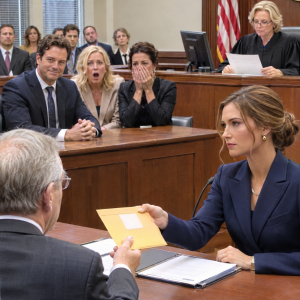
I closed the black folder.
“There’s one more matter we need to discuss.”
My father looked exhausted.
“What now?”
I placed a copy of a recorded deed on the table.
“The house was sold yesterday.”
He frowned.
“We know that. We signed the closing papers.”
“Then you know the buyer was Northbridge Residential Holdings.”
“An investment company,” he said.
I turned the page toward him.
“It’s a subsidiary of Northbridge Partners. Michael and I control the company.”
My mother stared at the document.
“What are you saying?”
“Our company purchased the house.”
She shook her head.
“No. That’s impossible. We sold it to investors.”
“You sold it to a company represented by its own attorney. The buyer was identified in the agreement, and you had independent counsel.”
My father read the document again.
His face slowly changed.
“You bought my house?”
“Northbridge bought the property at the agreed price. The transaction closed yesterday.”
Brent gave a bitter laugh.
“So that’s your plan. Take everything from us.”
I looked at him.
“Your debts forced the sale. We made an offer, and your parents accepted it.”
My mother pressed a hand against her chest.
“Caroline, that house has been in this family for decades.”
“I know.”
“Your grandmother spent her last Christmas there. You learned to ride a bicycle in that driveway. How could you do this?”
Her words brought back memories I hadn’t allowed myself to revisit in years.
I remembered my father teaching me to ride that bicycle, running beside me until I could balance on my own. I remembered my mother hanging Christmas stockings above the fireplace and letting me stay up late to watch old movies.
For a moment, I was thirty-nine again, standing in the foyer with a suitcase.
“I loved that house, Mom,” I said quietly. “I loved the people in it. You were the ones who told me I didn’t belong there anymore.”
She began crying harder.
“You can’t expect us to leave.”
“The contract gives you thirty days after closing. Those were the terms you accepted.”
My father pointed at me.
“You’re throwing your own parents out!”
“You received the sale proceeds, subject to your debts and closing costs. You have the means to arrange another place to live. I’m not changing the terms of a completed sale.”
He stared at me.
“You’ve become a cold woman.”
I shook my head.
“No, Dad. I just stopped confusing love with obedience.”
Brent gathered his papers and left without another word.
My father remained seated, looking at the deed.
My mother reached for me again.
“Caroline, please. We’re still your parents.”
I looked at her.
“I know. That’s why this hurts.”
She waited.
“But being my parents doesn’t mean you get to hurt me whenever you need something, then call it family loyalty.”
Michael stood beside me.
I picked up my handbag.
“If you want to discuss the sale, your attorney has the documents. If you ever want to talk about what happened twelve years ago without asking me for money, you know where to find me.”
My mother lowered her eyes.
She didn’t apologize.
Neither did my father.
Michael and I walked out together.
In the parking lot, I stopped beside our car.
For years, I’d imagined that proving Michael innocent would make everything right. I’d thought my father would finally understand, my mother would embrace me, and the family we’d lost might somehow return.
Instead, I felt an ache I couldn’t quite describe.
Michael opened the passenger door.
“Carrie?”
I looked at him.
“I really thought she’d say she missed me.”
He stepped closer.
“I know.”
“Twelve years, Michael. And she still only came because she needed something.”
He wrapped his arms around me.
I cried against his shoulder, not because I’d lost the argument, but because I’d finally stopped hoping there was a different family waiting beneath all that pride.
When I pulled away, Michael brushed a tear from my cheek.
“You did the right thing.”
I shook my head.
“I don’t feel victorious.”
“You don’t have to.”
He kissed my forehead.
“We can just go home.”
The months that followed were difficult for my parents.
The lender continued reviewing Brent’s financial records, and the authorities investigated the evidence submitted by our attorney. Brent eventually faced charges related to false financial documentation. My father lost control of Whitmore Development as creditors became involved.
The legal proceedings took time. There were no dramatic arrests at family dinners or instant punishments.
My parents moved into a smaller house nearby. They weren’t left homeless, although my mother continued telling relatives that I’d taken their family home out of spite.
I stopped trying to correct every rumor.
People who wanted the truth could ask.
Michael and I moved forward with our plans for the property.
We converted the old house into a vocational training center for young adults interested in construction, drafting, and building maintenance. Michael designed the renovations, preserving the original staircase and several of the older rooms while making the building suitable for classes and workshops.
We named it Second Chance House.
On the day construction began, I walked through the front door for the first time in twelve years.
The foyer seemed smaller than I remembered.
My father’s portrait still hung above the fireplace. The dining room chandelier was the same one my mother had insisted on importing from Italy.
Michael stood beside me.
“Want to keep any of this?”
I looked around.
“The staircase. The windows. Maybe the dining table if we can repair it.”
He nodded.
“And the portrait?”
I smiled faintly.
“I think Dad would prefer to have that back.”
We arranged for his personal belongings to be returned.
Nine months later, Second Chance House welcomed its first group of students.
Some were recent high school graduates. Others were adults changing careers after layoffs or family difficulties. Michael spent the morning teaching students how to read architectural drawings, while I met with a local nonprofit about scholarships.
Near lunchtime, I received a message from my mother.
Caroline, I’ve been thinking about everything. Do you believe you could ever forgive us?
I stood beside a window overlooking the garden.
Twelve years earlier, I’d checked my phone every birthday, every Christmas, and every Mother’s Day, hoping for a message like that.
Now I understood that forgiveness wasn’t the same as returning to a place where I’d been made to feel small.
I typed my reply.
Maybe someday, Mom. But forgiveness doesn’t mean pretending nothing happened. And it doesn’t mean going back to the way things were.
I sent it.
Across the room, Michael was helping a young woman understand the measurements on her first floor plan. She listened carefully, then smiled when she got it right.
He looked up and caught my eye.
“Everything okay?”
I nodded.
“I think so.”
That afternoon, we replaced the old brass nameplate on the front gate.
For decades, it had read WHITMORE ESTATE.
Michael held the new sign steady while I tightened the last screw.
SECOND CHANCE HOUSE — TRAINING & COMMUNITY CENTER.
When we finished, I stepped back to look at the building.
The front doors were open, and students were coming and going with notebooks tucked under their arms.
A cool breeze moved through the garden.
Michael noticed me shiver and began taking off his jacket.
It was the same gesture he’d made twelve years earlier in that cheap hotel room, when we had nowhere else to go.
I caught his hand before he could slip the jacket over my shoulders.
“Keep it, honey,” I said, smiling. “We’re going inside.”
He squeezed my hand.
Together, we walked through the open doors.