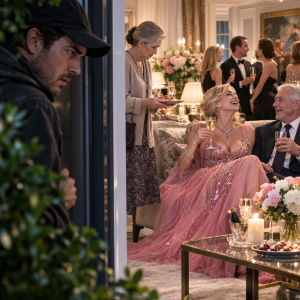
Behind us, my father’s voice followed like a closing gate.
“Run if you need to, Nathan. Every frightened boy eventually comes home.”
For once, I hoped he was wrong.
Part 5 — The House Beneath The House
The Whitmore estate overlooked the Hudson River from behind iron gates, winter trees, and enough inherited silence to suffocate a childhood. I had not entered that house since the funeral, when I stood beside a closed casket and accepted condolences from people who had feared my father too much to miss him.
Marissa had given me the service code, the location of the lower entrance, and one final warning written on the back of a parking receipt: He would rather destroy the company than lose control of the story.
We entered through a staff corridor near the old greenhouse. I carried Caleb until he insisted he could walk, then took his hand because neither of us was ready to admit that we needed it. Owen stayed close on my other side, silent and alert.
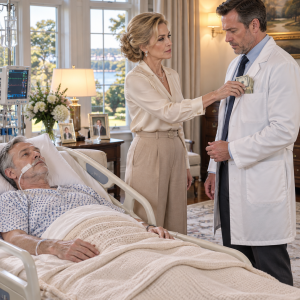
Beneath the library, a hidden stairwell led to a corridor lit with harsh white medical lights. The air smelled of antiseptic, polished wood, and money pretending to be medicine. Behind a glass door, Julia lay in a hospital bed with monitors beside her and an IV taped to one thin arm.
The boys saw her first.
“Mom!” Caleb cried.
Julia opened her eyes, and the sound she made was not quite a word. It was relief, pain, apology, and love all breaking through a body too tired to hold them back. Owen climbed carefully onto the bed while Caleb pressed his face against her side, and she wrapped both arms around them with a strength that seemed borrowed from somewhere beyond the room.
I stood at the doorway, suddenly unable to move.
Julia looked at me over their heads. She was paler, thinner, and visibly ill, but her gaze still had the power to strip away every excuse I had ever worn.
“You came,” she whispered.
“I should have come years ago,” I said.
Her eyes glistened, but her voice stayed steady. “Yes, you should have.”
I nodded because anything else would have been cowardice.
“I believed what was easy because the truth would have required me to become better,” I said. “I am sorry, Julia, but I know sorry is not enough to repair what you carried alone.”
She watched me for a long moment. “Then stop trying to sound forgiven and start being useful.”
Despite everything, I almost smiled. That was Julia. Even half-starved by illness and fear, she could still cut through a man’s vanity with one sentence.
“Tell me what to do,” I said.
She pointed weakly toward the cabinet beside the bed. Beneath the lowest drawer, taped against the wood, was a black drive.
“Conrad’s accounts, fake death records, payments to doctors, payments to Marissa, trust documents, and proof that he used Whitmore Global to hide illegal transfers,” she said. “Walter Briggs needs that drive, and federal investigators need it before Conrad locks the estate down.”
Footsteps sounded in the corridor before I could answer. My father appeared at the door with two men behind him, his cane touching the floor with measured patience.
“How touching,” Conrad said. “The ruined little family has staged a reunion.”
I moved between him and the bed.
He looked amused. “Do you imagine fatherhood has made you brave?”
“No,” I said. “It has made me honest.”
The alarms began before his men moved. A sharp mechanical cry filled the corridor, followed by voices from above and the pounding of boots on the stairs. Walter had received the files I sent from the vault, Marissa had clearly sent more, and Conrad’s private kingdom was finally receiving visitors it had not purchased.
My father’s expression changed for the first time. Fear did not soften him. It made him look smaller.
Federal agents entered the corridor with weapons lowered but ready, issuing commands with professional calm. Conrad tried to speak over them, tried to name judges, senators, and lawyers, but his voice had lost the room before his body understood it.
As they led him past me, he stopped.
“You will have nothing when this is finished,” he said.
I looked at Julia holding our sons, then at the drive in my hand.
“I had nothing before,” I answered. “I was just too well dressed to notice.”
Part 6 — What Remained After The Empire
By sunrise, Whitmore Global was frozen by federal order, my father’s resurrection had become a national scandal, and every respectable person who had ever praised him began explaining publicly that they had always sensed something troubling beneath his brilliance. The board demanded my resignation before noon, and I gave it to them without negotiation.
Julia was moved to a secure hospital in Boston, where doctors spoke carefully about blood disease, treatment plans, and the kind of hope that entered a room wearing gloves. The boys slept in chairs beside my knees for the first two nights, waking whenever a machine beeped too loudly. I learned how Caleb’s inhaler worked, how Owen pretended not to be hungry until Caleb had eaten, and how quickly children could become loyal to a person who simply stayed.
Julia did not forgive me quickly. I did not ask her to.
Some days she let me sit beside her bed and read updates from the case. Other days she told me exactly how lonely those five years had been, and I listened because the least I could offer was the dignity of not defending myself. Love, I began to understand, was not a speech. It was a chair beside a hospital bed, a school form signed on time, pancakes burned three mornings before they became edible, and the willingness to be present when presence no longer made you look noble.
Marissa testified. Walter built the timeline. Conrad’s lawyers tried to turn every witness into a liar and every crime into a misunderstanding, but paper has a stubborn memory when enough frightened people finally decide to tell the truth.
Months later, Julia’s treatment began working. Her hair grew back darker and softer, the boys turned six, and I sold the penthouse because no child should have to grow up in rooms designed only to impress visitors. We moved into a brick house near a park in Brookline, where Owen planted tomatoes he refused to eat and Caleb named every neighborhood dog as if running a census.
One year after the boys walked into my tower, Julia stood beside the kitchen window in a blue sweater, watching them chase each other across the yard. She was still rebuilding her strength, and I was still rebuilding the man I should have been, but the house was warm, loud, and imperfect in ways my old life had never dared to be.
“You know this does not erase anything,” she said.
“I know,” I answered.
She looked at me then, not with forgiveness fully formed, but with something living enough to grow.
“Good,” she said. “Because the boys do not need a perfect father. They need one who tells the truth and comes back after promising to.”
Outside, Caleb pressed his face to the glass and shouted, “Dad, Owen says tomatoes are fruit, but I think he is being dramatic.”
Julia laughed, and the sound filled the kitchen like light returning to a room that had waited too long.
I opened the back door and stepped into the noise, knowing there would be court dates, scars, hard conversations, and years of earning trust one ordinary morning at a time. Yet for the first time in my life, I was not standing at the top of an empire with nothing beneath me.
I was standing inside a family.
And this time, I knew enough to stay.
THE END