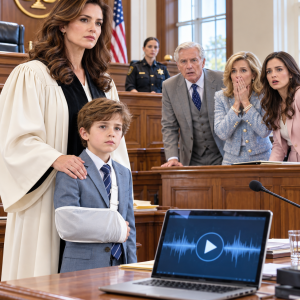
“Nothing happened between Graham and me. I was only trying to help my father find investors.”
I believed that might be true.
But it didn’t change what mattered.
“Evelyn, you didn’t have to choose between being a good daughter and being a good mother. You could have protected Caleb while still helping your father.”
She reached for my hand.
“Can we fix this?”
I stepped back gently.
“I don’t know. But we can’t pretend yesterday never happened.”
For the first time, I understood that I could care about someone and still refuse to return to the same situation.
My Father’s Decision Surprised Everyone
Over the following weeks, Bennett Regional Holdings worked with the company’s remaining creditors and management to develop a restructuring plan.
Dad insisted on one thing.
The employees would not be treated as disposable simply because Russell had made poor decisions.
Whitcomb Agricultural Supply employed dozens of drivers, warehouse workers, office staff, and maintenance technicians.
Those families had bills to pay.
They had children depending on them.
Dad wasn’t interested in ruining their lives to settle a personal disagreement.
After negotiations and a formal management review, Russell agreed to step down from day-to-day leadership.
He retained a limited ownership interest, but an independent management team took responsibility for the company’s operations.
The questionable transactions were referred for appropriate review.
One afternoon, I asked Dad why he hadn’t simply pushed to close the business.
He looked at me as though the answer should have been obvious.
“Because the people working there didn’t throw you out of your home.”
I smiled.
“You really thought this through.”
“Not everything. But I’ve learned that making somebody suffer doesn’t automatically make things right.”
Two months later, an operations director position opened within the cooperative’s regional transportation division.
Three candidates applied.
I was one of them.
Dad removed himself from the hiring committee.
I spent hours preparing.
I presented route optimization plans, fuel cost projections, seasonal staffing models, and recommendations for reducing delivery delays.
When the committee offered me the position, Dad was the second person I called.
Caleb was first.
“Buddy, Daddy got a new job.”
“Does that mean we can buy a house?”
I laughed.
“It means we’re getting closer.”
Then I called Dad.
“They offered me the position.”
“I heard. Congratulations.”
“Did you have anything to do with it?”
“I stayed out of the decision. You earned it.”
For the first time in months, I believed those words.
The Grandfather Who Came Back With a Yellow Tractor
Evelyn and I began working through our separation with professional guidance.
I never wanted Caleb to feel he had to choose between his parents.
He deserved stability, kindness, and adults who could put his needs ahead of their disagreements.
Evelyn began making a sincere effort to rebuild his trust.
Russell took longer.
Several months after the dinner, he arrived at Dad’s workshop carrying a cardboard box.
Caleb was helping Grandpa Walter sort tools.
When he saw Russell, he stopped smiling.
Russell remained near the doorway.
“Hello, Caleb. Is it okay if I come in?”
My son looked at me.
I nodded gently.
“It’s your choice, buddy.”
Caleb thought for a moment.
“You can stay over there.”
Russell accepted that.
He opened the box.
Inside was a brand-new yellow toy tractor, almost identical to the one Caleb had carried out of the apartment.
“I saw this and thought you might like it.”
Caleb looked down at the scratched tractor in his hands.
“Mine still works.”
Russell was quiet.
Then he closed the box.
“You’re right. I shouldn’t have assumed you needed a new one.”
He sat on a stool several feet away.
“Caleb, I said something unkind to you and your dad. I made you feel like you didn’t belong, and that was wrong.”
My son studied him.
“Are you going to make Daddy leave again?”
Russell’s eyes filled with tears.
“No. I should never have treated him that way.”
Caleb hugged his old tractor.
“Okay. You can leave the new one there.”
It wasn’t complete forgiveness.
But it was the beginning of something.
And sometimes beginnings are enough.
The Kind of Wealth I Want My Son to Remember
Six months after we left that apartment, Caleb and I moved into a small rented house outside Lexington.
It had a backyard, a narrow porch, and a garage where we could keep our bicycles.
It wasn’t luxurious.
But every evening, Caleb ran through the front door knowing he belonged there.
On weekends, we visited Dad’s farm.
Caleb helped feed the chickens, carried small tools around the workshop, and followed his grandfather everywhere.
One Sunday afternoon, I found them sitting beside the old pickup.
Caleb asked Dad a question.
“Grandpa, are we rich?”
Dad pretended to think.
“Well, your daddy brought hamburgers, we’ve got lemonade in the refrigerator, and nobody has to leave before dessert.”
Caleb grinned.
“So we’re rich?”
Dad wrapped an arm around him.
“I’d say we’re doing pretty well.”
I stood in the doorway listening.
For years, I had believed success meant earning Russell Whitcomb’s approval.
I thought that if I worked hard enough, stayed late enough, and proved myself useful enough, he would eventually respect me.
But respect that depends entirely on money or status isn’t respect at all.
My father had made mistakes, too.
He had kept important parts of his life hidden because he believed independence required distance.
Yet when I needed him most, he opened his door without asking what I could offer in return.
That was the lesson I wanted Caleb to remember.
Not the private dinner.
Not the expensive suit.
Not the folder that changed Russell’s future.
I wanted him to remember an old repair shop, a grandfather’s open arms, and a simple truth.
“Son,” I told Caleb as we drove home that evening, “you never have to earn your place in this family.”
He smiled from the back seat.
“Even if I don’t have any money?”
“Especially then.”
And when he fell asleep holding that scratched yellow tractor, I realized we had finally found something no amount of money could guarantee.
A home where nobody had to prove they were worthy of being loved.
10 Life Lessons This Story Leaves Behind
1. True wealth is not measured by the size of someone’s bank account or the property they own, but by the kindness they show when another person has nothing left to offer them.
2. A child may forget the expensive gifts adults buy, but they will remember the people who made them feel safe, protected, and welcome during the most uncertain moments of their childhood.
3. Never mistake someone’s simple clothing, ordinary job, or modest lifestyle for a lack of ability, because the people who make the least noise about their success may have built extraordinary things.
4. When someone uses money or influence to make another person feel small, they reveal far more about their own character than they ever reveal about the person they are trying to diminish.
5. Parents should teach their children to become independent and responsible, but they should also make certain those children know they will always have a place to return when life becomes overwhelming.
6. Loyalty in a marriage is not proven during comfortable years when everything is going well, but during difficult seasons when protecting one another requires courage, patience, and personal sacrifice.
7. Real strength is not found in embarrassing someone who once embarrassed you, but in having the power to make their life difficult and choosing a fairer, more compassionate path instead.
8. An apology becomes meaningful only when it is accompanied by a willingness to acknowledge the pain caused, accept responsibility, and make genuine changes without demanding immediate forgiveness.
9. Children learn what dignity means by watching the adults around them, especially when those adults must choose between protecting their pride and doing what is right for someone more vulnerable.
10. The greatest inheritance we can leave our children is not a business, a fortune, or a famous family name, but the confidence that their worth will never depend on wealth and that love should never come with a price tag.