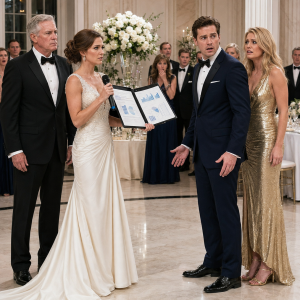
No one moved. The recording continued with Harold’s instructions, Vivian’s questions, and Grant’s description of the false financial papers. Photographs of the ledger and the seven envelopes appeared on the screen, followed by the account records and his messages to Lindsay.
Grant turned toward the control booth. Harold shouted for someone to stop the presentation. Vivian simply stared at the floor.
I entered through the rear doors and walked down the center aisle. The room seemed to open around me. Grant saw me when I was halfway to the stage, and the practiced grief fell from his face.
“Hello, Grant,” I said. “You promised everyone answers.”
He gripped the podium. “Claire, thank goodness. You don’t understand what happened.”
“I understand every word you said on my father’s yacht.”
I faced the reporters and told them that I had been found, that my parents were safe, and that the original recordings and financial files had been delivered to investigators. I spoke without embellishment because the facts required none. Behind me, Grant tried to blame his father. Harold blamed an adviser. Vivian insisted the recording had been altered.
Then Lindsay stepped from the press area with her phone in her hand.
“He gave me the same tablets,” she said, her voice trembling. “He told me they were vitamins. I saved one after I started feeling strange, and I gave it to the investigators this morning.”
That was when agents entered from every door. Grant, Harold, Vivian, and Colin were taken into custody, while another team met Grant’s cousin outside. Nora watched that cousin being escorted away and touched the green ribbon in her pocket. She did not smile, but for the first time since I had met her, the tension left her shoulders.
The criminal proceedings lasted more than a year. The evidence led to lengthy federal sentences for conspiracy, fraud, unlawful restraint, falsifying documents, and related offenses. Several old cases were reopened, giving families answers they had nearly stopped expecting.
However, the ledger also revealed that Harold had not built the network alone. Repeated payments went to a woman identified only by the initials M.R., the owner of a private financial-consulting firm in Savannah. Her legal name was Meredith Rowe, and she was Vivian’s older sister.
The Last Door
Meredith had spent twenty-five years constructing the machinery behind the Hollowells’ schemes. She supplied introductions, false records, private investigators willing to cross ethical lines, and accountants who moved funds through layers of companies. When federal authorities froze her accounts, she closed her Savannah office and vanished.
By then, my family had created the Harbor Light Initiative, an advocacy organization offering legal guidance, emergency housing, and financial-forensics support to people trapped in coercive relationships. Nora became its director of investigations, while I began law school at the University of Michigan and worked with Evelyn between semesters.
Our first independent client was a young bookkeeper named Owen Rowe, Meredith’s nephew. He arrived carrying a carton of copied records and years of guilt.
“My aunt told us her clients were hiding assets from unpleasant divorces,” he said. “Then my sister’s friend vanished after marrying one of those clients. I started copying everything.”
His files identified a storage facility outside Jacksonville where Meredith kept cash, identity papers, and original ledgers. Investigators placed the property under surveillance and learned she planned to visit it before leaving Florida by boat.
On a humid September night, Nora and I waited with a federal team near a quiet marina north of St. Augustine. I was there because Meredith had demanded to speak with me, promising to surrender the original records in exchange for favorable treatment. The agents believed she might try to manipulate me; I believed letting her talk would keep her occupied.
She arrived in a white linen suit, looking more like an elegant grandmother than the architect of a national fraud network. We sat at opposite ends of a table inside the marina office while agents listened nearby.
“You have made yourself very troublesome, Claire,” she said. “Do you truly imagine an organization can protect every trusting woman in America?”
“No,” I replied. “But we can teach them to recognize the pattern, and we can make people like you wonder who is keeping copies.”
Her smile tightened. “Grant chose poorly. Sentiment made him careless.”
“Grant had no sentiment. That was his weakness.”
Outside, a car door closed. Meredith glanced toward the window, realized the storage property had already been searched, and stood as if she meant to leave. Nora entered before she reached the door, followed by two agents.
Meredith looked at me for a long moment.
“You were supposed to be the easiest one,” she said.
“That is what happens when you mistake gentleness for surrender.”
The records recovered that night connected dozens of shell companies and brought the remaining operation apart. Meredith accepted a permanent federal sentence after several of her closest associates agreed to testify. The money recovered from the network helped fund restitution programs, though no amount could return the years stolen from the families who had waited for answers.
What the Ocean Gave Back
Three years after my honeymoon, Nora and I stood on a quiet bluff above Lake Michigan at the dedication of Harbor Light’s first residential center. Seven white rosebushes lined the garden, one for each woman named in the bank ledger. Audrey’s mother placed the green ribbon beneath her daughter’s memorial stone, then embraced Nora for a very long time.
My parents sat in the front row, older now but still side by side. My father had retired from daily management, and my mother had recovered enough strength to volunteer twice a week at the center. When I finished speaking, she took my hand.
“You built something beautiful from what they tried to take,” she said.
“We all did,” I answered.
That summer, Harbor Light hosted a retreat for women rebuilding their lives after financial exploitation and controlling relationships. We held it aboard a wide, stable sailing vessel on Lake Superior. The first morning, I stood alone at the railing while sunlight spread across the water. For years, the smell of salt and the groan of a hull had returned me to that dark night off Florida. Now there was only freshwater wind, distant laughter, and the quiet certainty of solid people nearby.
Lindsay joined me with two glasses of sparkling cider. She had completed a counseling degree and now worked with Harbor Light’s younger clients.
“Do you ever wish you had never met him?” she asked.
I considered the question. Grant had taken my easy trust, but he had not taken my capacity to care. That distinction had required years to understand. Suspicion was not strength, and isolation was not safety. Real strength was learning to place trust where actions had earned it, then refusing to apologize when a boundary had to become a locked door.
“I wish none of it had happened,” I said. “But I don’t wish away the woman who came through it.”
We touched our glasses together. Behind us, Nora was teaching a group of women how to use emergency radios, making them laugh whenever they forgot the call signs. My father was helping the captain coil a rope, although no one had asked him. My mother sat beneath a canvas shade, telling a story with both hands while three women leaned closer to hear her.
I turned toward the wind and felt no need to conquer the water or prove that I was unafraid. The ocean had not made me strong. It had merely stripped away everything false until I could see the strength that had been there all along.
On my honeymoon, one quiet phone call had saved my family, preserved the truth, and opened a door for women I had not yet met. Yet the most important call was the one I had made inwardly on that staircase, when I chose to believe the evidence of my own ears instead of the comforting story another person had written for me.
Grant had expected a sleepy bride who would follow him into the storm. What he encountered instead was a woman who finally woke up—and stayed awake.