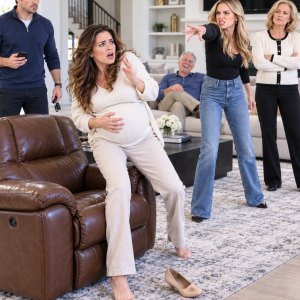
“What withdrawals?”
Dad said nothing.
I continued quietly.
“About one hundred eighty thousand dollars over several years.”
My sister’s face went pale.
“What are you talking about?”
I looked at her.
“The money Mom and Dad used when your studio closed, when your vehicle was purchased, and during several other times you needed help appears to have come, at least partly, from my trust.”
Elise’s mouth opened, but no sound came out at first.
Then she whispered, “They told me it came from their savings.”
I believed her.
That was the moment I stopped seeing my sister as part of the plan and began seeing her as another person who had been given a carefully edited version of our family.
Dad recovered enough to speak.
“This is a private family financial matter, and we can sort everything out later. Right now, we have a closing to complete.”
“No, you have a closing to complete,” I said. “Your name is on the purchase agreement.”
His phone began ringing on the counter.
The realtor.
He ignored it.
It rang again.
I lifted my coffee.
“You should answer that.”
When he finally did, I could hear the realtor asking whether the wire had been initiated, because the title company had not received confirmation.
Dad looked directly at me while she spoke.
I shook my head once.
No.
There would be no transfer.
After the call ended, Mom whispered, “Martin, what about the deposit?”
That was when I realized she might not know everything either.
I answered for him.
“The deposit came from a home-equity line against this house.”
She turned toward my father so quickly that her chair scraped the floor.
“You borrowed against our house?”
Dad looked furious now, but the anger had nowhere useful to go.
“I had everything arranged until Nora decided to sabotage her own family.”
For eighteen years, I had swallowed sentences so quickly that sometimes I barely knew I disagreed until hours later.
That morning, I did not.
“I didn’t sabotage anything,” I said. “You signed a contract using money you did not own, promised Elise a house without telling me, planned a home for yourselves with my inheritance, and borrowed against this property because you were certain I would obey you. I didn’t create that situation. I simply refused to finance it.”
Dad stared at me as though I had become a stranger overnight.
Maybe I had.
Or perhaps he had finally met the person who had been sitting quietly at his table all along.
I stood and picked up my mug.
“Call the realtor back before the situation becomes more expensive.”
Then I walked outside.
For once, I did not stay behind to make everyone feel better.
What Remained After the House Disappeared
I drove directly to my grandmother June’s farmhouse, where Grandpa’s workshop still stood behind a row of sycamore trees, its cedar siding faded by Kentucky summers.
Grandma opened the door, looked at my face, and simply said, “I suppose today is the day Harold prepared for.”
At her kitchen table, I told her everything.
When I finished, she held my hand and explained what Grandpa had never been able to explain himself.
Years before I was old enough to notice the pattern, he had noticed it.
He had watched Dad borrow, overspend, rescue Elise, and repeatedly assume tomorrow would repair whatever today had broken, and although Grandpa loved his son, he did not trust him with a large inheritance.
“Harold used to say your father could earn money,” Grandma told me, “but he never learned how to leave it alone.”
That was why the trust had been created for me.
Not because Grandpa wanted me to become extravagant, but because he wanted at least one branch of the family to have something secure.
The mansion deal fell apart.
My parents lost much of the deposit, and without access to my inheritance, the debts they had been hiding gradually became impossible to disguise.
Within months, they sold our old house and moved somewhere smaller.
I did not cause that.
I simply stopped providing the money they had privately assigned to solve it.
Elise called me two days after my birthday.
She cried through most of the conversation.
“I swear I didn’t know,” she told me. “Nora, I thought you had agreed to everything.”
“I know.”
“And the money they used for me before…”
“You didn’t know where it came from.”
She was quiet for a long time.
Then she said, “I’m sorry I never asked.”
That mattered more than she probably realized.
Our relationship did not magically repair itself, but over the following year Elise began changing in small, ordinary ways that convinced me the change was real: she found steady work with a local school photography company, sold the vehicle she could not comfortably maintain, rented a modest apartment, and stopped calling our parents every time life became inconvenient.
My parents reacted differently.
Mom sent letters explaining that she had only wanted everyone to remain close.
Dad once came to Grandma’s farmhouse with a proposal that sounded, to him, incredibly reasonable: if I released enough money to clear the home-equity debt, he would consider the entire conflict finished.
I listened until he was done.
Then I said, “The fact that you still think there is a version of this conversation where I give you more money tells me you have not understood the first conversation.”
I chose not to spend years pursuing the missing funds through a prolonged legal fight, although I preserved every document and received professional advice about my rights.
I wanted distance more than I wanted a courtroom victory.
The money Grandpa had protected paid for my university education, where I studied accounting, a choice that amused Evelyn because, as she put it, “You were conducting audits before anyone taught you what an audit was.”
The second thing I chose to preserve was Grandpa’s workshop.
Grandma transferred the building and its contents to me as part of her estate planning, and with carefully approved funds from the trust, we repaired the roof, rewired the building, restored several pieces of equipment, and reopened the place not as a business, but as a community workshop where local teenagers could learn basic repair skills.
The first afternoon we finished the renovations, I stood in front of the cedar door with Grandpa’s old brass key in my hand.
For years I had thought the key represented his trust in me.
Standing there, I finally understood that he had been trying to teach me something larger.
Other people can believe in you.
Other people can protect you.
Other people can leave instructions, money, tools, and doors.
But eventually, you have to become willing to trust your own judgment enough to turn the key yourself.
Elise visits now.
She is still terrible with tools, so she usually sits on a stool drinking coffee while I repair something, but we talk in a way we never did when we were children, because neither of us is performing the role our parents assigned anymore.
One Sunday, she arrived carrying a large shopping bag.
Inside was the expensive welcome mat she had purchased for the house that never became hers.
“I couldn’t throw it away,” she admitted.
I looked from the gray mat to the entrance of the workshop.
“Then put it in front of a real door.”
So we did.
Today, that mat lies outside the workshop Grandpa trusted me to lock when I was nine years old, while the inheritance remains quietly invested, doing exactly what he intended it to do.
It is not supporting a mansion.
It is not rescuing adults from every poor decision.
It is not sitting in a communal account labeled, in spirit, “one family pot.”
It is paying for an education, protecting a future, preserving a workshop, and giving me the freedom to decide what generosity actually means when generosity is voluntary.
For most of my childhood, everyone thought being the easy daughter meant I would always say yes.
They mistook silence for surrender, responsibility for unlimited availability, and love for permission.
On the morning of my eighteenth birthday, I did not scream, threaten anyone, or create a scene.
I simply read the papers they placed in front of me, understood the numbers better than they expected, and said no.
It turned out that one quiet word was enough to change the architecture of my entire life.
And every time I lock Grandpa’s workshop at the end of the day, feeling that familiar brass key turn smoothly beneath my fingers, I remember what he told me when I was little: a key means somebody trusts you to know when a door should open and when it should remain locked.
It took me eighteen years to understand that sometimes the person whose trust matters most is your own.