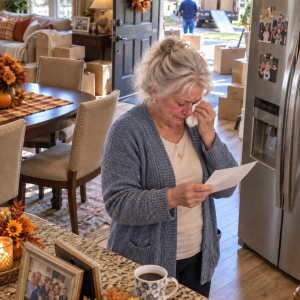
PART 1 — THE CHRISTMAS EVE HE ASKED ME TO DISAPPEAR
My husband asked me not to come home on Christmas Eve because his ex-wife was going to be there.
He said it beside the coffee maker, with the tree I had decorated glowing behind him and six places already set in the dining room for a dinner I had bought and planned myself.
“Sarah is the kids’ real mother,” David said, keeping his eyes on his coffee. “It’ll be easier if you’re not here tonight.”
At first, I thought he had chosen his words badly. Sarah was already invited. I had invited her myself, bought enough food for everyone, and even wrapped a green scarf I had seen weeks earlier because the color reminded me of her. I had never competed with Sarah. Ethan and Chloe were teenagers when I married their father, and I had never asked either of them to call me Mom.
“Did Ethan ask you to tell me not to come home?” I asked.
David’s thumb moved around the rim of his mug. “Not exactly.”
“Chloe?”
He looked down.
“I’m just trying to make everyone comfortable.”
I glanced toward the dining room, where pine branches, red napkins and candles ran down the center of the cream tablecloth. “Everyone except your wife.”
His mouth tightened. “Claire, it’s one night. Don’t turn this into a drama. Sarah is their mother, and I want the kids to have one Christmas that feels normal.”
That was ruder than his first request because now I understood what he meant by normal. I was the extra person in the family photograph, even though the photograph was being taken in my house.
I looked at David and said, “All right.”
Relief crossed his face so quickly that he could not hide it. “Thank you for understanding.”
That expression stayed with me while I went upstairs to pack an overnight bag. During the previous few months, David had gradually taken over most of our household finances. He said it was practical because he already paid the utilities, and eventually I had given him passwords to the shared email and accounts we used for bills. He checked statements more often than I did and sometimes teased me for still wanting paper copies.
While searching the desk drawer for my phone charger, I saw the corner of a blue folder beneath a stack of old tax records.
It contained the trust documents for the house.
I almost opened it. Instead, I pushed it back into the drawer, found my charger and zipped my bag.
At the front door, David kissed my cheek. “Thanks for understanding.”
This time I looked directly at him. “I understand more than you think.”
I did not book a hotel. I drove to Safe Harbor, a local family shelter outside Hartford where I had volunteered for several years. Miriam, the director, had asked weeks earlier whether I could help with Christmas Eve dinner, but I had declined because I was hosting my family.
Plans change.
Miriam took one look at my overnight bag and my face and did not ask for an explanation. She handed me an apron and said, “We’re short two people on mashed potatoes.”
For the first time that morning, I smiled.
At 3:12 that afternoon, Chloe texted me.
Where are you? Dad said you decided to give us some family time.
I called immediately.
“Did you ask your father to tell me not to come home tonight?”
“What? No.” Chloe sounded genuinely confused. “Why would I do that?”
“Did Ethan?”
“Of course not. Dad said Safe Harbor was desperate for volunteers and you offered to go.”
I sat down on a metal chair in the shelter kitchen. Around me, volunteers were carrying foil trays toward the dining room while children chased each other between tables decorated with construction-paper snowflakes.
David had not merely asked me to leave. He had made my absence sound generous.
“Claire, come home,” Chloe said. “Seriously. This is weird.”
For a moment I wanted to. Then I pictured myself walking into the dinner I had prepared and forcing Ethan and Chloe to referee a marriage problem in front of their mother.
“I’m staying here tonight.”
“But you didn’t choose this.”
“No. And neither did you.”
That evening, a local television crew arrived to film a short segment about shelters during a cold snap. While they were setting up, a pipe burst in the annex and water began spreading down a hallway where four families had been assigned rooms. We moved mattresses, medication, clothes and children while Miriam called an emergency plumber.
The shelter’s card would not cover the required holiday deposit. I paid it with my personal credit card.
A reporter stopped me later while I was carrying blankets.
“What brought you here tonight?”
I could have told the truth in a way that embarrassed David. Instead I said, “My plans changed this morning, and they needed help here.”
Later she asked what the evening had taught me. I looked toward the families gathered around a donated tree.
“Sometimes you don’t get the Christmas you planned. You just try to be useful where you are.”
Shortly after midnight, my phone rang.
David.
The television was audible behind him when I answered.
“Claire, why are you on the news?”
“Because a news crew came to the shelter.”
“Did you tell them about us?”
“No.”
He paused. “You need to come home.”
I looked across the room at the temporary beds we had arranged after the pipe burst. “Someone needed me here tonight. Merry Christmas, David.”
I ended the call.
Ten seconds later, Chloe called.
Her voice was different now—quieter, almost unsteady.
“Claire, Mom just told us something.”
“What?”
There was a brief pause. “Dad has been talking about you for months.”
I sat beside the vending machines with my coat still damp at the cuffs.
“Talking about me how?”
“He says you’re getting confused with money. That you spend things and forget, and that he had to take over the accounts because he can’t trust you to manage them anymore.”
I stared at the coffee machine across from me.
“David told you that?”
“Me and Ethan. We thought maybe something was happening and you didn’t want to tell us.”
I asked Chloe to put Sarah on the phone.
Sarah began before I could.
“Claire, I didn’t know he asked you to leave. He told me you wanted the kids to have Christmas with their parents like they used to.”
“I didn’t.”
“I know that now.” She hesitated. “There’s something else. He’s been saying you’re disorganized. He told me you miss payments and forget purchases. I thought he was worried about you.”
“Since when?”
“A few months.”
Then Sarah told me the part that made me stop looking at the coffee machine and sit completely still.
David had been asking questions about my house.
At first, they had sounded hypothetical: what would happen if I got sick, whether Sarah had ever noticed me forgetting things, whether someone might eventually need to make financial decisions for me. More recently, he had asked whether she would be willing to confirm that he had always handled our finances because I “wasn’t good with that stuff.”
“I told him no,” Sarah said. “I thought he was being dramatic. Claire, I’m sorry. I should’ve called you.”
The blue folder came back to me immediately—the one David mocked as my father’s paranoid paperwork, sitting beneath tax records in the desk.
So did his insistence that I give him my passwords.
I did not go home Christmas morning.
Instead, I changed every password I could change from my phone, blocked shared digital access where possible and began reviewing months of transactions. Most were ordinary until I noticed a pattern of smaller transfers from our joint checking account to the same unfamiliar account.
$900. $650. $1,100. $775.
I added them twice.
Over eight months, more than $13,000 had moved out.
I called David. He did not answer, but five minutes later he texted:
Don’t do anything impulsive. We’ll talk when you come home.
I searched our shared email for the bank name, then for words like transfer, attorney, trust and property. David had deleted several messages, but automated notices remained in the trash.
Two payments had gone to a law office.
One referenced an estate-planning consultation.