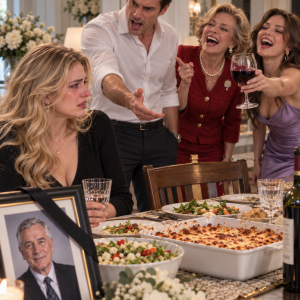
The last page mentioned a parentage report completed after Finn’s birth.
Warren called Simon.
“Tell me what the report says.”
“It says you are not Finn’s biological parent.”
The room seemed to lose its balance.
For five years, Finn had called Warren Dad, yet Warren could not name the boy’s teacher, his pediatrician, or the story he preferred before bed. He had purchased expensive toys, but he could not remember the last afternoon they had spent together.
Louise appeared in the doorway.
“She deceived me,” Warren said.
“And how many times did you deceive her?” Louise asked. “How many evenings did Audrey protect your reputation when Finn wondered why you had not come home?”
Warren closed the journal.
“I need to speak to her.”
“You will see her at nine.”
“Where?”
“The board has called an emergency meeting.”
The Vote in Nashville

Beckett Resorts managed luxury properties across the southeastern United States, and Warren had served as its president for nearly a decade. He entered the Nashville headquarters expecting the usual deference, but that morning, even his receptionist avoided his eyes.
Inside the boardroom, a large screen illuminated. Audrey appeared from a conference suite in Denver, dressed in a simple charcoal suit. Before her marriage, she had worked as a commercial real-estate attorney, although Warren had spent years treating her experience as an amusing detail from her former life.
A director began the meeting.
“Audrey Ellis Beckett now controls twenty-seven percent of the company.”
Warren leaned forward.
“That does not give her control.”
The door opened, and Louise entered.
She had transferred her nineteen-percent family interest to Audrey’s trust, making Audrey the largest voting shareholder.
“You chose her over your own son?” Warren demanded.
Louise met his anger without flinching.
“I chose the person who behaved like family.”
Audrey then presented three years of financial records. Under Warren’s leadership, operating income had fallen, senior employees had resigned, and company funds had covered private travel, jewelry, apartments, and weekends with Bianca.
A photograph of Warren entering a resort with her appeared beside an expense report labeled “investor relations.”
“This is personal,” Warren said.
“No,” Audrey replied. “If it were personal, I would argue with you. I am conducting an audit.”
The company bylaws permitted the board to remove its president for serious financial misuse. One by one, the directors submitted their votes.
Every ballot favored removal.
The title Warren had built his identity around disappeared in less than half an hour.
Before ending the call, Audrey looked directly into the camera.
“I began collecting records the night I drove myself to urgent care while you were with Bianca. For years I wondered how much disappointment I was expected to endure. Eventually, I realized the better question was how much evidence I needed to leave safely.”
By noon, Warren stood on a Nashville sidewalk holding a box of personal belongings. When Bianca called and asked him to come over, the tenderness he once felt had been replaced by suspicion.
“Are you really expecting a baby?”
She paused.
“Ask Simon,” she said before ending the call.
The Child Who Never Existed
Louise told him the rest.
Bianca had never been expecting a child. She was an event planner whom Warren had pursued after meeting her at a charity dinner, even after she declined his invitations. Simon, her fiancé, had eventually told Audrey what was happening.
Audrey did not create Warren’s affair. She allowed the relationship he had already chosen to continue while she documented what he was willing to neglect for the pleasure of being admired.
The supposed pregnancy had been the final test.
Warren had failed within days.
He found Simon and Bianca at their modest apartment. Bianca wore jeans and a sweater, and an engagement ring rested on her hand. Every gift Warren had purchased had either been returned, sold, or placed into an account for the corporate investigation.
“You ruined my life,” Warren told them.
Bianca’s expression remained steady.
“No, Warren. We documented the choices you made.”
“You accepted my attention.”
“After I had already asked you to stop,” she replied. “You did not care about me. You cared about winning.”
Simon stepped forward.
“I warned you about the expense reports and the contracts. Every time, you told me to remember my place.”
Warren remembered saying those words—not once, but often.