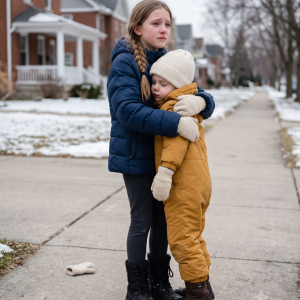
“What do you mean by allowed?”
I looked down at my hands.
It was a simple question, but answering it required me to admit something I had spent nearly two years trying not to acknowledge.
My son’s marriage was not nearly as happy as everyone believed.
Part Three: The Beautiful House With Closed Doors

Daniel had always been the kind of boy who noticed when someone was lonely. As a child, he would invite the quietest classmate to sit beside him at lunch, and when he grew older, he became the person friends called whenever they needed help moving furniture or repairing something around the house.
After college, he built a successful career designing residential landscapes, eventually opening a small firm with a longtime colleague.
Then he met Rebecca.
She was attractive, confident, and exceptionally organized, with a talent for interior design that had earned her a loyal following online. She photographed beautiful homes, offered decorating advice, and shared glimpses of the elegant life she and Daniel were building together.
Their house, in an affluent neighborhood outside Lancaster, looked like something from a magazine. Every room was carefully arranged, from the pale linen curtains to the perfectly coordinated furniture, and when Oliver arrived, Rebecca transformed the nursery into a picture of quiet luxury.
Online, their family appeared endlessly happy.
Rebecca posted photographs of Daniel holding their son beside a sunlit window, of tiny knitted blankets folded into neat squares, and of breakfast trays decorated with flowers.
Friends left comments about their beautiful life.
I sometimes left comments too.
But the family I saw in those photographs was not quite the family I encountered in person.
Over time, Daniel had become quieter. He stopped calling during his drive home, rarely visited without arranging it days in advance, and seemed to measure every word when Rebecca was nearby.
If he began telling a funny story at dinner, she would occasionally interrupt with a gentle correction, and he would fall silent.
If I asked how work was going, Rebecca often answered for him.
None of these things seemed serious enough to justify an argument, and I had told myself repeatedly that every marriage developed its own habits.
Yet there had been one evening I could never quite forget.
About four weeks after Oliver’s arrival, Daniel called me shortly before midnight. When I answered, I heard him breathing unevenly, as though he had been trying to compose himself.
“Daniel? Honey, what’s wrong?”
He didn’t answer immediately.
Then, faintly in the background, I heard Rebecca.
“Put the phone away, Daniel. We don’t need your mother involved in everything.”
The call ended.
I tried calling him back three times, but he didn’t answer. Eventually, a message appeared on my phone.
“Sorry, Mom. Everything’s fine. Just tired. Love you.”
I had accepted it because I wanted to believe him.
Sitting across from Detective Crawford, I realized how often love can persuade us to explain away things that deserve a closer look.
“Did you ever ask him directly whether he felt safe at home?” she asked.
I shook my head.
“I asked whether he was happy. He always said he was.”
The detective wrote something in her notebook.
“Those aren’t always the same question.”
I had no answer.
A social worker joined us later that afternoon and explained that, because of the concerns surrounding Oliver’s injuries, child protection authorities would be involved while the investigation continued.
For the time being, neither parent would be permitted to take him home.
Hearing those words was painful in a way I had never experienced before.
I loved my son. I remembered the little boy who used to fall asleep with a book against his chest, the teenager who mowed our elderly neighbor’s lawn without accepting payment, and the young man who had held my hand through my husband’s final months.
But I also loved the tiny baby lying in a hospital bed, completely dependent on the adults around him.
And whatever had happened, Oliver’s safety had to come first.
Part Four: The Phone Call
By early evening, Oliver had been moved to a quiet room where the medical staff could continue watching him closely.
A nurse helped me sit beside his bed, and I gently offered him my finger. His little hand closed around it almost immediately.
I cannot describe how much that small movement meant to me.
For the first time all afternoon, I allowed myself to believe that he might come through this difficult experience and eventually return to the ordinary comforts every baby deserves.
Then my phone rang.
Daniel.
I answered immediately.
“Daniel, where are you?”
“Mom, is Oliver with you?”
His voice sounded strained and breathless.
“He’s at the hospital. The doctors are taking care of him.”
There was a long silence.
“You changed his clothes?” he asked.
“Yes, Daniel. I saw the marks. Why didn’t you tell me?”
I heard him draw a shaky breath.
“Mom, listen carefully. You need to stay there with him.”
“I am staying. But you need to explain what’s happening.”
“Rebecca knows I brought him to you.”
“What does that mean?”
He hesitated, and when he spoke again, his voice was barely audible.
“I should have told someone sooner.”
My eyes filled with tears.
“Then tell me now.”
Before he could answer, I heard a commotion in the background, followed by someone calling his name.
“Mom, whatever happens, don’t let anyone take Oliver home.”
The connection ended.