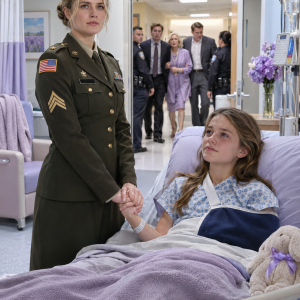
Lydia remained in rehabilitation for months. One afternoon, she asked me to visit the therapy gym. She gripped parallel bars while her therapist steadied her. With visible effort, she pushed herself upright and held the position for several seconds.
“They said I might never do that,” she told me when she sat down again.
“Doctors say a lot of things,” I said.
She smiled. Her recovery was uncertain, but she had regained some movement, and she hoped that with braces and continued therapy she might eventually walk short distances.
The Keene Family Foundation was dissolved. Several donors later asked whether I would preserve its original purpose under new leadership. At first, I wanted nothing connected to my father’s name. Then Lydia asked me what would happen to the people who had been meant to receive the help.
Six months later, I opened the Margaret House Mobility Fund, named for the woman who had given me a home when I had nowhere else to go. The fund paid for prosthetics, rehabilitation equipment, job training, and legal assistance for young people whose disabilities left them vulnerable to financial exploitation.
The first grant went to a seventeen-year-old from Worcester whose insurance would not cover the prosthetic knee system she needed. When she stood between the parallel bars at her fitting, she looked from her new leg to mine.
“Does it ever stop feeling strange?”
“No,” I said. Her face fell, so I added, “You just get busy living, and the strange part stops being the most important thing.”
What I Chose to Carry
Paige was sentenced the following year. Before reporting to a supervised program, she asked to meet me at a small café. I almost refused, but Margaret said I should go for my own sake, not Paige’s.
Paige did not ask me to forgive her. Instead, she told me she kept thinking about the day our parents threw me out.
“I remember Dad handing you the bag,” she said. “I remember looking down at my hands.”
I waited.
“I wasn’t really looking at them. I was staring because I knew if I looked at you, I’d cry.”
“That doesn’t make it better.”
“I know.” She took a breath. “I knew it was wrong. I was afraid of becoming you, and I was more afraid of losing the life they gave me than I was of losing you.”
The words hurt because they were honest. In our home, I had been the example of what happened when a daughter became inconvenient. Paige had learned to obey, perform, and stay useful. She had learned to become our parents.
“You became them,” I said.
“Yes.” She did not look away. “That’s why I’m facing the consequences.”
She slid an envelope across the table. It held a cashier’s check for the money she had left after selling her apartment and jewelry.
“This is for Margaret House,” she said. “I don’t want my name on anything.”
“You can’t buy forgiveness.”
“I know.”
I accepted the check for the young people who might need help. Paige apologized for the fraud, for Lydia, and for the years she had looked away when I needed her.
“I believe you’re sorry,” I told her. “That isn’t the same as forgiveness.”
She nodded. “I understand.”
My father’s trial lasted eleven days. I testified once. His lawyer asked whether I had hated my father for years.
“I haven’t had a relationship with him for years,” I said.
He pressed me on whether I wanted revenge. I told him I had been suspicious when two people who had ignored me for nineteen years appeared asking for a million dollars to replace missing charitable funds.
The jury found my father guilty. My mother accepted a plea agreement after investigators found she had helped move some of the money and had lied about financial records. Their home was sold, their remaining assets were liquidated, and the restitution process began.
A few months later, a letter arrived from my mother. She wrote that I believed they had failed me.
I stopped reading. Even then, she could not write, “We failed you.”
I put the letter through the shredder and went back to work. Healing, I learned, did not always arrive as a grand moment in a courtroom. Sometimes it was simply a piece of paper disappearing while you stood beside an office machine.
A year after my parents first came to my office, Margaret House opened its first rehabilitation center. Margaret stood beside me at the ceremony, looking uncomfortable beneath the sign bearing her name.
“You’ve named a building after me,” she said. “Wasn’t that enough embarrassment?”
“Apparently not.”
“I raised a tyrant.”
“You raised a CEO.”
“Same thing with better shoes,” she replied.
Lydia came using forearm crutches. She moved slowly, but she was walking. When she reached me, she grinned.
“You’re supposed to act like this is normal.”
“I’m trying.”
“You’re failing.”
Paige came too, having been invited by Margaret. She stood near the back of the room and offered to leave. I told her she could stay, but that the day was not about us. She nodded and kept her distance.
At the podium, I looked out at the families gathered in the lobby. For a moment, I saw the white rug, the red wine, and the black bag in my arms. Then I looked at Margaret.
“When I was sixteen, I arrived at my aunt’s home with a few clothes and no idea what my life would become,” I began. “I thought losing part of my leg was the hardest thing I would ever face. It wasn’t. The hardest part was being taught by the people who were supposed to love me that my body made me less valuable.”
I paused, then continued.
“This center exists because that lesson was wrong. When someone’s body changes, that should never be the moment their choices disappear. We don’t save people here. We give them tools, time, support, and room to build lives of their own.”
After the ceremony, Margaret found me by the elevators.
“Your parents were wrong about one thing more than all the rest,” she said.
“Which thing?”
“They thought throwing you out meant they were finished carrying you.”
I shook my head. “They never carried me.”
“Exactly.” She squeezed my hand. “You carried their shame and their cruelty for years. You can put it down now.”
That was what finally made me cry.
Later, after everyone had gone, I walked through the quiet center by myself. In a glass case near the prosthetics lab sat an old aluminum crutch wrapped in black electrical tape. Margaret had kept it. A small plaque beneath it read: What someone else calls broken does not have to define what comes next.
I stood there a long time, thinking about the two miles I had walked to her house, frightened and exhausted, certain I was leaving my life behind.
My phone buzzed with a message from Samuel. The final restitution payment from my father’s estate had arrived: a little over one million dollars, transferred into a fund for the people harmed by the foundation’s fraud.
I read the amount twice, then looked back at the crutch.
My parents had come to my home demanding a million dollars to make their problems disappear. They believed money could repair the records, quiet the auditors, and control what people remembered. In the end, the money did return, but it came from what they had built through deception, and it went back to the people they had harmed.
I did not smile because my father had been sentenced, or because my mother had lost the house, or because Paige had finally admitted what she had done. I smiled because their choices no longer decided what I would do next.
At sixteen, my father had handed me a bag and told me to leave. At thirty-five, he came asking me to save the family that had treated me as if I were a burden.
He expected to find the frightened girl who had stood in that living room.
Instead, he found someone who had spent nineteen years learning how to stand.
I turned off the hallway lights and left the old crutch behind the glass, exactly where it belonged.