“And the device?”
He turned the tablet toward me.
“It appears to be a small drug-delivery implant.”
My mother covered her mouth.
“How did it get there?”
“We can’t answer that yet,” Dr. Patel said. “But it was not documented in your medical records, and there is no consent form authorizing its placement.”
“What was inside it?”
He paused.
“A sedative compound.”
My father lowered the paper in his hand.
“She’s pregnant.”
“We know.”
“Could it have harmed the baby?”
“We’re monitoring closely. At this time, the fetal heart rate and development appear reassuring.”
I stared at the image on the screen.
The device was tiny.
Something so small had helped control where I went, what I remembered, and how much I trusted myself.
Dr. Patel continued.
“The same class of sedative was found in your blood.”
Dr. Reed added, “And preliminary testing detected a matching substance in the liquid from the silver cup.”
I looked toward the door.
For months, Aaron had told me the dizziness was ordinary pregnancy fatigue.
He had watched me grip the kitchen counter when the room spun.
He had taken the car keys after I forgot the route to my parents’ house.
He had known exactly why.
“Remove it,” I said.
Dr. Patel nodded.
“We can do that safely.”
“Today.”
“Yes.”
My mother reached for my hand.
I kept my eyes on the tablet.
“And update my chart again. Aaron Mitchell is not to receive any information.”
Dr. Reed glanced at the nurse.
“It’s already flagged.”
That was the first time I heard someone say Aaron’s name without adding doctor.
The Messages Sylvia Finally Handed Over
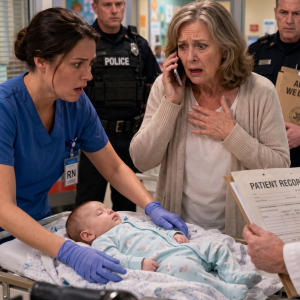
The procedure was brief.
When I woke, my throat was dry and my parents were still beside me.
A nurse brought water in a clear plastic cup.
I watched her open the sealed bottle before pouring it.
She noticed.
“Would you rather do it yourself?”
“Yes.”
She handed me the bottle.
I poured the water with both hands.
Later that afternoon, Officer Grant returned.
He carried a folder and placed it on the table.
“Sylvia gave a full statement.”
My father crossed his arms.
“After helping him for months.”
Officer Grant did not disagree.
“She also surrendered her phone.”
He showed me printed screenshots.
Aaron’s messages were short.
Give her the morning packet.
She’s asking about driving again. Use the full amount tonight.
Keep her foggy until delivery.
Don’t let her visit her parents alone.
One message had been sent the night before I scheduled the second opinion.
She’s becoming suspicious. Double it tomorrow.
My mother pushed her chair back.
“He knew she was coming here?”
“He was tracking her phone,” Officer Grant said.
I read the final message again.
Keep her foggy until delivery.
There was no medical explanation beneath it. No concern about anxiety. No mention of protecting the baby.
Just an instruction.
“Did Sylvia ever refuse?” I asked.
Officer Grant turned to another page.
There were several messages from her.
Is this too much?
Anna looks very tired.
Maybe we should stop.
Aaron’s responses were always similar.
You’re not the doctor.
Do what I told you.
Think about the baby.
I handed the pages back.
“She still did it.”
“Yes.”
Sylvia asked to speak with me.
I refused.
Then she sent a written statement through Officer Grant.
I did not read it.
My mother folded it once and put it inside her purse.
“You can decide later.”
“Throw it away.”
She looked at me for a moment, then tore it in half.
Aaron Tried to Call It Treatment
Aaron was allowed one interview with investigators before he was removed from the hospital.
He claimed the device had been placed during an earlier examination to manage severe anxiety.
There was no consent form.
No chart entry.
No prescription record.
No second physician’s approval.
When investigators asked why Sylvia had been instructed to hide powder in my drinks, Aaron said she had misunderstood him.
When they showed him the messages, he stopped answering questions.
Two days later, the hospital suspended his clinical privileges pending review.
The state medical board opened an investigation into his records.
Officer Grant explained that the criminal case would take time.
I did not ask how long Aaron might be punished.
I asked for the practical things.
“Can he enter the house?”
“Not if you obtain a protective order.”
“Can he access my accounts?”
“Change everything today.”
“Can he make decisions when I give birth?”
Dr. Reed answered that one.
“No.”
My father brought my laptop to the hospital.
Together, we changed passwords, removed Aaron from shared accounts, and redirected my mail.
I replaced the emergency contact on every form.
For the first time, my mother’s name appeared where Aaron’s had been.
When Aaron called from an unknown number, I answered once.
“Anna, you’re making permanent decisions while you’re emotional.”
His voice was calm.
Professional.
The same voice he used when telling nurses what I needed.
“You put drugs in my body.”
“I treated a condition you refused to acknowledge.”
“Without telling me.”
“You weren’t acting rationally.”
I looked at the water bottle beside my bed.
The cap was still sealed.
“You made sure I couldn’t.”
He was silent.
Then he said, “My mother is confused. She’ll say anything because she’s scared.”
“The messages are yours.”
“Context matters.”
“No.”
That was all I said before ending the call.
The Birth Plan With Only My Signature
I moved into my parents’ house after discharge.
The sedative left my system gradually.
The first week, I still woke dizzy.
By the third week, I could read an entire page without losing my place.
My memory did not return all at once. Small pieces came back during ordinary moments.
Aaron locking my phone in his desk.
Sylvia watching me finish the tea.
My car keys disappearing from the hook.
Each memory made me check another account, another document, another door.
I filed for divorce and obtained a temporary protective order.
Sylvia asked twice to see the baby after the birth.
I declined both times.
Her confession helped the investigation, but it did not erase the mornings she stood in my kitchen and watched me drink.
When labor began, Dr. Reed was the first person I called.
At the hospital, a nurse handed me the birth plan.
Every section had been reviewed with me in advance.
Pain management.
Visitors.
Emergency decisions.
Newborn access.
At the bottom was one signature line.
Mine.
My daughter was born safely just after sunrise.
My mother stood beside me.
My father waited outside until I invited him in.
No one entered the room without asking.
My Own Cup
Three months later, I drove my daughter to her pediatric appointment.
It was the first time I had driven alone in nearly a year.
My hands were tight around the steering wheel at first.
Then I turned onto the main road and loosened my grip.
At home, I hung the keys on a hook beside the front door.
No one moved them.
That afternoon, I made tea while my daughter slept in a bassinet near the kitchen window.
I opened the package myself.
Boiled the water myself.
Poured it into a plain white ceramic cup I had bought after moving.
The silver cup remained in police evidence.
I did not need it back.
I carried my tea to the table, sat beside my sleeping daughter, and drank without asking anyone what had been placed inside.