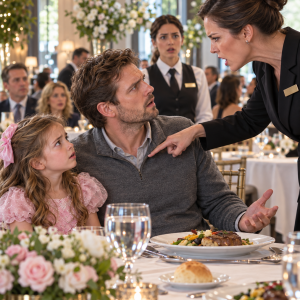
For months, those words were exactly what I had wanted to hear.
Now they felt late.
“You had six months.”
“I didn’t understand how bad things had become.”
I looked at him.
“You didn’t want to understand.”
He started to argue, but I continued.
“When your mother took the SUV, you knew. When she questioned my spending, you knew. When I told you I felt uncomfortable here, you knew.”
He lowered his head.
“You knew enough, Derek.”
His hand fell away from my suitcase.
I left.
The Morning After I Walked Away
Dad took Caleb and me home with him.
That night, he made tea while I sat at his kitchen table trying to understand how my life had changed in a few hours.
Finally, I whispered:
“I’m embarrassed.”
Dad sat across from me.
“Why?”
“Because I stayed.”
He shook his head.
“Things rarely become unbearable all at once. People adjust one small step at a time until they suddenly realize how far they’ve moved.”
I wiped my eyes.
“I should have called you.”
He nodded.
“Yes. You should have.”
I actually laughed.
Then he reached across the table.
“But you called me now.”
The next morning, my phone was filled with missed calls and messages.
One message from Derek caught my attention.
His mother was threatening to get rid of the SUV if I didn’t return.
Dad read it.
“Save it.”
That became our new rule.
Save everything.
Getting My Life Back Piece by Piece
With appropriate professional advice, I separated my finances.
I opened a new account.
Changed passwords.
Redirected my paycheck.
Protected my credit information.
Organized receipts.
Saved messages.
Collected every document connected to the SUV.
Three days later, Derek asked to meet me at a public café.
He looked exhausted.
“I told Mom she can’t use the SUV anymore.”
I waited.
“I’m returning it to you.”
Still, I said nothing.
Finally he asked:
“Aren’t you going to say anything?”
I looked at him.
“I shouldn’t have needed my father to appear before you decided I deserved access to something I was paying for.”
He nodded.
“I know.”
“And I shouldn’t have needed to leave before you noticed what was happening to our finances.”
His eyes dropped.
“I know.”
Then I asked the question that mattered.
“Why didn’t you stand beside me before?”
He couldn’t answer.
And somehow, his silence answered perfectly.
The Keys Came Back
Derek returned the SUV that evening.
He handed me every key and every document.
Caleb’s stroller was still in the back.
His little mirror was attached behind the passenger seat.
Seeing those ordinary things made my eyes burn.
The SUV had never really been the issue.
It represented something larger.
I had allowed myself to believe that if someone spoke confidently enough, they could decide what I deserved.
Derek placed the keys in my palm.
“I’m sorry.”
I closed my fingers around them.
“I believe you.”
Hope appeared in his face.
Then I added:
“But being sorry and changing are two different things.”
He looked down.
Before I drove away, he asked:
“Is there still a chance for us?”
I thought carefully.
“I don’t know.”
That was the truth.
“But if there is, it won’t begin with me moving back into your mother’s house.”
Strength Doesn’t Always Look Loud
Over the following weeks, I learned more about what had happened financially.
Derek admitted that he had allowed his mother access to information she never should have had.
He said he thought she was helping.
Perhaps he truly believed that.
But intentions didn’t erase consequences.
So I stopped arguing about the past.
I focused on rebuilding.
My ankle healed quickly.
My confidence took longer.
One evening, Dad and I sat on his porch while Caleb crawled across a blanket.
I asked him something I had been wondering about.
“When you found me walking that afternoon, were you angry?”
Dad laughed softly.
“Very.”
“You didn’t look angry.”
He watched Caleb for a moment.
“Anger is useful only when you remain in control of it.”
I smiled.
Then I said:
“Cynthia changed completely when she learned your rank.”
Dad nodded.
“Some people notice status before they notice character.”
He looked at me.
“Pay attention when people show you that.”
The Moment That Actually Changed My Life
People would probably assume everything changed when Derek’s family discovered that my quiet, silver-haired father had once been a four-star Army general.
They would be wrong.
Yes, the revelation shocked them.
But his rank wasn’t the moment that changed me.
That happened earlier.
On the side of an ordinary North Carolina road.
My ankle hurt.
Grocery bags were digging into my hands.
My tired baby needed to get home.
My father pulled over and asked:
“Where’s your car?”
I finally told someone the truth.
And he didn’t tell me to be patient.
He didn’t ask me to keep everyone happy.
He didn’t tell me family relationships were complicated.
He opened the passenger door.
“Get in.”
That was the moment I remembered something I had forgotten.
I was allowed to leave a situation that required me to disappear in order to keep everyone else comfortable.
Weeks later, Derek told me he had started counseling.
Maybe he would change.
Maybe our marriage would eventually find another path.
I didn’t know.
For once, I didn’t need to know.
I had Caleb.
I had my work.
I had control of my paycheck.
I had my SUV keys inside my own purse.
I had somewhere safe to sleep.
Most importantly, I had my voice again.
And this time, I intended to keep it.
Sometimes losing your voice does not happen in one dramatic moment; it happens through hundreds of small compromises that slowly teach you to believe your needs matter less than everyone else’s comfort.
A person who truly stands beside you should not need an important title, an influential relative, or a public confrontation before deciding that your dignity deserves protection.
Family support should help you become stronger and more independent, not leave you feeling as though every basic need must be justified before you are allowed to have it.
When someone repeatedly asks you to remain silent simply because speaking honestly would make another person uncomfortable, peace may be coming at a price you should never have been asked to pay.
Financial independence is not only about money; sometimes it is also about preserving your ability to make decisions, protect your future, and walk away when a situation no longer feels healthy.
Strength does not always arrive as anger or confrontation; sometimes strength is quietly gathering your documents, changing a password, packing a suitcase, taking your child’s hand, and choosing a different direction.
An apology can matter, but real change is shown through consistent choices over time, especially when nobody powerful is watching and there is no immediate consequence for doing the wrong thing.
The people who genuinely love you may not be able to make every difficult decision for you, but they can remind you that you still have choices when fear has convinced you otherwise.
You should never have to become smaller, quieter, or less confident simply to earn a place inside a relationship that is supposed to feel like home.
Sometimes getting your life back does not begin with revenge, victory, or proving someone else wrong; it begins with realizing that you still have a voice, you still have choices, and you are finally ready to use them.