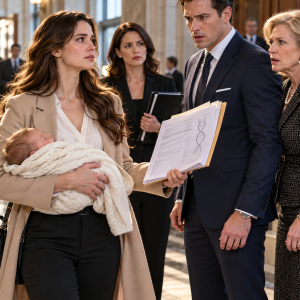
Part Five: The Letter My Father Left Behind

The months that followed were difficult in ways I hadn’t anticipated, because leaving a marriage did not instantly erase the habits I had developed while living inside it.
I still checked my phone whenever it vibrated, occasionally rehearsed explanations for ordinary purchases, and sometimes felt guilty for enjoying an evening without having to report where I had been.
The legal proceedings moved slowly, but the evidence eventually established that Ethan had authorized improper transfers involving funds he was not entitled to use, and that he had participated in preparing misleading documents concerning my company.
He accepted responsibility for the financial misconduct through the resulting proceedings and was required to make restitution, while Patricia’s struggling business faced separate scrutiny and eventually entered insolvency proceedings.
My ownership of the studio remained intact.
When Caroline called to tell me the financial judgment had been finalized, I was standing beside a new desk we had purchased for our first additional designer.
“Your company is still yours, Natalie,” she said. “And the repayment arrangements are now enforceable.”
I thanked her, hung up, and sat quietly for several minutes, looking around the office that had survived something I once believed would destroy everything I had worked for.
That evening, I visited my mother at her small home outside Beaufort.
She was preparing chicken and dumplings, just as she had when Lauren and I were children, and after dinner she brought an old photograph to the kitchen table.
It showed me at twenty-five, standing outside the first office I had rented, holding a cardboard sign with my business name written across it.
“Your father took this,” she said.
My father had passed away several years before my wedding, and I still missed his steady voice, his practical advice, and the quiet confidence he had always placed in me.
My mother opened a drawer and removed a folded letter.
“He wrote this when his health began failing. He told me to give it to you whenever you needed reminding of who you were.”
The letter was written in his familiar handwriting, with the careful, slightly uneven lines I remembered from notes he used to leave beside my breakfast plate.
My sweet Natalie,
You’ve always wanted to repair whatever was broken, whether it was an old radio, a friendship, or someone’s difficult day, and that generous heart is one of the things I admire most about you.
But I hope you remember that loving someone does not mean surrendering the things that make you who you are.
You deserve a home where your ideas are welcomed, where kindness is ordinary, and where you never have to make yourself smaller to keep someone else comfortable.
If you ever find yourself somewhere that makes you forget your worth, remember that you have permission to walk away.
You were enough long before anyone asked you to prove it.
Love, Dad.
I read the letter twice before folding it against my chest, and when my mother reached across the table to hold my hand, neither of us needed to say anything.
For the first time in months, I remembered the young woman in the photograph not as someone foolish enough to make a painful mistake, but as someone whose confidence was still waiting to be reclaimed.
Part Six: Learning What Peace Really Feels Like
A year after the restaurant incident, my divorce was finalized, and Lauren met me outside the courthouse with two cups of coffee and the sort of smile that made me grateful she had never stopped believing I could build a different life.
“Well,” she said, handing me a cup, “how does freedom feel?”
I glanced at the folder of legal documents beneath my arm.
“Expensive. Apparently, freedom comes with a very impressive attorney’s bill.”
We laughed so hard that a couple walking past us turned to look, and I realized how long it had been since laughter had come without the fear that someone might disapprove.
That spring, I expanded my studio, hired two more designers, and began volunteering with a community organization that helped women understand basic financial planning and protect their access to important records.
At my first workshop, a woman near the door admitted that her husband constantly told her she was incapable of managing money, although she had once handled the bookkeeping for her family’s business.
“It sounds to me like you already have skills worth trusting,” I told her.
She left carrying a folder of resources, and watching her walk away gave me a quiet sense of purpose that no financial judgment could have provided.
Several months later, Thomas Bennett invited Lauren and me back to the Charleston restaurant, where he and a few staff members had arranged a small dinner to acknowledge everyone who had helped that evening.
I was nervous about returning, but when we entered, I noticed an elderly couple sitting at the table where Ethan had humiliated me, sharing dessert and laughing over something only they understood.
The sight surprised me.
That table had remained unchanged, yet my life had become entirely different.
During dinner, the young waiter who had supported my account approached with a handwritten note, explaining that his older sister had once experienced a controlling relationship and that witnessing my decision to speak up had reminded him how important it was not to ignore someone who needed help.
“I wasn’t sure I did enough that night,” he admitted.
“You told the truth when it mattered,” I answered. “That was more important than you know.”
Later, Thomas raised his glass and spoke about how hospitality sometimes required more than providing a pleasant meal, because people deserved to feel safe and respected wherever they were.
I thanked everyone, although I struggled to find words that could fully explain what their kindness had meant.
As Lauren and I walked outside, she asked what I was thinking.
I considered telling her that I was fine, the answer I had offered automatically for so many years, but instead I told her what was actually on my mind.
“I spent so much time waiting for Ethan to become kind again that I almost forgot how many kind people were already around me.”
She slipped her arm through mine, and we walked toward her car beneath the soft evening sky.
The following Sunday, my mother, Lauren, and a few close friends came to my apartment for dinner. Someone spilled lemonade on the kitchen counter, my mother’s dessert turned out slightly lopsided, and everybody laughed while we cleaned up the mess together.
Nobody raised their voice.
Nobody demanded an apology.
Nobody made anyone feel foolish for an ordinary mistake.
Later, standing near the open balcony door, I received a message from a woman who had attended one of my workshops.
I opened my own savings account today. I was nervous, but I finally did it. Thank you for helping me believe I could.
I read her message with a smile before slipping my phone into my pocket.
From the kitchen, Lauren called that dessert was ready, and I turned toward the voices of people who wanted me there simply because they loved me.
On the hallway shelf stood the photograph of my younger self outside her first office, with my father’s letter carefully framed beside it.
For years, I had believed that leaving meant admitting I had failed at keeping my family together, but I had finally learned that a family worth keeping did not require me to surrender my voice, my independence, or my self-respect.
That evening, as laughter drifted through the apartment and my mother called me to the table, I understood that I had not lost everything when I finally said no.
I had simply stopped paying for a place where I was never truly valued, and in doing so, I had made room for a life filled with the kind of love that never demanded a price.