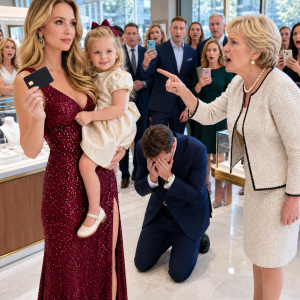
The Smallest Plate at the Table

There are moments that seem insignificant while they are happening, the kind of moments no one would think to photograph or write down, yet years later you can still remember the color of the room, the sound of a fork touching china, and exactly where everyone was sitting when your life quietly divided itself into a before and an after.
For me, that moment began with my eight-year-old daughter reaching for breakfast.
We were spending a long weekend at a resort outside Charleston, South Carolina, celebrating my mother-in-law’s sixty-eighth birthday, and by Sunday morning everyone was tired from two days of pretending we enjoyed one another more than we actually did. The dining room overlooked a marsh washed in pale spring sunlight, and the breakfast buffet was crowded with families carrying coffee, fruit, pancakes, eggs, and plates piled much higher than anyone needed.
My daughter, Lily, had been unusually quiet.
She took a small plate and placed two strips of bacon beside her scrambled eggs.
My husband, Grant, noticed.
“Put that back.”
Lily froze.
“I only took two.”
Grant reached across the table and struck the back of her hand sharply enough that the plate slipped from her fingers and landed sideways on the carpet.
A server turned toward us.
Lily stared at her fingers, then tucked her hand beneath the table.
She did not cry.
That somehow made it worse.
“Grant,” I said, barely recognizing my own voice. “Did you seriously just do that over two pieces of bacon?”
He leaned back as if I were the one creating a problem.
“Somebody has to teach her self-control, Claire. You let her have whatever she wants.”
I remember staring at him and thinking that the bacon probably cost the restaurant less than three dollars.
Before I could answer, Grant’s nine-year-old nephew, Owen, picked up the specialty menu and pointed to a seafood breakfast platter.
“Uncle Grant, can I get this?”
It was $149.
Grant glanced at it for perhaps half a second.
Then he smiled.
“Sure, buddy. Get whatever you want.”
My mother-in-law, Judith, reached over and smoothed Owen’s blond hair.
“A growing boy needs a real breakfast. Besides, this young man is carrying the family name forward.”
Lily looked down at the fallen bacon.
Something inside me went very still.
For years I had told myself that Judith was old-fashioned rather than cruel, that Grant was demanding rather than controlling, that the comments about our having only one daughter were irritating but harmless. I had become remarkably talented at translating behavior I did not want to face into words I could tolerate.
Then Owen crumpled his napkin and tossed it toward Lily.
“Girls don’t need as much food anyway.”
“Owen,” I said, “apologize to Lily.”
Grant slapped his palm against the table.
“Enough, Claire. He’s a kid.”
His sister-in-law, Melissa, immediately pulled Owen toward her.
“He’s been through a lot. You know that.”
Melissa had supposedly lost her husband, Grant’s older brother Nathan, several years earlier, and every rude thing Owen did had somehow become excusable because he was being raised without his father.
Grant looked at Melissa with a softness I had not seen directed at me in years.
“You don’t need to apologize for him.”
Then he turned toward me.
“Maybe you’d be less sensitive about Owen if you’d given me a son.”
Judith gave a small laugh.
“I’ve always said the same thing.”
I said nothing.
Everyone at that table knew why another pregnancy had never been a realistic possibility for me.
Eight years earlier, late in my pregnancy with Lily, Grant and I had been arguing in our kitchen. He had shoved past me in anger, and I lost my balance against the edge of the island. Lily arrived weeks earlier than expected, and my recovery was long and complicated. My doctors later told me another pregnancy could carry serious risks.
For years, Grant’s family treated that history as an unfortunate inconvenience rather than something that had happened to me.
And I stayed.
I told myself Lily needed both parents.
I told myself difficult marriages had seasons.
I told myself vows mattered most when things were hard.
What I had never asked was what my daughter was learning while watching me honor those vows alone.
That morning, looking at her little hand hidden beneath the table, I finally asked.
“Lily, get your coat. We’re leaving.”
The Ride We Were Not Allowed to Take
Rain had begun falling heavily by the time Lily and I reached the entrance, and we stood beneath the awning waiting for a rideshare when our SUV pulled around.
I had paid for most of that vehicle.
Grant was driving.
Melissa sat beside him.
Judith and Owen were in the back.
From where I stood, they looked almost like a family arranged for a Christmas card.
Lily instinctively lifted her hand.
“Dad?”
Grant lowered the window.
“Your mother can apologize, and then you can both get in.”
I actually thought I had misunderstood him.
“Apologize for what?”
“For the way you treated Owen.”
“I defended our daughter.”
Grant climbed out.
“You embarrassed me in front of my family.”
“Your daughter is your family.”
His jaw tightened.
“Don’t forget who’s been supporting you all these years.”
That sentence almost made me laugh, because Grant had no idea how carefully I had protected the illusion that he was the financial engine of our household.
His commercial construction company, Whitmore Development, looked successful from the outside—large projects, expensive vehicles, a polished office in downtown Charleston—but twice in six years I had quietly helped keep it afloat using investment assets inherited from my father. Several lenders had extended favorable terms because accounts connected to me stood behind portions of Grant’s borrowing.
Grant loved telling people banks trusted him.
What he never understood was that they trusted the collateral.
Then I noticed Melissa resting one hand on her stomach.
She looked at me.
And smiled.
There was something about that smile that stayed with me.
Not happiness.
Possession.
I looked at Grant.
“What’s going on?”
He caught my arm.
“Stop making a scene.”
I pulled away, lost my footing on the rain-slick pavement, and landed hard in a shallow puddle.
Lily screamed and ran to me.
Grant stared at us for a moment before returning to the SUV.
“Without me,” he said through the open window, “you two wouldn’t last a month.”
Then he drove away.
I sat there in the rain with Lily clinging to me, her swollen hand pressed against my shoulder, and something strange happened.
I wasn’t frightened anymore.
I called my older brother, Daniel, who worked in commercial banking and knew Grant had recently applied for a multimillion-dollar expansion loan.
“Is Grant’s application still under review?”
Daniel hesitated.
“Yes. Why?”
“From now on, no personal favors, no assumptions about my support, and no new guarantees connected to me unless I personally approve them.”
“Claire, are you sure?”
I looked at Lily.
“Completely.”
That evening, after Lily fell asleep beside me at my mother’s house, I opened our financial records.
I found one transfer to Melissa.
Then another.
Then dozens.
Over several years, hundreds of thousands of dollars had moved in her direction.
The newest transaction included a note.
“Toward our fresh start.”
Attached was a purchase agreement for a house near Savannah.
Four bedrooms.
A fenced yard.
A highly rated elementary school nearby.
The buyers were Grant Whitmore and Melissa Whitmore.
Move-in date: six weeks away.
One additional note appeared beneath the floor plan.
“Prepare fourth bedroom for baby.”
I stared at those words until the screen blurred.
Grant was not planning to leave me someday.
He had already been constructing another life.
And without realizing it, I had helped finance it.
The Numbers Begin Talking

The next morning I called Evelyn Price, an attorney who had handled estate matters for my family for years.
I did not ask her how to punish Grant.
I asked her to help me understand the numbers.
By lunchtime, Evelyn’s conference table was covered with bank statements, corporate records, property documents, credit agreements, and tax filings.
After nearly two hours, she removed her glasses.
“Claire, the payments to Melissa didn’t all come from your household accounts.”
I felt my stomach tighten.
“Where else?”
“Whitmore Development.”
That mattered because Grant had spent almost a year complaining that the company was suffering from rising material costs, delayed payments, equipment repairs, and difficult clients.
Meanwhile, money had been quietly leaving the business.
“Remove me from any future financial backing I’m legally entitled to withdraw,” I said.
Evelyn studied me.
“That may make borrowing considerably harder for Grant.”
“I’m not asking anyone to hurt his company. I want lenders to judge it on its own finances instead of mine.”
By eleven that morning, Grant was calling.
By noon, he was pounding on the front door.
Melissa remained in the SUV outside.
“What did you do?” he demanded.
“Nothing to your company.”
“The lender stopped processing my loan.”
“They’re reviewing it without assuming I’ll support it.”
“That’s the same thing.”
“If your company is as strong as you’ve always told everyone, it shouldn’t matter.”
The expression on his face told me it mattered enormously.