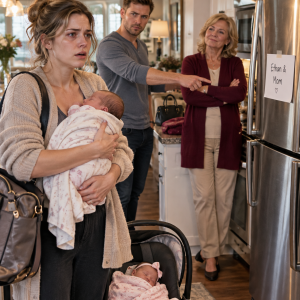
“Is it true?”
“Yes.”
She absorbed his answer without moving. Then she faced Margaret. “And you’re happy because he’s a boy?”
Margaret began to offer the sort of explanation adults use when they want a child to accept something the adults themselves cannot defend. Emma did not wait for it. She walked upstairs, closed the guest-room door, and remained there until I was ready to take her home.
In the car, Grant kept glancing at her in the mirror. Finally, Emma spoke.
“Please don’t tell Paige and Lucy tonight. Lucy will think Dad wanted a boy because we weren’t enough.”
That was the moment my remaining hope for the marriage became very small. My fifteen-year-old had just discovered her father’s betrayal, yet her first thought was to protect her sisters. Grant and Margaret, meanwhile, were discussing a nursery and a family portrait.
Within a month, Jenna and Caleb had been welcomed to Sunday lunches. I brought my daughters too, refusing to let them believe another child’s arrival had displaced them. Caleb was a shy, sweet boy, and I made certain the girls understood that the adults had created the confusion; no child should carry it.
Margaret gave Caleb lavish gifts, skipped Lucy’s school concert, and ordered custom furniture for his new room. Jenna praised every choice and called her the grandmother Caleb had always needed.
The final injury came when Lucy and I stopped by to retrieve a book Paige had left behind. The framed portrait of my three girls, which had hung above the mantel for nine years, was gone. In its place was a large photograph of Grant with Caleb.
Lucy squeezed my hand. “Where did Grandma put us?”
Ruth stood near the staircase, her discomfort plain. “Mrs. Holloway asked me to store the other portrait downstairs.”
Margaret entered with a cup of tea. “There is no need to make a scene. I was updating the family wall.”
Lucy looked up at me. “Did she put us away because we’re girls?”
I knelt and wrapped my arms around her. Then I asked Ruth to bring me the portrait from storage.
“What do you think you’re doing?” Margaret demanded.
“Taking my daughters’ faces somewhere they will be cherished.”
That evening, after Lucy fell asleep holding the frame against her blanket, I called Rebecca Sloan, a family-law attorney recommended by a colleague. I had spent weeks asking whether my marriage could be repaired. Margaret had answered the question by putting my children in a box.
Three Girls and a Westbound Plan

Rebecca’s office overlooked the Scioto River, and she listened without interruption as I described the affair, the secret transfers, the questionable report, and Margaret’s treatment of the girls. When I finished, she folded her hands over a yellow legal pad.
“What life are you trying to build after this?” she asked.
“My parents live outside Santa Barbara. I want primary custody, and I want permission to relocate with all three girls. My company has a branch there, and my supervisor has already offered me a position.”
Rebecca warned me that moving children across the country would require evidence, patience, and a detailed plan. Grant fought immediately after receiving the divorce petition. One afternoon, while I was carrying groceries into the kitchen, I heard him speaking softly to Emma in the living room.
“You could stay here with me,” he told her. “You would keep your school, your friends, and your room. Your mom could take Paige and Lucy to California, and you could visit.”
I stopped just beyond the doorway. He was not offering stability; he was trying to split the girls because he knew I would never leave without all three.
Emma closed her laptop. “You want me to give up my sisters for a bedroom?”
“That isn’t what I said.”
“It is exactly what you said. If you cared about keeping us close, you wouldn’t ask me to help divide us.”
I entered the room and set the bags on the floor. “Do not make our daughter responsible for solving a problem you created.”
The months that followed were exhausting, but facts were steadier than emotion. I documented years as the girls’ primary caregiver and submitted my California transfer offer, school options, housing plan, and a visitation calendar granting Grant long summer stays and alternating holidays. His frequent work travel made his own custody proposal difficult to defend.
Grant eventually agreed. A court dispute would expose the secret spending, and Emma had made it clear she would not leave her sisters. He signed the custody and relocation agreement six weeks before our move.
While I packed our house, Jenna moved into Margaret’s downstairs suite and made herself indispensable, arranging appointments and repeatedly reminding Margaret that I was taking the girls two thousand miles away.
Ruth watched it happen. She also noticed a worn blue pickup parked near the gates on three separate afternoons. The driver was a lean man in his early thirties who wore work boots and a mechanic’s jacket. On the fourth visit, he approached the front steps while Ruth was sweeping leaves.
“I’m looking for Jenna,” he said. “My name is Daniel Shaw.”
Jenna opened the door before Ruth could respond. At the sight of Daniel, her entire manner changed.
“You can’t come here,” she said, stepping outside and pulling the door partly closed.
“I want the truth about Caleb.”
“You already know the truth. Grant is his father.”
“We were still together when you became pregnant. I stayed quiet because I was angry and ashamed, but I won’t keep doing that.”
Jenna ordered him off the property. After he drove away, she told Ruth he was an unstable former boyfriend and warned her not to upset Margaret by mentioning the visit.
Daniel returned two days later while Jenna was shopping. He handed Ruth a business card and a sealed note.
“I don’t want their money,” he said. “I want a supervised test, handled by a real clinic from beginning to end. If I’m wrong, I will leave them alone. If I’m right, Caleb deserves to know who his father is.”
Ruth placed the card in her apron pocket. She had worked for Margaret for eight years and had never challenged her openly, but loyalty, she later told me, did not mean standing quietly while someone rushed toward a terrible decision.
The Announcement at the Harvest Dinner
On the Saturday before Thanksgiving, my daughters and I ate peacefully among moving boxes while Margaret’s annual harvest dinner filled her estate with relatives.
Caleb was introduced as the future of the Holloway family, while Jenna corrected anyone who called her Margaret’s guest.
“We’re family now,” she would say.
After dessert, Margaret gathered everyone in the library. A burgundy legal folder rested on the table beside her chair. Ruth recognized it from the study; it contained recent drafts prepared by Margaret’s estate attorney.
“I have an announcement,” Margaret said. “Tomorrow I intend to place half of this property, along with a substantial investment account, into a permanent trust for Caleb. This house should remain with the next generation of Holloways.”
Jenna pressed one hand to her chest. “Margaret, that is far too generous. People will say I influenced you.”
Grant set down his glass. “Mom, slow down. Claire and the girls have not even moved yet, and Caleb has been part of our lives for only a few months.”
“I have considered this carefully,” Margaret replied. “The papers will be signed in the morning.”
Ruth stood in the doorway holding a tray of coffee cups. She thought of Lucy asking whether her grandmother had put her away because she was a girl. She thought of Daniel’s quiet request and the business card tucked into her apron.
The cups rattled as she lowered the tray.
“Mrs. Holloway, please do not sign those papers tomorrow.”
Every conversation stopped. Margaret stared at her as if a piece of furniture had spoken.
“What did you say?”
Jenna rose quickly. “Ruth, this is a private family discussion.”
“A man named Daniel Shaw has come to the gates three times,” Ruth continued. “He says he and Jenna were still together when Caleb was conceived. He wants a supervised genetic test.”
Jenna’s coffee cup slipped from her fingers and broke against the floor.