Dad had created a listing for the cabin under his own name. He called it “Frank’s Lakeside Retreat,” described the screened porch and private dock, and claimed he had owned the family property for years. The listing used photographs of Grandma’s quilt, her porch, and the old refrigerator. It also showed Lucy’s crayon drawings, the ones she had made after Grandma’s passing so the cabin would not feel lonely.
There were more than twenty reviews from guests who had stayed there over two summers, many of them on weekends Dad had told Mom he was going fishing alone. One guest had praised the “sweet granddaughter’s artwork” on the refrigerator.
The Lock and the Call

On Wednesday morning, Wyatt sent me a picture of the new brass deadbolt. A second image showed Dad’s fishing cap and tackle box in a cardboard carton on the porch. That afternoon he sent one more message: he had confirmed the final detail and submitted the evidence to the rental platform.
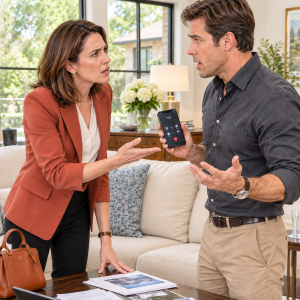
I did not call Dad to ask what he had done. I wanted the facts in order before I heard his explanations. He was quiet all day, but on Thursday evening, while I was making dinner, my parents arrived at my apartment. Dad came in first, demanding that I call Wyatt and tell him to give back the key. Mom stood behind him in the green cardigan she wore to church and family gatherings, trying to soften his anger into something that sounded reasonable.
I told him he had visited twice in the months Grandma needed help, while I had spent nights on the porch so I could hear her call. He started to answer, but Mom changed the subject to Lucy. She said Lucy was resilient and would get over waiting at school.
“She saved half her sandwich because she thought no one might come,” I said.
For a moment Mom’s expression faltered. Then she asked again whether I would call the locksmith. I said no.
Dad’s phone began ringing. He looked down and went pale. His thumb slipped, and the call came through on speaker. Jenna was on the line, upset and confused. She was parked outside the cabin with the twins. The key Dad had given her no longer worked, and a box with his fishing cap sat on the porch. Wyatt had explained that the property belonged to me.
“You told me Grandma left the cabin to you,” Jenna said. “You promised it would be ours someday. I packed the boys and invited Nick’s parents for the holiday weekend. What am I supposed to tell them?”
Mom turned slowly toward Dad. He said nothing.
I asked Jenna if the boys were safely in the car. She said they were, and Wyatt had given them popsicles to help calm them down. Then I told Dad to explain why the rental platform had suspended his account. He asked me not to do this. I opened my laptop and read the listing aloud: the cabin was described as his family heirloom, his property, and his to share with guests.
I explained that Wyatt had contacted Dad posing as a potential guest and had recorded Dad offering a lower price for cash, saying it would keep the payment off the books. In the recording, Dad had even dismissed me as someone whose name was on old paperwork but who had nothing to do with the cabin.
Mom sat down hard in one of the kitchen chairs. She had believed Dad’s boat was paid for with vacation savings, and that he had been putting money aside for Jenna’s boys’ preschool. Jenna, still on speaker, asked if her children’s tuition had been paid with money from my cabin. Dad didn’t answer.
He turned on me instead, accusing me of setting him up. I told him Wyatt had submitted the deed and the listing to the platform, and that the company had frozen his account. As for the money, I gave him ninety days to deposit the amount he had earned through the listing into a college account for Lucy. If he didn’t, I would take the records and the recording to the county authorities. It was his decision what to do next.
Dad said he didn’t have that much cash. I reminded him that he owned a boat he could sell. Mom looked down at the floor. I told her that Dad had enjoyed his retirement in a cabin I paid for, while Lucy waited for him at school. The words sounded sharp, but they were true.
From the hallway, I heard Lucy’s bedroom door open. She had taken off her headphones. She stood there in her socks and asked her grandfather one question.
“Are my drawings still on the refrigerator at the lake?”
I told her Wyatt had packed them safely. “They’re yours, sweetheart.”
She looked at Dad for a moment, then returned to her room and closed the door carefully. I opened the front door and told my parents it was time to leave. To Jenna, I said Wyatt would help her pack the boys into the car, and she should take them to the diner by the marina. I offered to cover dinner.
What Came Back to Us
Jenna called a little over a week after the confrontation. She didn’t know how to apologize, but she admitted Dad had told her for years that I didn’t want her family at the cabin. I told her I had never said that. She said she should not have posted the zoo picture without thinking about where Lucy might be, though she hadn’t known Dad had promised to collect her.
A few days later, Jenna brought the boys to our apartment. Lucy taught them Go Fish, explaining that the faster card game was for advanced players. When one twin lost and looked ready to cry, she quietly gave him a good card from her own hand. Jenna watched from the kitchen doorway, and when they left, she hugged me tightly. It was not a perfect apology, but it was a beginning.
Dad tried once to collect Lucy from school without being on the authorization list. The office staff turned him away. Lucy watched through the glass as he stood by the curb holding a melting chocolate milkshake, then gave him a small, polite wave and went back to her library book.
That evening, while we folded laundry, she told me what had happened.
“It was like finding a dollar in my winter coat,” she said. “Nice, but I already got through winter without it.”
When summer came, Wyatt blocked off a week for us at the cabin. He said the place needed to remember who it belonged to. Lucy and I drove north with the windows open and a cooler sliding around in the back. The new key turned easily in the lock. Inside, the cabin smelled of cedar, lake water, and lemon cleaner. Grandma’s quilt was folded at the end of the bed, just where she used to leave it.
The old drawings had been returned to us in a large envelope. Lucy had put them in a decorated shoebox under her bed, saying they had done their job and could rest now. That first evening, she drew a new picture at Grandma’s kitchen table: the cabin, its crooked dock, and two people standing at the end of it, one tall and one small. She pinned it to the refrigerator with a bass-shaped magnet.
Above the figures, in careful block letters, she wrote: “OUR LAKE HOUSE. MOM ALWAYS COMES.”
I stood there reading the words longer than I meant to. I thought of the old softball field, the empty dugout, and Grandma arriving in her robe and slippers. For years I had believed that if I kept showing up for everyone, eventually someone would show up for me. I understood now that love was not proved by how much mistreatment a person could absorb. Sometimes love meant drawing a boundary, especially when a child was watching to learn what she was allowed to expect.
After dinner, Lucy and I walked down to the dock. The heron came to rest on the rocky point, folding its wings as the water darkened. She shuffled the cards and dealt two hands.
“Ready?” she asked.
“Ready,” I said.
She beat me six times in a row, and I did not let her win once. She didn’t need me to. She had learned that people who love her should keep their promises, and she had begun to understand that she could stand on her own when they did not.