“Sloane.”
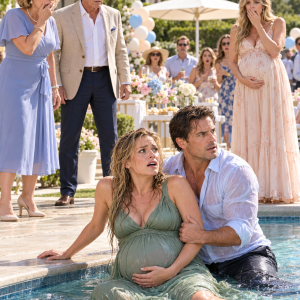
Her hands tightened around her bouquet.
Finally, she whispered:
“We should postpone the wedding.”
Preston stared at her.
“Why?”
Tears filled her eyes.
“Because there is something I should have told you a long time ago.”
Everyone went still.
Sloane asked to speak with Preston alone.
Twenty minutes later, he found me outside on the terrace.
His face looked completely different.
“Sloane says the triplets might not be mine.”
I had suspected something was wrong, but hearing him say it still surprised me.
“Might not be?”
“Before we were together, she was seeing someone else.”
He stared across the lawn.
“She says the timing overlaps.”
“Did you ever have a DNA test?”
He shook his head.
“No.”
Then he said something that mattered more than I expected.
“They’re almost two years old, Camille. They call me Daddy. I love them.”
I looked at him.
“Then remember that before you make any decisions. A laboratory can answer a biological question, but it can’t erase two years of bedtime stories, scraped knees, first words, and mornings when those boys reached for you.”
He nodded slowly.
For the first time that day, he wasn’t acting like an Ashford heir.
He was simply a confused father.
Someone Had Been Controlling the Story
That evening, Lenora came to my hotel alone.
She apologized for the way she had treated me two years earlier.
Then she placed an old envelope on the table.
I recognized my handwriting.
It was the letter I had sent Preston while pregnant.
The envelope had been opened.
“Where did you find this?”
Lenora hesitated.
“In a locked cabinet used by the family’s longtime attorney, Everett Sloan.”
My stomach tightened.
So the letter had reached the Ashfords.
It simply hadn’t reached Preston.
The next morning, Preston confronted Everett.
Within hours, the attorney resigned.
He admitted receiving my pregnancy letter but claimed he believed the family needed a “clean separation” after the divorce.
Then another discovery changed everything.
Sloane admitted that she had contacted Everett before telling Preston she was pregnant.
She had been uncertain about the paternity of her triplets and had asked about testing.
According to her, Everett discouraged it.
He believed three male heirs would bring stability to the Ashford family.
Then Sloane showed me something she had kept for nearly two years.
An internal family-office memo.
The document was dated one day after the Ashfords learned she was expecting triplets.
One sentence made my hands cold.
Everett had recommended completing my divorce quickly before additional claims involving future descendants could appear.
There was only one problem.
At that point, I hadn’t told anyone I was pregnant.
Then I remembered something.
Ten days before Gordon called me to Connecticut, I had undergone routine blood work at a Manhattan clinic.
I never returned for the results because my life fell apart days later.
The clinic belonged to a healthcare network financially connected to an Ashford charitable foundation.
I looked at Sloane.
“Someone knew I might be pregnant before I signed those papers.”
She nodded.
That changed the entire story.
For two years, I had believed Preston knowingly abandoned four children.
Preston had believed I disappeared without ever telling him.
Sloane had allowed everyone to assume her three sons were unquestionably Preston’s.
And Gordon and Lenora had believed they were protecting the future of their family.
But somewhere behind all those assumptions, someone had been deciding which information people were allowed to receive.
The Truth Was Bigger Than Revenge

I had returned to Long Island believing I was bringing one secret to Preston’s wedding.
Four children.
One DNA report.
One truth he could no longer ignore.
Instead, I discovered that our entire family had been shaped by missing information.
Preston had lost almost two years with his biological children.
I had spent those years believing their father knew about them and simply didn’t care.
Sloane had built a life around a question she had been too afraid to answer.
And three little boys had grown up calling Preston “Daddy,” completely unaware that adults were questioning the circumstances surrounding their birth.
Suddenly, revenge seemed small.
There were seven children involved.
Seven innocent children who deserved something better than adults fighting over surnames, inheritance, money, and pride.
I looked at Preston that evening while our four children played nearby.
He wasn’t asking me to forgive him.
I wasn’t asking him to return to me.
There were too many things we still didn’t understand.
But when Caleb walked over and handed Preston a wooden train, Preston crouched beside him.
“Is this for me?”
Caleb nodded.
Preston smiled.
“Thank you.”
It wasn’t a dramatic reunion.
It was simply a beginning.
And perhaps beginnings don’t need to repair everything that came before them.
Sometimes they only need to stop the next generation from carrying the same secrets.
Sometimes the truth arrives much later than we wanted, but discovering it can still change the future even when it cannot repair the past.
A person’s silence does not always mean rejection, because sometimes messages are lost, intercepted, misunderstood, or never given the chance to reach the person who needed to hear them.
Money can create comfort and opportunity, but it cannot replace trust, honest communication, or the ordinary moments that turn people into a real family.
Children should never have to carry the consequences of adult pride, hidden decisions, old resentment, or arguments about status and inheritance.
Biology can reveal where a child came from, but love is also built through thousands of ordinary moments of care, patience, presence, and responsibility.
Forgiveness does not require pretending that painful choices never happened; sometimes it simply means refusing to let those choices control every chapter that follows.
Before judging someone entirely by what we think they did, it is worth asking whether we actually know the complete story or only the version created by missing information.
The strongest response to betrayal is not always revenge; sometimes it is building a peaceful life, protecting the people who depend on you, and returning to the truth only when you are ready.
Families become healthier when they stop protecting appearances and start protecting honesty, because secrets that seem convenient today can become burdens carried by innocent people tomorrow.
We cannot rewrite the years already lost, but we can decide that the next generation will grow up with more truth, more compassion, and fewer decisions made behind closed doors.