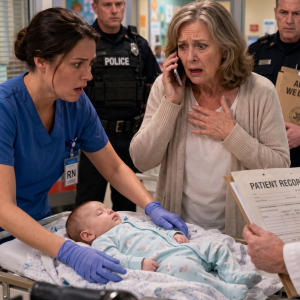
Marissa sat down in one of the waiting-room chairs.
Ryan lowered his voice.
“Dylan was being disrespectful.”
“So you locked him inside?”
“For a few minutes.”
“He was still there when I arrived.”
Ryan rubbed both hands over his face.
“Dad, you’re making this sound worse than it was.”
That sentence might have worked on me once.
It didn’t anymore.
I pulled Dylan’s tablet from my bag.
Ryan stared at it.
“What’s that?”
“Something you should’ve remembered before telling your son nobody would believe him.”
His expression changed again.
This time, he knew.
“Dylan recorded us?”
I didn’t answer.
A hospital staff member approached and asked Ryan and Marissa to wait elsewhere.
Ryan looked at me.
“You’re taking his side?”
I folded his note and returned it to my pocket.
“I’m listening to him.”
That was different.
And we both knew it.
“But You Always Asked Dad First”
The hospital contacted the appropriate authorities because of Sophie’s condition, the medication and what Dylan had reported.
I spent most of that morning answering questions.
Dylan showed them the recording and the photograph of the HOUSE RULES sheet.
Family problems stay in the family.
If a teacher asks questions, say everything is fine.
Do not call Grandpa without permission.
Dylan does not speak for Sophie.
Seeing those sentences again bothered me more than I expected.
Especially the third one.
I found Dylan later sitting near a vending machine.
I sat beside him.
“Can I ask you something?”
He nodded.
“Why didn’t you call me before?”
His sneaker moved slowly against the floor.
“Dad said not to.”
“You could’ve called anyway.”
Dylan looked at me.
“Would you have believed me?”
I opened my mouth.
Nothing came out.
He looked back at the vending machine.
I remembered other conversations.
Dylan saying his father had taken away dinner after an argument.
Ryan telling me Dylan was exaggerating.
Dylan saying Sophie was afraid when their parents fought.
Ryan telling me children misunderstood adult conversations.
Each time, I’d called Ryan.
Each time, I’d accepted his explanation.
“I’m sorry,” I said.
Dylan shrugged.
“But you always asked Dad first.”
There was no accusation in his voice.
That made it worse.
I put my hands together between my knees.
“I did.”
He waited.
“I shouldn’t have.”
He didn’t forgive me on the spot.
He didn’t hug me.
He simply nodded.
That was enough.
The Refrigerator
Sophie recovered without signs of lasting physical harm.
But neither child went home with Ryan and Marissa.
Temporary arrangements were made for them to stay with me while the situation was investigated.
I had spent years imagining grandchildren staying at my house as something fun.
Pancakes.
Movies.
Too much ice cream.
It wasn’t like that at first.
The first morning, I walked into the kitchen and found Dylan standing in front of the refrigerator.
His hand was on the handle.
He wasn’t opening it.
“What’s wrong?”
“Can I get juice?”
“Of course.”
He opened the refrigerator.
Sophie appeared behind him.
“Can I watch TV?”
“Yes.”
That night she came into my bedroom.
“Grandpa?”
“What’s up?”
“Can I leave the hallway light on?”
“Sure.”
She stayed there.
“All night?”
I looked at her.
“All night.”
Over the next few weeks, I noticed how often they asked permission.
Could they sit on the couch?
Could they have a snack?
Could Dylan call a friend?
Could Sophie take a second cookie?
At first I kept saying:
“You don’t need to ask me.”
Then I stopped.
They did need to ask.
Not because I required it.
Because somebody had taught them that ordinary things could become reasons for punishment.
So I simply answered.
“Yes.”
Little by little, the questions became less frequent.
My Son Wanted Me to Fix It
Ryan called constantly.
“Dad, you’re destroying this family.”
“No.”
“Dylan has always been dramatic.”
“I heard the recording.”
Silence.
Then another explanation.
The hotel was nearby.
Sophie had been sleeping.
They planned to return early.
The closet was supposed to be temporary.
Marissa had agreed with him.
Every explanation was about what Ryan had intended.
None was about what his children had experienced.
His contact with them became restricted and supervised while the case moved forward. Both parents were required to cooperate with counseling and other conditions.
Marissa accepted responsibility sooner.
Ryan resisted.
Then, during one supervised visit months later, I saw something small.
Ryan opened his arms toward Dylan.
“Come here.”
Dylan stepped backward.
Ryan’s face tightened.
For a second, I expected the old reaction.
Instead, he lowered his arms.
“Okay.”
Dylan watched him.
Ryan sat back down.
“I can wait.”
Nobody congratulated him.
He was simply respecting an answer he once would have challenged.
Later, Sophie sat across from him coloring.
Without looking up, she asked:
“Why did you leave me?”
Ryan froze.
He could have said her fever wasn’t that high.
He could have mentioned the hotel being close.
Instead, he looked at her.
“Because I was selfish.”
Sophie studied him for a few seconds.
Then she returned to her picture.
“Okay.”
That was all.
One Year Later
Almost exactly a year after the phone call, Dylan walked into my kitchen carrying his tablet.
I was making coffee.
He placed it on the counter.
“Grandpa?”
“Yeah?”
“I’m deleting it.”
I knew immediately what he meant.
The recording.
“You sure?”
He nodded.
“Everybody who needed to hear it already heard it.”
He opened the file.
Pressed delete.
Then emptied the trash.
No speech.
No ceremony.
He put the tablet under his arm, grabbed an apple from the refrigerator without asking permission and walked outside.
I stood there looking at the refrigerator door.
A few minutes later, Sophie ran into the kitchen.
“Grandpa! Dylan ate the last chocolate pudding!”
Dylan shouted from outside.
“You ate two yesterday!”
“That doesn’t count!”
I opened the refrigerator.
“There’s vanilla.”
Sophie stared at me as if I’d insulted her.
“Vanilla is not chocolate.”
I laughed.
So did she.
That night, after they went upstairs, I opened my desk drawer.
Ryan’s note was still inside.
The paper had softened along the fold.
DON’T CALL ANYONE.
I kept it not because I needed evidence anymore.
I kept it because I needed the reminder.
At 1:58 that morning, an eight-year-old girl had broken the most important rule in her house.
She called someone.
And this time, someone finally listened.