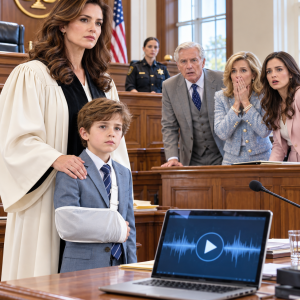
That picture felt more like home than the house I grew up in.
“It stopped feeling like home a long time ago.”
My mother’s voice softened.
“Families help each other.”
I almost smiled.
“Families don’t send invoices to their daughters.”
Silence filled the apartment.
Vanessa rubbed her hands together.
She looked exhausted.
Not angry.
Just tired.
“Emily… I honestly didn’t know.”
I studied her face.
For the first time in years, she wasn’t wearing expensive jewelry.
Even her engagement ring looked different.
Smaller.
She noticed me looking.
“We sold the original one.”
I didn’t know what to say.
Because I believed her.
She truly hadn’t expected any of this.
Growing up, she’d never questioned why everything came so easily.
Why would she?
Children usually believe the version of love they’re given.
After they left, I carried the folder into my home office.
Something kept bothering me.
Not the foreclosure.
The paperwork.
One page listed my full legal name in connection with a preliminary refinancing review.
I didn’t remember authorizing anything.
I called the attorney who had handled our courthouse will and estate documents.
His name was Daniel Brooks.
After listening quietly, he asked only one question.
“Did you ever sign any paperwork agreeing to guarantee your parents’ mortgage?”
“Never.”
“Email me everything.”
Within an hour, he called back.
His tone had changed.
“Emily, don’t contact your father yet.”
My stomach tightened.
“Why?”
“Because someone attempted to submit loan documents using your personal information.”
The next morning I sat in Daniel’s office.
He spread three signatures across the conference table.
Mine from my driver’s license renewal.
Mine from our marriage license.
And the one attached to the refinancing paperwork.
I didn’t need a handwriting expert.
The third signature wasn’t mine.
It wasn’t even close.
Daniel tapped the page gently.
“The bank flagged inconsistencies before approving the loan. That’s why the refinancing stalled.”
I stared at the paper.
“He actually tried to sign my name?”
Daniel nodded.
“It appears so.”
For several seconds, neither of us spoke.
Then he asked,
“Do you want to protect your identity?”
That answer came easily.
“Yes.”
Everything moved quickly after that.
The bank froze the application.
A fraud investigation began.
My credit reports were locked.
Daniel contacted every institution involved.
I never had to speak to my father directly.
A detective interviewed me once.
The meeting lasted less than forty minutes.
Most of the evidence already existed in the bank’s files.
I simply confirmed that I had never signed the documents.
Dad called for the first time in six months.
I let it go to voicemail.
Then another.
And another.
His messages changed with each call.
First angry.
Then defensive.
Then desperate.
Finally one arrived with only seven words.
“Please tell them this was a misunderstanding.”
I deleted it without replying.
Two months later the house was listed for sale.
The white porch where Vanessa and I had played as children disappeared behind a real estate sign.
I drove past only once.
The curtains were gone.
The flower beds had dried out.
Moving trucks filled the driveway.
I didn’t stop.
Some places become memories long before they become someone else’s property.
Several weeks later, Vanessa asked if we could meet alone.
We chose a quiet coffee shop halfway across town.
She arrived wearing a simple sweater and carrying no designer handbag.
After ordering coffee, she looked out the window for a long time.
Finally she spoke.
“I used to think Mom and Dad loved us the same.”
I waited.
“I thought I was just… luckier.”
She laughed once.
It wasn’t a happy sound.
“Now I realize they trained me to expect things that were never really free.”
I wrapped both hands around my coffee mug.
She looked at me.
“I’m sorry.”
There was no excuse after it.
No explanation.
Just two words.
I appreciated that.
Then I answered as honestly as I could.
“They taught you that love was a privilege you earned by being their favorite.”
I paused.
“They taught me that love always came with a bill.”
Vanessa lowered her eyes.
She didn’t argue.
That night my phone buzzed one last time.
A message from my mother.
Family should forgive. Family should be compassionate.
I read it twice.
Then typed my reply.
Family should not invoice love.
I pressed send.
Blocked the number.
Set my phone on the kitchen counter.
Caleb walked in carrying groceries.
“Everything okay?”
I looked at our little apartment.
At the courthouse photograph still sitting on the shelf.
At the quiet we’d built together.
Then I smiled.
“Yeah.”
For the first time in my life, nobody could send me another bill for being their daughter.