His voice changed.
“Lucy, get back on.”
My daughter stopped crying at once. She became unnaturally still, just as she had on my porch.
I called my attorney, Rachel Bennett, and told her what I had found.
“Does Owen know those files were uploaded?” she asked.
“I don’t think so.”
“Don’t contact him. Preserve the original files, make two secure copies, and send everything to me exactly as it appeared.”
The next recording showed Lucy limping back toward the vehicle. She drove again because the adult she trusted had made obedience feel like the price of his affection.
Near the edge of the field, one wheel entered a shallow ditch. Lucy was thrown onto the grass, landing with enough force to leave her breathless.
Owen lifted her by both arms, gripping the precise areas where Dr. Hart had photographed the darkest marks.
“You’re hurting me!”
“Then stop pulling away.”
“My legs hurt. I want a doctor.”
“You don’t need one.”
“Please call Mom.”
“We are not calling her.”
The final recording contained almost no picture because the camera had been placed inside the SUV, but the voices were clear.
“If your mother asks, you fell near the climbing wall,” Owen said.
“But there wasn’t a climbing wall.”
“It’s easier than explaining everything.”
“That isn’t true.”
“Your mother will tell the judge about the off-road vehicle. Then the judge might decide you can’t visit me anymore.”
“Not ever?”
A pause followed.
“That depends on what you tell her.”
When Lucy came downstairs, I explained that her camera had saved the recordings automatically. Her face lost its color.
“All of them?”
“Yes, sweetheart.”
She began to cry.
“I’m sorry. Dad told me to erase the bad parts, but I didn’t know how.”
I gathered her into my arms.
“You have nothing to apologize for.”
Owen had not merely invented a convenient explanation. He had asked a frightened child to remove the evidence and convinced her that honesty might cost her a father.
By that afternoon, Rachel had filed an emergency request to suspend unsupervised visits.
A Carefully Cropped Truth

When Owen received the court notice, he called repeatedly. I did not answer. His messages arrived one after another.
“You’re taking my daughter from me.”
“She wanted to drive.”
“It was an accident.”
“One day Lucy will understand what you’ve done.”
That last message hurt because Lucy loved him. Protecting her did not erase that love, nor did it protect her from missing him. She could feel safer and still wish he would walk through the door. Children are capable of carrying two opposing truths, even when adults prefer simpler stories.
The court temporarily required professionally supervised visits while the recordings, medical report, and circumstances were reviewed. Owen responded by submitting a video of his own.
His version lasted ninety seconds.
It showed Lucy arriving at the farm, smiling beside the machine, and wearing her helmet. It ended with her driving slowly while Owen cheered from behind the camera.
“That’s it, kiddo! You’ve got it!”
There was no first fall, no request to stop, no second attempt, no hard cider, and no child asking for medical help. Anyone seeing only that clip would have thought Owen was a devoted father giving his daughter an exciting afternoon.
He had always been skilled at creating beautiful fragments. His social media pages displayed apple-picking trips, lakeside picnics, soccer games, and ice-cream outings. I handled school conferences, dental appointments, permission slips, laundry, and the quiet routines that never looked impressive in photographs.
Owen created visible memories. I maintained the invisible structure beneath Lucy’s life.
That afternoon at the farm, he had tried to create another perfect memory. When Lucy’s pain disrupted the story he wanted, he removed the inconvenient parts.
Digital specialists confirmed that Lucy’s files were complete and unaltered. They also determined that Owen’s clip was genuine but heavily shortened. It was not fabricated; it was a carefully cropped truth, and in some ways that made it more persuasive.
Lucy was later interviewed by a child specialist named Dr. Joanne Foster. I waited outside because the interviewer needed Lucy’s memories without either parent influencing her.
Afterward, Dr. Foster explained that Lucy had spoken plainly. She remembered being excited. She remembered the engine being loud. She remembered falling, asking to stop, and noticing that her father became stern when she asked for me.
When asked why she repeated the story about climbing equipment, she answered:
“Dad said Mom would use the truth to make him go away.”
I felt no triumph when I heard that. Only sorrow that an eight-year-old had been made responsible for preserving an adult’s access to her.
The Difference Between an Accident and a Choice
At the hearing, Owen’s attorney described the outing as a father-daughter adventure that had simply gone wrong.
Owen admitted that Lucy had initially wanted to participate. That was true, but enthusiasm is not permanent permission. A child may begin an activity happily and still have the right to stop when she becomes frightened or hurt.
He acknowledged both falls and admitted that he had not taken her for an examination.
“I thought she was only sore,” he said.
Rachel stood.
“If you believed Lucy was fine, why did you put her in a long-sleeved jacket on a warm afternoon?”
“She said she felt cold.”
“Why did you remind her to keep the sleeves down?”
“I don’t remember saying that.”
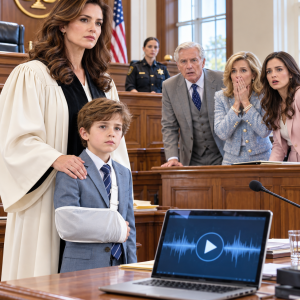
Rachel played the recording.
Owen’s own voice filled the room.
“Keep your sleeves pulled down when we get there.”
He stared at the table.
“Why did you tell Lucy to say she fell near climbing equipment?” Rachel asked.
“Because Claire overreacts.”