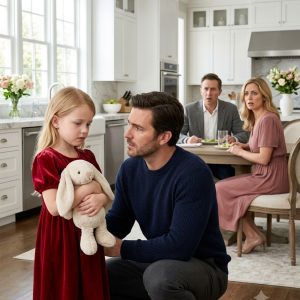
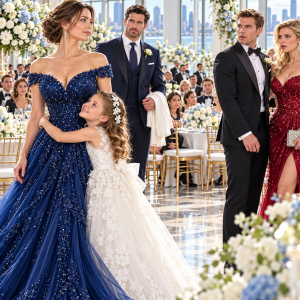
Molly answered, “You came back.”
I turned away.
Some moments do not need witnesses.
The Man in the Bookstore

A week later, after Noah had recovered, Rachel agreed to travel with us to Vermont.
The bookstore sat on the main street of a town so small that the café across from it closed at three in the afternoon.
An older man stood behind the counter arranging used hardcovers.
Silver hair.
Thin shoulders.
Wire-rimmed glasses.
He looked up.
Rachel stopped breathing for a second.
“Dad?”
Peter Carter placed both hands on the counter.
He had spent almost two decades living under another name while attorneys and investigators tried unsuccessfully to untangle the financial network he had uncovered.
He had remained away because he believed distance protected Rachel.
Rachel did not immediately forgive him.
Neither did Molly.
And I was glad.
Real families are not repaired because somebody finally explains why they disappeared.
Peter had explanations.
Rachel had twenty years of questions.
Molly had only one.
“Did you know about my chocolate?”
Peter smiled.
“Forty-three bars?”
Her eyes widened.
He had arranged it.
Knowing the route I took to a monthly development meeting, Peter had sent Rachel instructions to bring Molly to that particular intersection with exactly forty-three chocolate bars, a number Eleanor had once used as a private joke with me.
He knew I would notice.
He knew curiosity would make me stop.
What he had not expected was Noah becoming ill that morning.
“You shouldn’t have involved her,” I told him.
Peter met my eyes.
“You’re right.”
No defense.
No clever justification.
Just two words.
It occurred to me how rarely powerful men said them.
What Forty-Three Dollars Bought
The records Peter and Eleanor preserved were eventually handed to federal investigators, along with testimony from Rachel, Warren and several former employees.
People connected to the old financial scheme were questioned, and the foundation was completely reorganized under independent oversight.
I stepped away from its board.
For most of my life, stepping away from control would have felt like failure.
This time it felt responsible.
Rachel and the children moved temporarily into Eleanor’s cottage while she decided what she wanted next.
That distinction mattered.
I offered.
She chose.
Peter visited, cautiously at first.
Molly made him pay one dollar for the chocolate bar she had saved for him.
He gave her five.
She returned four.
“One dollar means one dollar.”
Peter looked at me.
“She’s tough.”
“You have no idea.”
Noah recovered quickly and soon became fascinated with opening every kitchen cabinet he could reach.
The old stroller remained in the shed even after Rachel bought a new one.
When I asked Molly why she kept it, she shrugged.
“It got us where we needed to go.”
That sentence stayed with me.
I had spent decades replacing anything broken.
Cars.
Companies.
Furniture.
Relationships.
If something stopped working, I removed it from my life.
Molly understood something I hadn’t.
Broken did not always mean worthless.
Sometimes broken things had carried you farther than anyone knew.
Several months later, I returned to the intersection where I had first seen her.
The weather was warmer.
People hurried through the crosswalk carrying coffee, briefcases and grocery bags, each absorbed in a private world.
I stood there remembering the tiny girl in the oversized coat, the crooked stroller and forty-three perfectly arranged chocolate bars.
I had believed I was stopping to help her.
That wasn’t entirely true.
Molly had interrupted a life I had spent years making too efficient for tenderness.
She had forced me to look at what I had avoided: my sister’s warnings, Warren’s silence, Peter’s fear, Rachel’s struggle and my own habit of calling control protection.
That Sunday, I drove back to Eleanor’s cottage.
Molly was sitting on the front steps.
She held the brass key.
“Mom says this belongs to you.”
I took it.
“I suppose it does.”
“Are you going to throw it away?”
“No.”
“Why?”
I sat beside her.
“Because I spent a long time believing that if you locked something away, eventually it stopped mattering.”
She frowned.
“That’s dumb.”
I laughed.
“Yes. It is.”
From inside the cottage, Rachel called that dinner was ready.
Noah squealed somewhere in the kitchen, followed by Peter asking who had hidden his glasses.
Molly stood.
Then she turned back.
“Are you coming next Sunday?”
My first instinct was to think about my calendar.
Meetings.
Flights.
Deadlines.
For years, those things had been treated as immovable while people were expected to understand.
Instead I said, “Yes.”
She narrowed her eyes.
“Promise?”
Eleanor’s voice came back to me.
Whatever you promise that child, keep it.
“I promise.”
Molly reached into her coat pocket and handed me a chocolate bar.
“What’s this for?”
“Emergency.”
“What kind of emergency requires chocolate?”
She gave me the patient look children reserve for adults who have somehow reached middle age without learning anything useful.
“Most of them.”
I slipped the chocolate into my pocket beside the brass key.
Then we went inside.
For most of my life, I had believed protecting people meant becoming powerful enough to remove every danger before it reached them.
Eleanor had tried to teach me otherwise.
Protection was not control.
It was showing up.
It was listening when someone smaller, poorer or less powerful than you said something was wrong.
It was giving people choices instead of making decisions for them.
It was returning when you said you would.
And sometimes it was nothing more complicated than stopping at an intersection because an eight-year-old girl had forty-three chocolate bars arranged in six careful rows and a little brother who needed someone, just once, to notice.
I had stopped that afternoon believing I was going to spend forty-three dollars.
Instead, I found a key to a room in my life I had kept locked for nearly twenty years.
And the most valuable thing inside wasn’t the evidence, the old letters or even the truth about my sister.
It was a promise.
This time, I intended to keep it.