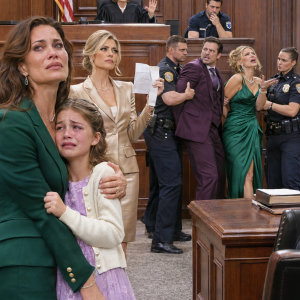
“You knew where I was. You knew it was cold. You knew I wanted to come home.”
Tammy wiped her cheeks.
“So you’re just going to let them put me in prison? I’m your daughter.”
Mom’s expression changed.
For a moment, I thought she might apologize again.
Instead, she sat a little straighter.
“You’ll always be my daughter. But I can’t keep pretending what happened was all right.”
Tammy stared at her.
“After everything I’ve done for you?”
Mom looked down at her hands, then back at Tammy.
“You did help me sometimes. You took me to appointments and picked up groceries. I remember those things. But they don’t make what happened afterward acceptable.”
She paused.
“I love you, Tammy. I always will. But you can’t live in my house anymore, and you can’t manage my money.”
Tammy began crying harder.
“You’re choosing Ezra over me.”
Mom shook her head.
“No, sweetheart. I’m finally choosing to take care of myself.”
Nobody spoke for several seconds.
Then Mom stood.
“I’m ready to go home, Ezra.”
I helped her into her coat.
As we walked out, Tammy called after us.
“Mom, please.”
Mom stopped but didn’t turn around.
“I hope someday you understand why I had to do this.”
Then she continued walking.
Outside, she took a long breath and held my arm.
“That was harder than I thought it would be,” she whispered.
“I know.”
She looked toward the parking lot.
“But I needed to say it.”
THE HOUSE ON CHERRY STREET AGAIN
With the attorney’s help, Mom completed the necessary steps to regain possession of her house.
By December, Tammy and Buddy were no longer living there.
I spent several days cleaning and putting things back where Mom wanted them.
Dad’s recliner had been moved to the basement. His photographs were packed in a cardboard box, and the dining room table was covered with old mail.
I carried the recliner upstairs, cleaned the kitchen, and washed the curtains.
Then I went to the store and bought fresh sheets for Mom’s bed.
When she walked through the front door, she stopped in the living room.
“You found your father’s chair,” she said.
“It was downstairs. I figured he’d want it back where it belonged.”
She smiled faintly.
Then she walked down the hallway and opened her bedroom door.
Her quilt was folded neatly across the bed. A lamp glowed beside the window, and Dad’s green Army blanket lay at the foot.
Mom stood there for a long moment.
“I used to lie awake in that storage unit wondering whether I’d ever sleep here again,” she said.
I put my arm around her shoulders.
“You’re home now.”
She sat on the edge of the bed and ran her hand across the quilt.
“I know.”
That evening, I made chicken soup while she sat in Dad’s recliner watching the news.
She fell asleep before the weather report ended.
I covered her with a light throw and turned down the television.
For the first time since I’d returned from patrol, she looked comfortable.
THE PEOPLE WHO HAD BEEN FORGOTTEN
Caroline stayed in Pennsylvania long enough to arrange proper care for Fern.
Eventually, she brought her mother to Arizona, where she could visit regularly and make sure she was receiving the support she needed.
Before leaving, Caroline came to Mom’s house.
The two women sat at the kitchen table drinking coffee.
“Thank you for talking to my mother at night,” Caroline said. “The nurses told me she kept asking about a lady named Elsie.”
Mom looked embarrassed.
“She sounded lonely. Sometimes I’d just ask her what she’d had for supper, and she’d settle down.”
Caroline reached across the table and took her hand.
“You were kind to her when she needed somebody.”
Mom’s eyes filled.
“She was kind to me too. It helped knowing I wasn’t completely alone.”
Augie remained in the hospital for several weeks while he recovered from pneumonia and dehydration.
A social worker and veterans’ service staff helped him find a suitable residential care setting near Lake Erie.
His new room had a comfortable bed, regular meals, and a window overlooking the water.
The first time I visited, he was sitting beside that window wearing his old Army cap.
His Purple Heart rested in a small display case on the dresser.
He told me he’d earned it after being wounded during the Korean War, though he didn’t like discussing the details.
“I was a young fellow then,” he said. “Thought I could handle just about anything.”
He looked down at his hands.
“I guess I got too used to thinking that way.”
I pulled up a chair.
“You don’t have to handle everything alone anymore.”
He smiled.
“That’s what the nurse keeps telling me.”
Mom and I began visiting him on Sundays after church.
Sometimes we brought cookies. Sometimes we took him to lunch when he was feeling strong enough.
He liked asking about my work and telling stories about his old Army friends.
One afternoon, he looked at Mom and said:
“Elsie, I don’t think I’d have made it through those nights without hearing your voice through that wall.”
Mom reached over and patted his hand.
“Well, Augie, I was glad to have somebody to talk to.”
Neither said anything else.
They didn’t need to.
WHAT HAPPENED TO MY SISTER
The criminal investigation continued through the winter.
Authorities reviewed the advertisements, rental records, bank transactions, and statements from the people involved. They also examined the benefit payments Tammy had accessed and the money she’d received from the families.
Tammy and Buddy were charged in connection with the exploitation and mistreatment of the three older adults.
At one hearing, Tammy’s attorney described her financial difficulties and argued that she’d never intended for anyone to become seriously ill.
I understood that she’d been struggling.
I’d seen her lose jobs, fall behind on bills, and ask relatives for help. I’d lent her money myself more than once.
But financial trouble didn’t explain why she’d accepted payments for accommodations she wasn’t providing or why she’d left our mother in a storage unit while living in Mom’s house.
Months later, Tammy and Buddy entered guilty pleas to charges arising from the scheme.
The court imposed prison sentences, with Buddy receiving a longer term.
Mom cried when she heard the outcome.
We sat together on a bench outside the courtroom while people walked past us toward the elevators.
“I never wanted this for her,” she whispered.
“Neither did I.”
“She’s still my daughter.”
I put my arm around her.
“I know, Mom.”
She sat quietly for a while.
Then she looked at me.
“But I couldn’t keep making excuses for her.”
I nodded.
“You shouldn’t have to.”
I didn’t feel pleased about Tammy going to prison.
I wished she’d asked for help before things reached that point. I wished she’d understood that being overwhelmed or resentful didn’t give her the right to take advantage of people who trusted her.
But I couldn’t change what she’d done.
And Mom no longer had to carry the responsibility for fixing it.
THE BLANKET AND THE PARADE
I requested a shore-based assignment that would allow me to spend more time in Erie.
The transfer took time, but eventually I was able to settle into a routine that kept me closer to home.
I helped Mom with appointments and made sure she had people she could call when I was working.
Over the following months, she regained her strength.
By spring, she was tending Dad’s tomato plants again. She returned to church, started meeting friends for lunch, and insisted on doing her own grocery shopping.
Every Sunday, we still went to the diner.
Sometimes Augie joined us.
He liked the pancakes, although he complained that the coffee wasn’t nearly strong enough.
One afternoon, Mom brought Dad’s Army blanket out of the hall closet.
She’d washed it carefully and folded it the way he used to.
“I think I’ll put this away for a while,” she said.
I looked at the familiar green wool.
“You don’t have to, Mom.”
“I know. But I don’t need it beside my bed anymore.”
She handed it to me.
I placed it on the top shelf of the closet, next to Dad’s old fishing hat.
For two months, that blanket had been the closest thing Mom had to a warm, familiar home.
Now it was simply Dad’s blanket again.
That November, I accompanied Augie to the Veterans Day parade in downtown Erie.
He’d been looking forward to it for weeks.
Mom helped him straighten his Army cap before we left, and I made sure his Purple Heart was pinned securely to his jacket.
The morning was cold, but the streets were crowded with families, veterans, and schoolchildren waving small American flags.
I pushed Augie’s wheelchair along the parade route as the marching band played.
He sat a little straighter whenever someone thanked him for his service.
Halfway down State Street, a young boy standing beside his father noticed Augie’s medal.
The boy raised his hand in a careful salute.
Augie looked surprised.
Then he slowly lifted his own hand.
His fingers trembled, and tears gathered in his eyes.
When the boy lowered his arm, Augie kept looking after him.
“You know something, Ezra?” he said.
I leaned closer.
“What’s that, sir?”
“A year ago, I thought nobody would notice if I disappeared.”
I stopped pushing the wheelchair for a moment.
He looked down at the Purple Heart on his jacket.
“I spent my nights in that storage unit wondering how a man could live ninety-one years and end up with nobody knowing where he was.”
I rested my hand on his shoulder.
“People know where you are now, Augie.”
He nodded and wiped his eyes.
“Yes,” he said softly. “They do.”
The band began playing again, and I continued pushing him down the street.
Mom was waiting near the end of the route, wrapped in a warm red coat and waving when she spotted us.
Augie lifted his hand to wave back.
When we reached her, she bent down to straighten his scarf.
“You looked handsome out there,” she told him.
He grinned.
“Well, Elsie, I had a good escort.”
Mom laughed and slipped her arm through mine.
As we walked toward the diner, I noticed she’d left her coat unbuttoned despite the November chill.
A year earlier, she’d been wrapped in Dad’s Army blanket, afraid to ask whether she could go home.
Now she was deciding where we should have lunch.