By twelve-forty, more than twenty people were standing in my house.
Some were relatives I vaguely knew. Others were people I had never met.
And gradually I realized something important.
They weren’t behaving badly.
They thought they had been invited.
An older woman named Evelyn introduced herself as a relative of Daniel’s late father. She held a pecan pie carefully with both hands and said, “Thank you for having me. Helen said you wouldn’t mind one more.”
One more.
I almost laughed.
Instead I took her pie.
“I’m glad to finally meet you.”
At twelve-forty-five, another car pulled into the driveway.
Through the front window, I saw Helen step out.
She was wearing her good cream coat and carrying nothing.
Of course she was carrying nothing.
She walked through the front door to a room full of people she had personally assembled and immediately smiled.
“See?” she announced, looking around. “I told everyone this house was big enough.”
Then she removed her coat.
Her eyes moved toward the dining room.
She took two steps.
Stopped.
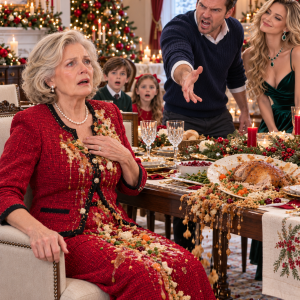
For the first time in six years, I watched my mother-in-law enter my dining room and find absolutely nothing she could rearrange to fix what she had done.
She stared at the table.
Then at the chairs.
Then at the place cards.
Her eyes landed on the centerpiece.
The one she had moved the year before.
Finally, she turned toward me.
“Oh my God. Rachel… what did you do?”
Twenty people stopped talking.
I folded the dish towel I was holding and placed it on the kitchen counter.
“I set my Thanksgiving table.”
Helen stared at me.
“For eight people?”
“For the eight people I invited.”
And behind her, the room went completely quiet.
PART 2 — THE PEOPLE SHE INVITED HEARD EVERYTHING
“I Thought You Wouldn’t Mind.”

Helen glanced toward the parlor, and for the first time she seemed to remember that the people standing there could hear us.
Her voice dropped.
“Rachel, can we talk privately?”
Normally, I would have agreed.
Privacy had always been useful to Helen because private conversations allowed her to emerge afterward with whatever version of events protected her best.
This time, however, the problem was standing in my front parlor holding pies.
“We can talk here.”
Her face tightened.
“There are twenty people here.”
“I know.”
“You knew they were coming.”
“Since Tuesday.”
A few people exchanged glances.
Helen stepped closer.
“Then why didn’t you prepare?”
There it was.
Not why hadn’t she asked.
Not why hadn’t she told me.
Why hadn’t I fixed it?
I rested one hand on the back of my chair.
“Because I didn’t invite them.”
Helen lowered her voice even further. “They’re family.”
“Some of them are. Some of them I’ve never met.”
“Thanksgiving isn’t the day to start counting chairs.”
I almost smiled at that, because counting chairs was exactly what I had spent six years doing.
“I counted every chair, Helen. There are eight.”
Someone behind her coughed to cover a laugh.
Helen heard it.
A faint flush climbed into her cheeks.
“I told you before that people might come.”
“No. You didn’t.”
She looked at Daniel.
That was automatic too.
For years, whenever Helen and I disagreed, she had looked toward her son as though he were the appeals court.
Daniel didn’t move.
She tried anyway.
“Daniel, surely you told her.”
He took a slow breath.
“No, Mom. I didn’t. And I should have. But Rachel’s right. You didn’t ask us.”
Helen stared at him.
I watched something shift in her expression.
It was small, but I saw it.
The door she normally escaped through had just closed.
“I didn’t think she’d mind,” she said.
That sentence again.
Six years of extra guests, moved decorations, opened doors, rearranged rooms and swallowed irritation reduced to six words.
I nodded toward the centerpiece.
“Do you remember that?”
Helen followed my gaze.
“The flowers?”
“Last Thanksgiving you moved my centerpiece into the kitchen because you didn’t like where I’d put it.”
Her expression suggested she could not understand why that mattered now.
“Rachel, that was a year ago.”
“I know. The year before that, you took people upstairs without asking me. The year before that, you changed my place cards. The first year, you brought another turkey because you weren’t sure I could handle dinner.”
Her mouth tightened.
“I was helping.”
“I know you believed you were.”
That answer seemed to unsettle her more than anger would have.
I continued, keeping my voice level because I no longer needed volume.
“Every time it happened, I adjusted. I found another chair. I cooked more food. I smiled. And every time I did that, you learned the same thing—that you could make a decision about my home and I would make it work afterward.”
Nobody in the parlor moved.
Even the children had disappeared upstairs, apparently having sensed with the supernatural accuracy children possess that the adults were having a conversation worth avoiding.
Helen crossed her arms.
“So what, exactly, are you trying to prove?”
“Nothing. I’m just not fixing a decision I didn’t make.”
She stared at me.
Then she gestured toward the people behind her.
“What are they supposed to do?”
For six years, that question would have trapped me.
What are they supposed to eat?
Where are they supposed to sit?
What will everyone think?
How can you embarrass family on Thanksgiving?
This time, the answer was obvious.
“I don’t know. You invited them.”
Helen’s face changed.
And before she could answer, a voice came from behind her.
“She’s right.”
It was Evelyn.
The Woman With the Pecan Pie
Evelyn stepped out of the parlor still holding the pecan pie she had brought.
She was somewhere in her seventies, silver-haired and small, with the composed manner of someone who had reached an age where she no longer wasted energy pretending not to understand obvious things.
“Helen,” she said, “you told me Rachel had invited the family.”
Helen turned.
“I said Thanksgiving was here.”
Evelyn raised her eyebrows.
“That’s not the same thing.”
Someone else spoke from the parlor.
“You told us she had plenty of room.”
Another voice followed.
“I thought Rachel knew.”
Helen looked around.
I watched the realization reach her slowly.
Until that moment, I think she had believed I was embarrassing her in front of her guests.
Now she understood something worse.
They weren’t her audience anymore.
They were people discovering that she had placed them in an embarrassing situation too.
Evelyn looked at me.
“I’m sorry. I wouldn’t have come to somebody’s house without being invited.”
“I know.”
And I meant it.
That changed something in me.
I had spent two days imagining twenty entitled relatives descending on my house. But standing among them now, I saw people who had dressed nicely, cooked food, bought wine and driven across town because someone they trusted told them they were welcome.
Helen had crossed my boundary.
But she had also used their good manners to do it.
That mattered.
I looked around the room.
“Nobody here did anything intentionally disrespectful to me. You came because you believed you were invited. So nobody needs to feel ashamed.”
Helen looked almost relieved.
Then I added, “But we still have a practical problem.”
I explained the choices.
We could order additional food and wait.
We could bring folding tables upstairs and turn the living room and den into improvised dining rooms.
Or anyone who felt uncomfortable could take their food and go home without hard feelings.
“What I’m not going to do,” I said, “is pretend this was the plan all along.”
Evelyn nodded immediately.
“Fair enough.”
And then the strangest Thanksgiving of my life reorganized itself.
A few people decided to leave. They weren’t angry. One couple had family nearby and said they could easily join them.
Several others volunteered to stay and help.
Michael brought folding tables up from the basement. Daniel moved furniture. Pam found extra plates.
Evelyn set her pecan pie down beside my centerpiece and started organizing the desserts without touching anything else.
Before moving a single serving dish, she asked me:
“Where would you like this?”
Such a small question.
I nearly cried over it.
Not because of the pie.
Because nobody had asked me that question in my own dining room for years.
Helen Picked Up Her Coat
Helen did not help.
For about ten minutes, she simply stood near the dining-room doorway watching everyone solve the problem she had created.
Then she picked up her coat.
I found her near the front door.
“I’m going home.”
She sounded tired rather than angry.
I could have let her.