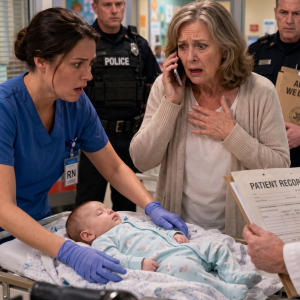
He had been trying to stay near the family he had never been publicly allowed to claim.
I looked at Noah sleeping against my chest.
The birthmark had never been proof that I had betrayed my husband.
It was evidence of a family connection hidden long before I entered their lives.
What Trust Costs
Outside Daniel’s house, Andrew followed me toward the car.
“Come home with me.”
I stopped.
“I’m going back to Megan’s.”
“Claire, we know what happened now. We know Noah is mine. We can fix this.”
I stared at the man I had loved for nine years.
He was the father who taught our daughters to ride bicycles, burned pancakes every Mother’s Day, and once drove three hours through a snowstorm because Lily had forgotten her stuffed rabbit at her grandmother’s house.
He was also the man who had looked at me in the most physically vulnerable hours of my life and decided a birthmark mattered more than my character.
“You still don’t understand.”
His face tightened.
“Then help me understand.”
“The biggest problem isn’t that you were wrong.”
“What is it?”
I shifted Noah higher against my shoulder.
“You needed no evidence to condemn me. But you needed laboratory results to believe me.”
Andrew lowered his eyes.
“I panicked.”
“I was exhausted, frightened, and holding the baby we had waited years for. I was in no condition to defend myself. And instead of asking one question, you walked out.”
“I’m sorry.”
“You told me to leave our home.”
He covered his face briefly.
“I didn’t know what to do.”
“Neither did I. But I stayed with our children.”
That was the sentence that finally quieted him.
Over the next several weeks, Andrew apologized repeatedly.
Not only to me.
He apologized to Noah, although Noah was too young to understand. He apologized to our daughters for disappearing emotionally when they needed him. He apologized to Daniel for reducing years of brotherly loyalty to suspicion.
He also started counseling.
One afternoon, he dismantled the elaborate blue nursery he had created as though having a son were the achievement our family had been waiting for.
Then he bought Ellie a proper new bed.
For years she had slept on the oldest one because Andrew kept saying we should save money for “the boy’s room someday.”
When I saw the new bed, I went into Megan’s kitchen and cried.
Not because Andrew had finally understood.
Because I had.
Our daughters had spent years hearing adults speak as though our family were incomplete until a boy arrived.
I had allowed it too.
I had agreed to another pregnancy even when my heart and body were asking for rest because I had mistaken sacrifice for love.
That realization belonged to me.
The accusation did not.
Three months later, Andrew came to Megan’s house and asked if we could talk.
He brought no flowers.
No jewelry.
No dramatic promises.
He brought his counseling notes and a written parenting plan.
“I’m not asking you to come back today,” he said. “I’m asking whether there’s any possibility at all.”
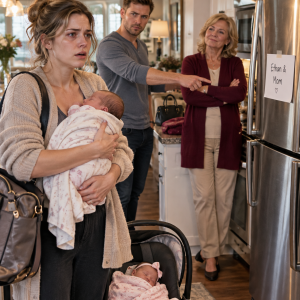
Noah slept in his stroller beside us.
The little crescent was hidden beneath his onesie.
I looked at Andrew for a long moment.
“There is a possibility that you can become the father all five of our children deserve.”
His eyes filled.
“And us?”
I breathed slowly before answering.
“I don’t know.”
He nodded, although I could see how much it hurt.
“I’m not going to promise reconciliation just to make your guilt easier to carry.”
For once, Andrew did not ask me to comfort him.
He simply said,
“I understand.”
And strangely, that was the first moment I believed he might actually be changing.
The Mark We Almost Misread
Life did not return neatly to what it had been.
Maybe that was a good thing.
Andrew became more present with all five children instead of centering everything around the son he had spent years imagining.
Daniel remained part of our lives, though his relationship with Andrew needed time. Some days they seemed like the old friends they had always been. Other days, I could see Andrew studying him with the strange awareness that the man beside him was also his brother.
As for our marriage, I still cannot give people the ending they usually want.
We are not fully reconciled.
We are not enemies.
We are two people trying to understand whether love can survive after trust has been damaged, and whether forgiveness and reunion are necessarily the same thing.
I have learned that they are not.
Sometimes forgiveness means releasing anger.
Sometimes it means allowing someone to grow.
And sometimes it means wishing them well while refusing to return to the version of yourself that accepted too little.
Noah’s crescent-shaped mark is still there.
One day, when he is old enough to ask about it, I will tell him the truth in a way a child can understand.
I will tell him that families carry stories across generations.
Some are beautiful.
Some are complicated.
Some are hidden until the smallest detail finally brings them into the light.
But I will never allow him—or his sisters—to believe that he completed us.
We were already a family before he arrived.
He simply became another person for us to love.
And if there is one thing I hope all five of my children learn from what happened, it is this:
Love should make room for trust.
Love should not require someone to surrender their dignity to prove their loyalty.
And no child should grow up believing that keeping a family together matters more than treating the people inside that family with respect.
My son entered this world with a small mark on his back.
Andrew believed it proved I had betrayed him.
Instead, it uncovered a truth his own family had hidden for decades.
But the most important thing it revealed had nothing to do with genetics.
It showed me how many years I had spent trying to earn my place inside a family I was already helping hold together.
Once I understood that, I stopped measuring love by how much I could endure.
I started measuring it by something much simpler.
Whether the people who claimed to love me were willing to believe me when it mattered most.