That was his answer.
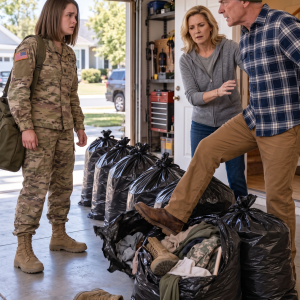
Four days later, Loretta, Tatum and several relatives followed another resident into the building and came to my floor. They pounded on the door while Loretta shouted that I couldn’t keep her son from his own home.
I gave them three minutes to leave.
They refused, so I called building security and then the police when the group still would not go.
When two officers arrived, I provided identification and proof that the condo was mine. The relatives were told to leave the property.
Vance remained in the hallway.
Eventually, after speaking with Thatcher, I allowed him to retrieve his belongings and discuss what would happen next under clear conditions. The remaining $5,000 had to be restored. There would be no more unauthorized guests. There would be no more discussions about changing the deed.
He agreed to all of it.
For several hours, I wondered whether the shock had finally reached him.
Then, shortly after one in the morning, I went into the kitchen for water.
A thick legal envelope was sitting on the counter.
My name was typed across the front.
I opened it.
Inside was a freshly drafted postnuptial agreement.
I read the first page, then the second. Most of the language was dense enough that I knew better than to interpret it alone.
Then I reached the property section.
One clause proposed giving Vance a fifty-percent ownership interest in my condo.
I read it twice.
The condo Loretta had insisted made her son look like a kept man.
The condo Tatum had taken a key to.
The condo they had planned to move into.
The condo Vance had repeatedly told me he didn’t care about.
Suddenly, several earlier conversations meant something different.
The fork had been about hierarchy.
The paycheck demand had been about control.
The key had been about access.
The $10,000 transfer had been about entitlement.
And now there was a legal document sitting on my kitchen counter asking me to make that entitlement permanent.
I photographed every page and sent the file to Thatcher.
His reply came a few minutes later.
“Do not sign anything. Call me in the morning.”
I barely slept.
When Vance came into the kitchen the next morning, his suitcases were waiting beside the front door.
I placed the postnup on the island.
“Before we got married, you told me you wanted nothing from my property.”
He looked at the papers.
“My mom pushed for that.”
“Your mother didn’t bring this into my kitchen.”
“Sloane, listen—”
“Did you intend to sign it?”
He didn’t answer.
That was enough.
“My family is worried you’re going to leave me with nothing,” he finally said.
I almost laughed.
“We’ve been married ten days.”
“Exactly. And you’re already threatening divorce over my sister.”
“I’m considering divorce because you gave your sister access to my home after I said no, transferred ten thousand dollars without telling me, lied when I asked about it, promised her she could move in, and now there’s a document in my kitchen asking for half my condo.”
His eyes filled.
“I love you.”
That was the hardest part.
I believed he probably did.
But I had also learned that love was not the only loyalty governing our marriage. Whenever loving me required disappointing his mother or sister, I was the person expected to bend.
Thatcher filed the paperwork.
The final serious conversation with Vance’s family happened at Loretta’s sixtieth birthday dinner several weeks later. I had no interest in staging a public humiliation, but several relatives had continued insisting that everything could be solved if I agreed to one “reasonable family compromise.”
So I brought a binder.
I let them speak first.
Loretta wanted an apology to Tatum.
Aunt Marilyn suggested that Vance should receive some protection regarding the condo.
Someone else proposed that Tatum repay the remaining money gradually.
When they finished, I opened the binder.
I placed the bank transfer on the table.
Then the access records.
Then the messages about moving Tatum into my guest room.
Finally, I placed the postnuptial agreement in front of Loretta.
Nobody spoke.
I turned to Vance.
“You told me your mother pushed for this. Is that true?”
He looked at Loretta.
She answered for him.
“I told him any intelligent husband should protect himself.”
“From what?”
Her eyes moved toward me.
“From a woman who thinks because she earns more, everything belongs to her.”
I almost admired the clarity of it.
My salary should be shared.
My condo should be shared.
My guest room should be shared.
My savings should be available when Tatum needed them.
But the moment I insisted that my consent mattered, I was selfish.
Thatcher’s proposed settlement papers were the last document I removed from the binder.
Vance would waive any claim against my premarital condo. The remaining joint funds would be divided appropriately after the missing money was restored. Our financial lives would separate cleanly.
Loretta’s face reddened.
“You’re destroying this family.”
I closed the binder.
“No. I’m leaving a marriage that your family treated like an acquisition.”
Vance looked at me.
“Sloane, please don’t do this.”
I slid the postnup toward him.
“You wanted me to sign something that gave you half my home after ten days of marriage.”
Then I placed the divorce papers beside it.
“I’m signing something else.”
There was no applause. No triumphant speech. Nobody suddenly admitted I had been right.
Loretta cried.
Tatum called me vindictive.
Vance followed me into the parking lot and asked whether I could really throw away a marriage over money.
That question told me we were finished more clearly than anything Thatcher could have put into legal language.
“It wasn’t the money,” I said.
He looked exhausted.
“Then what was it?”
I thought about the first Sunday dinner.
About my hand above the crab platter.
About the fork striking my skin.
About Vance leaning toward me afterward, not to ask whether I was hurt, but to make sure I stayed quiet.
“You watched your sister test whether she could disrespect me, and your first instinct was to manage my reaction. Everything after that was the same choice with higher stakes.”
He didn’t answer.
The divorce moved quickly because there wasn’t much to untangle. The condo had been mine before the marriage. The disputed joint-account money was restored, and we separated what remained.
On Vance’s final moving day, he carried boxes into the elevator and returned his building access fob to the concierge.
Before the doors closed, he looked at me.
“I still don’t understand how ten days became enough for you.”
I considered explaining it again.
Instead, I said, “That’s exactly why ten days was enough.”
The doors closed.
Months later, I finally changed the guest room.
For weeks I had avoided it because I kept remembering Tatum standing in my lobby with suitcases, already speaking as though the room belonged to her.
Eventually, I moved the bed into storage and turned the space into a small home gym. I put a stationary bike near the windows, rolled out a yoga mat and moved a narrow bookshelf against the wall.
While cleaning the desk drawer, I found something small and silver.
A seafood fork.
It wasn’t the one Tatum had used. It was part of my own flatware set, something I had bought years earlier and forgotten I owned.
I held it for a moment.
Five months earlier, the sight of it would have taken me straight back to Loretta’s dining room—to the red mark on my hand and my husband’s whispered request that I not make a scene.
This time, I carried it into the kitchen and put it where it belonged.
That evening I made seafood for myself.
When I sat down by the window, there was no family hierarchy deciding who ate first, no missing key fob in the bowl by the door, and no legal envelope waiting on the counter.
My condo was quiet.
The guest room was mine again.
And when I reached for the first crab leg, nobody stopped my hand.