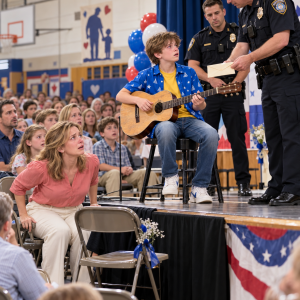
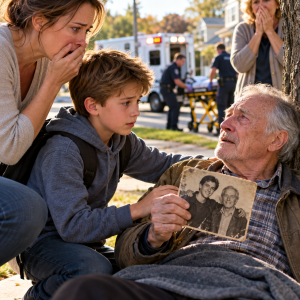
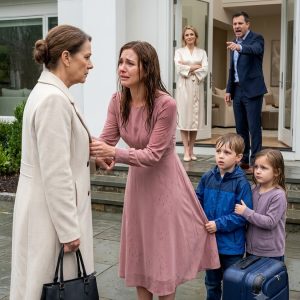
“You’re right. But I can show you who I intend to be from this day forward.”
He did not embrace me, and I did not ask him to.
Before I left, however, he agreed that I could call the following week.
It was a small beginning, but after nearly four decades of not knowing him, it felt extraordinary.
Part Three: The Other Family Margaret Protected

Two days later, I visited the bank mentioned in Margaret’s letter, expecting to learn only about the investment account she had established for Christopher.
Instead, the bank’s estate representative explained that the account belonged to a trust with two beneficiaries.
Christopher was one.
The other was a woman named Hannah Whitmore.
I had never heard of her.
An accompanying letter directed me to a modest house fifteen miles from my own, where a woman in her early forties answered the door and greeted me as though she had been expecting me.
Hannah explained that Margaret had been her aunt.
My wife, who had always told me she was an only child, had actually grown up with an older brother named Peter.
After a painful disagreement with their parents, Peter had left home, and the family gradually stopped speaking about him.
Years later, Margaret found him struggling to support his young daughter, and she quietly began helping with rent, groceries, and school expenses.
When Peter’s health failed, Margaret arranged for Hannah to be raised by a kind couple who managed a neighborhood community center.
I remembered attending a Christmas fundraiser at that center many years earlier, where a little girl had played piano while Margaret stood beside me, smiling proudly.
“That was you?” I asked.
Hannah nodded.
“She wanted you to know me, but she was afraid that explaining our family would lead you back to Rebecca and Christopher.”
For the first time, I began to understand how thoroughly Margaret’s earliest deception had shaped everything that followed.
She had loved Hannah, supported her education, and remained a steady presence throughout her adulthood, yet had never allowed me to know that part of her life.
Before I left, Hannah handed me another envelope.
It was addressed to Christopher.
Inside were photographs of a young girl and a letter explaining that he had a daughter from a college relationship, someone he had never known existed.
Her name was Natalie.
Christopher recognized the girl’s mother immediately when I showed him the pictures.
His former girlfriend, Allison, had left college unexpectedly during their senior year, after receiving a message that their relationship was over.
He had believed she sent it.
According to Margaret’s research, Allison’s wealthy mother had interfered, convinced that Christopher was unsuitable for her daughter.
Years afterward, Margaret had encountered the family through a charitable organization and discovered the truth.
She had hesitated to interfere, first because of pressure from Allison’s mother and later because Allison herself begged for more time.
Once again, years passed.
Christopher and I traveled together to meet Natalie, now a twenty-eight-year-old elementary school teacher living in Connecticut.
At first, she refused to believe his explanation, having grown up with the understanding that her biological father knew about her but wanted no involvement.
Then she read the letter.
I watched my son sit beside his daughter on a bench outside her school, patiently answering questions that neither of them should have needed to ask.
Eventually, Natalie reached for his hand.
I stood several yards away, understanding that their relationship would require time, patience, and more than a single emotional conversation.
But when Christopher turned toward me afterward, his eyes were filled with tears.
“I think I’m beginning to understand how you felt when you found me.”
I placed a hand on his shoulder.
“I wish neither of us had needed to learn it this way.”
Part Four: The House Full of Letters
The following week, Hannah told us about a small cottage Margaret had inherited from her brother, a property hidden among maple trees in the Pennsylvania countryside.
She had used it for years to store family papers, photographs, and belongings she could never quite bring herself to discard.
Christopher, Rebecca, Hannah, and I drove there together.
Inside, we discovered carefully labeled boxes containing letters, photographs, financial records, and birthday cards addressed to people who had never received them.
There were letters for Christopher, for Natalie, for Hannah, and even for Rebecca.
In one cabinet, we found a digital recorder bearing a handwritten note asking Christopher and me to listen together.
Margaret’s familiar voice filled the quiet room.
She explained that she had spent years trying to protect people from consequences she herself had helped create, confusing secrecy with kindness until she could no longer recognize the difference.
She had saved money for Christopher, supported Hannah, and quietly intervened when Allison’s mother threatened Christopher’s early career, using evidence of financial misconduct that Peter had discovered years earlier.
But she admitted that none of those efforts justified withholding the truth.
“I kept telling myself I was waiting for the right moment,” she said. “What I was really waiting for was a moment when telling the truth would no longer frighten me.”
Among the documents, we discovered that Margaret had established a substantial charitable fund and transferred the cottage into a trust intended to support families separated by adoption, estrangement, and long-hidden family circumstances.
She hoped it might become a place where difficult conversations could happen before years were lost.
Hannah began crying as she examined the plans.
Christopher sat quietly beside the window.
Neither of us knew whether forgiveness was possible yet, but we understood that Margaret had spent her final months trying, however imperfectly, to leave something useful behind.
Then I opened the last envelope.
Inside was a photograph of my mother.
My mother, whom I had believed was gone for forty-one years.
Beneath the photograph was an address in coastal Maine.
And a note from Margaret.
“Nathan, there is someone else waiting for you.”
Part Five: The Mother I Thought I Had Lost
I was nineteen when my father told me that my mother had been involved in a serious highway accident and would never come home.
I remembered the memorial service, the closed casket, and the unbearable quiet afterward, but I had never imagined there could be another explanation.
Christopher insisted on accompanying me to Maine.
We found my mother in a small assisted-living residence overlooking the Atlantic, sitting beside a sunlit window with a book resting on her knees.
She was eighty-nine, with white hair and delicate hands, but when she looked up and spoke my name, I recognized her voice immediately.
“Nathan? My beautiful boy?”
I crossed the room and held her, unable to understand how forty-one years could disappear and remain painfully present at the same time.
Eventually, she explained that my father had been deeply controlling, managing her money, isolating her from friends, and threatening to keep us apart whenever she tried to leave.
When she finally escaped the marriage, he intercepted her letters and convinced me she was no longer living.
She had attempted to contact me repeatedly, but every effort failed.
Twenty-two years earlier, after my father’s passing, Margaret discovered some of those letters among his belongings and tracked my mother down.
She wanted to tell me immediately, but my mother, learning that I was struggling through a difficult period in my business and marriage, asked her to wait.
The delay became another year, then another, until both women had grown afraid of what their silence would mean.
“I thought I was protecting you,” my mother whispered.