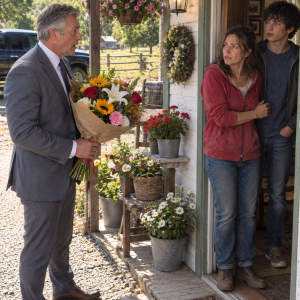
“Yes,” she replied.
Her answer was not an invitation to return to her life. It was simply the truth.
I began to cry. Claire did not reach for me, but she did not leave either.
“He will need more than your name,” she said.
“I know.”
“He will need you to show up when there isn’t an emergency. You can’t buy your way into his life, decide what’s best without listening to me, or disappear when it becomes difficult.”
“I understand.”
She held my gaze.
“You promised me once that you would listen. You promised that you trusted me. Then you left. What makes this different?”
“Nothing I can say today,” I answered. “Only time and consistency.”
Claire studied me for a long moment.
“Then we’ll see.”
Showing Up
Noah grew stronger over the next several weeks. His oxygen support was reduced, then removed. He moved from the incubator to an open bassinet, and eventually he was able to breathe without assistance.
I came to the hospital each morning before work. I learned how to hold him without feeling that I might break him. I learned which lullaby settled him and how to change his diaper without turning the process into a small emergency. I kept notes during the doctors’ rounds because I was afraid I would miss something important.
Claire watched me carefully. She did not reward me for arriving on time or praise me for doing what a father should do. Her caution was fair. I had to earn the right to be trusted through ordinary, repeated actions.
The investigation continued. Records from my father’s archive supported the board’s findings: Dr. Weller, who had overseen part of the study, had changed how data was reviewed and pressured members of the research team to downplay the inherited risk. My father had not created the false records, but he had delayed reporting the problem and allowed the company’s reputation to matter more than the patients who depended on honest research.
He resigned from Calloway Biotech and accepted responsibility for the company’s failure to report the concerns promptly. The company survived, but only after the board created an independent ethics council, a patient compensation fund, and a clear separation between research oversight and executive leadership.
I sold the family’s private jet and several estates to help fund the first restitution program. My father objected at first, then signed the documents.
During one of my visits, he asked whether I hated him.
“I hate what you chose,” I said. “But I don’t want to spend my life knowing only how to punish people.”
He looked away.
“I don’t know how to be your father without trying to control you.”
“Then learn.”
It was the first thing I had ever asked of him that he could not solve with money. He began counseling and agreed to meet with patients through their advocates, even when they did not want to see him. He learned to accept that they owed him nothing.
Claire returned to medicine six months later. She declined a position with Calloway Biotech, even after the new ethics council invited her to lead an independent research group. Instead, she joined a university hospital and continued studying inherited heart conditions with support from a patient advocacy foundation.
Nolan remained her colleague and became one of Noah’s godfathers. When I finally met him properly, he offered his hand.
“I never wanted to be part of your history,” he said.
“You were part of my misunderstanding,” I answered.
He smiled. “That sounds worse.”
“It was.”
We shook hands, and, at last, I stopped treating him as the explanation for choices I had made myself.
Co-parenting was not easy just because the test had settled the question of Noah’s paternity. Claire and I disagreed about schedules, medical specialists, travel, and how much help to accept from our families. Once, I arranged a consultation with a specialist without telling her. Claire canceled it.
I was angry until I understood that she was right. I had made a decision that belonged to both parents, then expected her to be grateful because I believed I was helping.
I apologized without offering excuses. Over time, I made fewer mistakes because I finally began asking before acting.
The Life We Chose

Noah became a sturdy, curious toddler with a fascination for water. Bath time delighted him, and he reached for every cup, towel, and faucet he could find.
On his first birthday, Claire held a small gathering near Lake Michigan. There were no photographers or company executives, only a few friends and family members: Nolan, Vivian, Claire’s parents, Martin, and me. My father did not come, but he sent a wooden toy he had carved himself. Noah ignored it and tried to chew the wrapping paper, which made everyone laugh.
I stood beside Claire near the water while our son took a few unsteady steps between us.
“I never thought we would get here,” I said.
“Neither did I.”
“Are you happy?”
Claire watched Noah toddle toward the lake path, where one of us could easily catch him.
“Yes. I’m happy with my life.”
I looked at her. “And with me?”
She turned back toward me.
“I’m learning to be.”
That answer was not the promise I once would have demanded. It was better because it was honest. I reached for her hand, and she let me take it.
A year later, I asked Claire to marry me in our kitchen. Noah was asleep upstairs after protesting bedtime longer than either of us had expected. I placed a simple ring on the table between us.
Claire studied it.
“If you’re asking because marriage will prove you repaired everything, the answer is no.”
“I’m not.”
“If you’re asking because our families would find it convenient, the answer is also no.”
“I know.”
“If you’re afraid I might leave, then no.”
“I’m asking because I love you.”
She looked down at the ring.
“I loved you once.”
“I know.”
“I don’t know whether I can become the woman who loved you before.”
“I’m not asking you to become her. I’m asking for a chance to build something with the woman you are now.”
Claire’s eyes filled, and she let out a quiet laugh.
“I need time.”
“I can give you that.”
Three months later, she said yes.
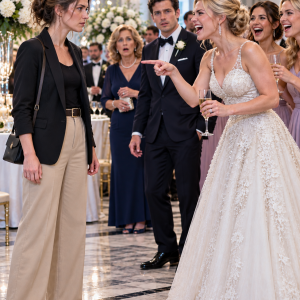
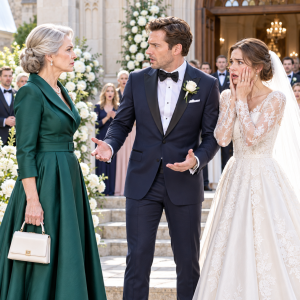
We married beside the lake on a cool spring morning. The ceremony was small enough that we could hear the wind through the trees. Vivian sat in the front row with her new partner. Martin stood near my father, who had come quietly and remained toward the back. Claire’s parents held hands, and Nolan carried the flowers.
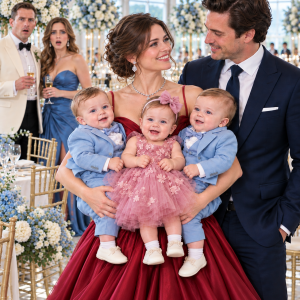
Noah wore a tiny blue suit and was carried between us by his grandfather. When Claire reached me, she looked only at me.
“I choose you,” she said. “Not your name.”
“I know.”
“Not your money.”
“I know.”
“Not because you’re Noah’s father.”
“I know.”
She placed her hand in mine.
“Because you finally learned that love is not something you own.”
My throat tightened.
“And I choose you because you taught me that trust isn’t earned by promises.”
“What is it earned by?”
“Showing up.”
Claire smiled. “Then keep showing up.”
“I will.”
Noah reached for both of us, and we bent to lift him between us.
The past did not vanish. It remained part of our story, a reminder of how easily fear and silence can separate people who love one another. But it no longer decided what our future would be.
I had once believed money and influence could protect me from betrayal. I learned instead that a second chance cannot be purchased, and trust cannot be demanded. It can only be rebuilt, patiently, through the ordinary days when no one is watching—and by showing up again and again.