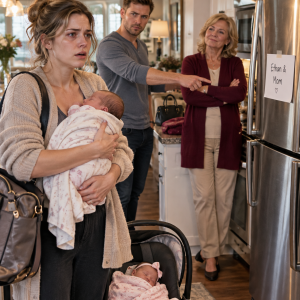
“Yes, you are.”
“Then act like my son.”
I looked at Sophie, who was still leaning against Hannah.
“I am also her father, and I am Hannah’s husband.”
My mother waited, perhaps expecting the old guilt to take hold and correct my behavior for her. It did rise in me, because lifelong habits rarely disappear in one clean moment, but this time I did not mistake guilt for guidance.
Lorraine went to the guest room and packed a suitcase while I remained with my wife and daughter. I did not want Sophie standing near the door, listening for footsteps and wondering what might happen next.
In fragments, Hannah told me how the situation had developed. Lorraine had begun with comments about meals and housekeeping, then introduced schedules and rules for Sophie. When Hannah disagreed, my mother reminded her that I worked too hard to be bothered by complaints. Eventually, she began controlling purchases, transportation, and even when Hannah could visit friends.
Each time my wife tried to tell me something was wrong, I had answered that Mom was adjusting, that she meant well, or that the two of them simply needed more time.
My mother’s greatest advantage had not been her forceful personality.
It had been my refusal to listen.
“I’m sorry,” I told Hannah.
She looked down at the keys in her hand.
“I don’t need one apology, Ethan.”
The truth of that statement hurt, but I had no right to defend myself from it.
“Then tell me what you need now.”
“When Sophie or I tell you something is wrong, believe us before you see proof with your own eyes.”
“I will.”
“And do not make decisions about your mother without talking to me, even if she apologizes later.”
“Especially if she apologizes later.”
The Family I Had Nearly Failed
When Lorraine emerged with her suitcase, she told me that Hannah was separating me from my family. Sophie heard her and raised her head.
“Mommy is family too.”
My mother looked at her but offered no answer.
I opened the front door. I did not insult Lorraine or demand that she admit what she had done. I simply watched her carry her own suitcase across the threshold. For the first time in months, our doorway stood open without her deciding who had permission to pass through it.
The house did not become peaceful immediately. It felt unfamiliar, as though the rooms themselves were waiting to learn what kind of home they would become.
Sophie repeatedly asked whether her grandmother was coming back. Hannah checked the locks before bed and carried her recovered keys from room to room. I canceled several work trips, rearranged the rest, and began doing what I should have done long before that afternoon: listening without interrupting, asking questions before offering explanations, and resisting the impulse to defend my mother whenever Hannah described something uncomfortable.
I eventually spoke with Lorraine, though not that night. She remained convinced that she had merely taught order and responsibility and that Hannah had humiliated her in front of her friends. She refused to describe her behavior as control, but I stopped arguing over vocabulary. What mattered was that it could no longer continue beneath our roof.
I explained that any future contact with Sophie would require agreement from both Hannah and me, and, most importantly, that our daughter would need to feel safe. My mother became angry, attempted to negotiate, and then stopped calling for several weeks.
That silence was painful, but pain did not automatically mean the boundary was wrong.
Hannah’s habits changed slowly. One afternoon, several weeks later, she left her keys on the kitchen table while she took a shower. When she returned and found them exactly where she had placed them, she stood looking at them for a long moment.
Neither of us spoke. Some victories were too delicate to announce.
Sophie’s hands improved much sooner than the fear behind one question she had begun asking. Whenever she wanted a snack, she would stand near the kitchen doorway and say:
“Am I allowed to have something now?”
Hannah and I always gave her the same answer.
“You never have to earn your food, sweetheart.”
At first, she seemed uncertain. Then she began opening the refrigerator without asking, and eventually the question disappeared altogether.
The Drawer We Never Locked Again

Several months later, the three of us decided to empty the walnut cabinet. Hannah opened the same drawer my mother had kept locked, but nothing important remained inside. Her debit card was back in her wallet, her keys hung on a hook beside the front door, and the small brass key Lorraine had carried lay alone at the bottom.
Sophie appeared with a box of crayons, a notebook, and several folded pictures.
“Can I keep my things in here?”
Hannah looked at me, then knelt beside our daughter.
“It’s your home too.”
Sophie arranged her crayons inside the drawer and placed a drawing on top. It showed three figures holding hands beneath a wide yellow sun, all of them standing in front of a house with an enormous blue door.
She pushed the drawer closed but did not lock it.
A moment later, Hannah called from the kitchen to say she had sliced watermelon, and Sophie hurried away, leaving the cabinet behind her without a second glance.
No one stopped her.
No one asked what she had done to deserve the food.
And the little brass key remained where it belonged—unused, unnecessary, and slowly forgotten inside a home that was finally learning the difference between obedience and love.