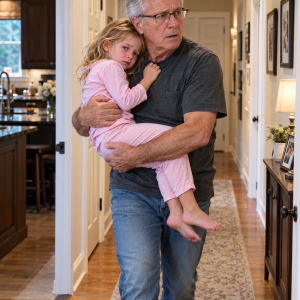
“I want to tell her I’m sorry.”
“She is four. That apology would comfort you, not her.”
He lowered his voice.
“I can learn to be her father.”
“What medicine is she allergic to?”
He did not know.
“Who is her pediatrician?”
He did not know.
“What comforts her during storms?”
Again, silence.
“You had years to learn,” I said. “You were in the house, but you looked through her.”
Rosie appeared behind me holding her rabbit by one ear.
“Mommy, who is that man?”
Blake closed his eyes.
“That is your father.”
She studied him.
“Is he staying?”
“No.”
“Okay.”
She returned to her book.
Blake leaned against the hallway wall.
“Will she hate me?”
“No. She may simply grow up without knowing you. That is what your choices created.”
What We Built Afterward

Vale Specialty entered court-supervised restructuring the following month. Alden Health acquired the essential distribution systems, protected medicine deliveries, and offered jobs to employees who had acted honestly.
At the custody hearing, Blake admitted that he had redirected Rosie’s Aurelin because he wanted to punish me. The judge ordered supervised visits. He attended once; Rosie spent most of the appointment behind the social worker’s chair, and he never scheduled another.
Our divorce was finalized in December. The audit confirmed that Blake had moved millions to Tessa, while I received primary custody and full medical decision-making authority.
I returned to Alden Health as executive chair but kept one day each week at the children’s hospital. We created Harbor Medical Access, where every scarce treatment passed through an independent clinical committee and no executive could favor a friend or relative.
Blake’s unfinished research campus became a cleanup project after inspectors found serious contamination hidden by contractors. Once the land was restored, Alden donated part of it for a pediatric recovery center.
His empire did not disappear. We turned everything useful inside it into something safer.
On Rosie’s fifth birthday, yellow ribbons moved beneath the maple trees, children raced across the lawn, and a cake shaped like her rabbit, Button, waited beneath five candles.
That evening, Rosie climbed into my lap with a card Blake had mailed. A yellow sun was printed above a cartoon rabbit. Inside, he had written that he was sorry he had not known her when he had the chance.
“What does it say?” she asked.
I read it exactly.
She thought for a while.
“Do I have to forgive him?”
“No.”
“Can I forgive him later?”
“Yes.”
“Can I decide not to?”
“Yes.”
She leaned against me.
“Then I’ll decide when I’m bigger.”
A year later, Rosie stood beneath a golden tree at the opening of the pediatric recovery center. Her health had returned, and she filled every quiet room with questions.
After the ceremony, Martin handed me a letter from Blake. He wrote that he now worked at a medical warehouse receiving Harbor shipments and finally understood that medicine belonged not to the person controlling the contract, but to the patient who needed it. He asked for no answer, no visit, and no forgiveness. He wrote only that he hoped Rosie still liked yellow.
“Is it from Daddy?” Rosie asked.
“Yes.”
“What did he say?”
“That he hopes you’re happy.”
She smiled.
“I am.”
That winter evening, snow settled across our yard while Rosie pressed her face to the window and noticed a small nest resting in the bare branches.
“Will the birds leave?”
“In the spring.”
“Will they come back?”
“They might.”
She turned toward me.
“We’re coming back, right?”
“We’re not going anywhere.”
I turned on her yellow night-light, placed Button beside her pillow, and tucked the blanket beneath her chin. She held out her little finger.
“Promise?”
I linked mine with hers.
“Promise.”
For years, I had confused endurance with love. I had believed preserving the appearance of a family mattered more than asking whether the people inside it felt secure.
Rosie taught me otherwise.
A family was not an impressive name, a grand house, or a man standing at the head of a table. It was the hand that stayed beside a hospital bed, the voice that answered in the middle of the night, and the person who never asked a child to compete for the right to be loved.
Outside, the branches bent beneath the snow, but they held.
So had we.