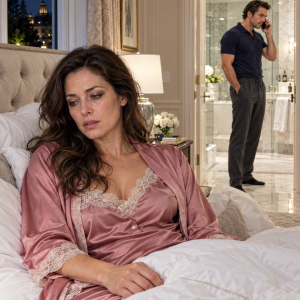
Rose read it once.
Then she drove to the office of Camille Hart, an estate attorney Samuel had trusted for twenty years.
Camille placed the letter on her desk.
“This is intimidation.”
“Can he win?”
“No.”
“Can he delay the sale?”
“He can try.”
Camille opened a file.
The deed was solely in Rose’s name.
The renovation receipts had been paid from Rose’s account.
Michael had no lease granting equity.
No written promise of ownership.
No partnership agreement.
Nothing.
Camille tapped the audio transcript.
“And this establishes that he recognized your right to leave.”
Rose exhaled.
“Then proceed.”
That afternoon, she signed three documents.
The first revised her will.
Michael would receive no direct inheritance.
The second created protected trusts for Sophie and Noah, with an independent trustee controlling every distribution.
The third established the Samuel Bennett Memorial Scholarship for students entering skilled trades at a local community college.
Samuel had been an electrician.
He had spent his life telling young people that dignity did not require a corner office.
Rose placed the pen down.
“He wanted Michael to stand on his own.”
Camille closed the folder.
“Maybe this is the first time he’ll have to.”
The Day the House Was Sold
The Richmond house sold in forty-seven days.
A retired couple from Maryland made a full-price offer.
Michael refused to leave after the formal notice expired.
Camille filed in county court.
At the hearing, Michael sat beside his attorney in a navy suit he could no longer afford to dry-clean.
Lauren sat behind him, arms crossed.
Rose remained at the opposite table.
The judge reviewed the deed, bank records, written notice, and recording.
Michael’s attorney stood.
“My client believed the home would eventually become his.”
The judge looked over his glasses.
“Belief is not ownership.”
“He invested years of labor into the property.”
Camille slid forward the receipts.
“Every material and contractor was paid by Mrs. Bennett.”
The judge turned to Michael.
“Did your mother ever sign over any portion of this house?”
Michael looked down.
“No.”
“Did she ever execute a written promise to do so?”
“No.”
The ruling took less than ten minutes.
Rose had the right to possession.
Michael and Lauren had fourteen days to leave.
Outside the courtroom, Lauren grabbed Michael’s arm.
“You said she’d never go through with it.”
“Not here.”
“Where exactly should we have this conversation? We don’t have a house.”
Rose heard every word.
She kept walking.
Everything He Thought Was His Disappeared
Without Rose’s money, Michael’s business collapsed quickly.
The company had been surviving on loans she believed were temporary.
Suppliers stopped extending credit.
Two commercial clients canceled contracts after learning materials had not been ordered.
The landlord locked the warehouse.
Michael sold his truck, then his boat, then the expensive watches Lauren had given him.
It still was not enough.
Lauren moved with the children into her parents’ basement.
Michael rented a room above a mechanic’s shop and took a sales job at a building-supply store.
His marriage began breaking under the weight of blame.
Lauren accused him of lying about the business.
Michael accused her of turning Christmas dinner into a public spectacle.
Their arguments became so loud that Sophie began wearing headphones at the dinner table.
Rose saw the children every Saturday.
She never criticized their parents.
She took them to the library, baked Samuel’s cinnamon bread, and reminded them that adult problems were not theirs to carry.
One afternoon, Sophie sat on the cottage steps beside her.
“Dad says you destroyed everything.”
Rose’s hands paused over a flowerpot.
“What do you think?”
Sophie stared at the river.
“I think he thought you would always fix it.”
Rose swallowed.
The child was only twelve.
Yet she had seen what every adult had ignored.
“I love your father,” Rose said. “But loving someone does not mean protecting them from every consequence.”
Sophie leaned against her shoulder.
“Do you still love him now?”
Rose looked at the winter-bare trees.
“Especially now.”
The First Apology Without a Demand
Seven months passed.
Then, one rainy evening, someone knocked on Rose’s door.
Michael stood on the porch in a store uniform.
No attorney.
No threats.
No polished speech.
His shoulders looked smaller.
Rose opened the screen door but said nothing.
Michael held out a paper bag.
“Cinnamon rolls.”
Rose glanced inside.
They were slightly burned.
Samuel used to burn them the same way.
“Did you make these?”
“I tried.”
She stepped aside.
Michael entered carefully, as though the house might reject him.
He sat at the kitchen table.
For a long moment, neither spoke.
Then he pressed both hands against his face.
“I kept thinking you would give in.”
Rose waited.
“I thought the house was basically mine. The business too. The tuition. All of it.”
His voice broke.
“I told myself you wanted to help. That it made you feel needed.”
Rose’s eyes remained steady.
“And when I stopped?”
Michael looked up.
“I called you cruel because it was easier than admitting I was terrified.”
Rain moved across the windows.
“I treated your sacrifice like a contract,” he whispered. “Then I humiliated you when you stopped signing it.”
Rose felt pain move through her chest, slow and deep.
Not because the apology erased anything.
Because, for the first time, it asked for nothing.
Michael pulled an envelope from his jacket.
Inside was a repayment plan.
Small monthly amounts.
Almost painfully small.
“I know I can’t repay everything.”
“You can’t.”
He nodded.
“But I want to start.”
Rose pushed the envelope back.
“Pay your children’s expenses. Pay your debts. Build a life you can support.”
His eyes filled.
“Do I get another chance with you?”
Rose looked at him for a long time.
“A chance is not the same as forgiveness.”
“I know.”
“And forgiveness is not the same as access.”
He nodded again.
“I know.”
Rose cut one of the cinnamon rolls in half.
“Then we can begin with coffee.”
The Thanksgiving Table
The following November, Rose hosted Thanksgiving at the cottage.
Not twenty-two people.
Only twelve.
Sophie and Noah set the table.
Lauren came separately from Michael. Their marriage had not survived, but both were learning to speak without using the children as weapons.
Michael arrived carrying Samuel’s old wooden toolbox.
He had restored it by hand.
Before dinner, he stood beside the fireplace.
His fingers tightened around the handle.
“I need to say something.”
The room quieted.
Michael looked at Rose.
“Last Christmas, I told my mother to pay rent in a house she owned or leave.”
No one moved.
“For six years, she carried my family while I pretended I was carrying myself.”
His voice shook.
“When she stopped, I lied about her. I called the police. I posted things online. I tried to use a lawyer to force her to keep rescuing me.”
Sophie reached for Noah’s hand.
Michael swallowed.
“I was not betrayed by my mother. I was exposed by my own choices.”
Rose looked down at Samuel’s toolbox.
The same one he had used to teach Michael how to replace a fuse when he was ten.
Michael placed it beside her chair.
“I’m sorry, Mom.”
Rose touched the worn wooden handle.
“Thank you for saying it where everyone can hear.”
Dinner began.
No one asked Rose to pay for anything.
No one spoke over her.
When the meal ended, Michael stayed to wash the dishes.
Rose watched him stand at the sink while Sophie dried the plates beside him.
The cottage was smaller than the old house.
The table was cheaper.
The chairs did not match.
But for the first time in years, Rose did not feel like a guest inside her own life.
She had once believed a good mother gave until nothing remained.
Now she understood something Samuel had tried to teach them both:
Sometimes the most loving thing a mother can give her child is the boundary that finally forces him to grow.