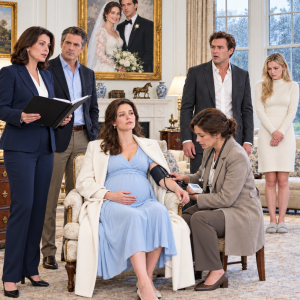
Patricia looked furious.
“You’re going to involve lawyers because of a family disagreement?”
Allison answered before I could.
“The child’s well-being is the priority. Mrs. Whitfield is entitled to seek legal guidance and protection for her daughter.”
Brooke began insisting that she had done nothing seriously wrong.
But the photographs of Maisie’s cheek, the statements from those present, and the report I had arranged to make that evening would allow the incident to be reviewed properly.
Walter, who had remained quiet, finally approached me.
“Rebecca, surely there’s a way to settle this privately.”
I looked at him with genuine sadness.
“Walter, I tried to settle things privately for years. Every time I spoke up, I was told to be quiet for the sake of the family.”
He had no answer.
Andrew stepped closer.
“Can I at least talk to Maisie?”
I glanced toward Natalie, who was sitting with my daughter near the lobby windows.
“Not tonight. She’s tired and frightened. We can discuss what happens next through Allison.”
Andrew rubbed his forehead.
“I never wanted any of this.”
I nodded.
“Neither did I.”
When the last box was loaded, I took Maisie’s hand and walked toward the waiting car.
I didn’t turn around.
There was nothing left to explain.
Six Months Later, Everything Was Different
Spring arrived in Chicago with bright mornings and cool breezes from Lake Michigan.
By then, Maisie and I had settled into a comfortable new apartment with wide windows and a little balcony where we planted flowers together.
It wasn’t as grand as our former condominium.
But it felt peaceful.
There were no uncomfortable family dinners, no arguments about whether my daughter was behaving perfectly, and no relatives waiting to criticize every decision I made.
The divorce proceedings had been difficult.
Andrew initially challenged the property arrangements, but the records of my premarital purchase and the family trust supported my position regarding ownership.
Our attorneys eventually reached a settlement.
The court granted me sole legal and physical custody of Maisie, with Andrew permitted supervised visits under the agreed arrangements.
He attended some of those visits, although his relationship with our daughter remained distant.
The consequences for his family extended beyond our marriage.
During the separation, Andrew’s employer reviewed irregularities involving his company expense account. He eventually resigned from his position.
Patricia’s social circle became uncomfortable with the attention surrounding the Christmas incident, and she gradually withdrew from several organizations she once considered essential to her status.
Brooke moved to Arizona, hoping for a fresh start while the matter involving Maisie continued through the appropriate process.
Walter retired from his consulting work earlier than planned.
I didn’t celebrate any of those changes.
I had spent enough years allowing the Whitfields to occupy my thoughts.
What mattered most was the little girl sitting at our kitchen table, coloring a picture of a house surrounded by flowers.
The Little Girl Who Learned to Smile Again
One Saturday morning, I was preparing breakfast when Maisie came into the kitchen carrying her drawing.
“Mommy, look! I made our house.”
I studied the picture.
Two smiling figures stood beneath a bright yellow sun.
There was a large tree, a blue front door, and a small dog, even though we didn’t own one.
“It’s beautiful, sweetheart. Who’s the puppy?”
She giggled.
“That’s the dog we’re getting someday.”
I laughed.
“We’ll have to discuss that with the landlord.”
She climbed onto a stool beside me.
After a moment, she asked, “Mommy, can we make turkey for dinner tonight?”
I paused.
It was the first time she had mentioned turkey since Christmas.
“Of course. Would you like to help?”
She nodded enthusiastically.
Then she added, “Can we make mine without the crispy skin?”
I smiled.
“Absolutely. You can have it exactly the way you like.”
She looked relieved.
“And nobody will be mad?”
I crouched beside her and took her hands.
“No, sweetheart. You are allowed to have preferences. You are allowed to ask questions. And you never have to be afraid to speak kindly and honestly in your own home.”
Maisie wrapped her arms around my neck.
“I like our new home, Mommy.”
I held her close.
“So do I, baby.”
That afternoon, an email arrived from my company confirming my promotion to senior vice president.
Natalie called moments later to congratulate me.
“You did it, Rebecca! I knew you would.”
I looked through the window at the sunlight reflecting across the lake.
For years, I had measured my success by how well I could keep everyone else happy.
Now I understood something different.
A beautiful home means very little when the people inside it don’t feel safe or respected.
A respected family name means nothing when kindness is missing.
And a marriage cannot survive on one person’s willingness to remain silent.
That Christmas Eve had been one of the hardest nights of my life.
But it had also been the night I finally stopped confusing patience with acceptance.
I hadn’t left because I wanted to punish Andrew or his family.
I left because my daughter deserved to grow up knowing that her feelings mattered.
As Maisie ran through our living room, laughing at something she had seen in her picture book, I realized that the greatest thing I had given her wasn’t an expensive home, a private education, or a comfortable lifestyle.
It was the freedom to be herself.
And that was something no amount of money could replace.
A Message to Every Parent and Every Family
A child should never have to become quiet, frightened, or unusually careful simply to avoid upsetting the adults around them, because a loving family should be the place where children feel safest expressing themselves.
Sometimes the most painful disappointment comes not from the person who behaves unkindly, but from the person we trusted to stand beside us who chooses to remain silent when support matters most.
Keeping peace within a family can be meaningful, but when that peace depends on one person constantly accepting disrespect, it is no longer genuine harmony but an unfair burden disguised as tradition.
A beautiful house, expensive furniture, and a respected family name may impress strangers, but none of those things can replace the warmth, patience, and kindness that make a home worth returning to.
Parents teach their children important lessons not only through the advice they give, but also through the behavior they accept, the boundaries they establish, and the courage they show when difficult decisions must be made.
Financial independence is not simply about earning money or owning property; it can also provide the freedom to make thoughtful decisions without being controlled by people who mistake generosity for weakness.
No child should ever believe that asking a respectful question, expressing a preference, or making an innocent mistake means they deserve humiliation, because their dignity matters just as much as an adult’s.
Walking away from a painful situation does not always mean giving up on a family; sometimes it means choosing a healthier future and refusing to allow old patterns to shape another generation.
The people who truly love us will not demand that we abandon our self-respect to earn their approval, because real affection makes room for boundaries, honest conversations, and mutual understanding.
In the end, the greatest gift we can give our children is not a perfect childhood without disappointment, but the lasting confidence that they are loved, their voices matter, and they will never have to face life’s hardest moments completely alone.