His expression became unreadable.
My mother stepped toward him.
“Owen, I’m your grandmother.”
He remained where he was.
“Dorothy Bell was my grandmother.”
My mother froze.
“Biologically, I mean.”
Owen nodded.
“Biology isn’t the part I’m confused about.”
They Thought Their Name Could Buy Him
My father changed tactics.
He had spent decades running a medical investment company and knew how to make everything sound like a business opportunity.
“You are building an impressive career,” he told Owen. “Our family has relationships with research institutions, foundations, and private hospitals across the country. There are opportunities we could create for you.”
Owen stared at him.
“Why?”
My father seemed surprised.
“Because you are family.”
“Was I family when my mother was seventeen?”
Silence.
My mother stepped closer.
“Your mother has given you only one side of a painful situation.”
Owen looked at me briefly.
Then back at her.
“She gave me twenty-one years. You gave me twenty-one minutes and already started criticizing her.”
My father finally lost his patience.
“Young man, you should think carefully before rejecting what the Langford name can provide.”
Owen gave a tired smile.
“My mother worked double shifts while taking night classes. Dorothy sold her car to help with my first semester of college. Grant taught me that showing up matters more than making speeches. I think I’ve already received what I needed.”
My mother reached toward him.
Owen gently stepped back.
“Please don’t.”
That was when I asked hospital staff to end the visit.
As they walked away, my father turned.
“This isn’t finished.”
He was right.
But not in the way he expected.
The Story They Told Everyone
Two days later, my parents gave an interview.
They described themselves as aging grandparents desperate to reconnect with a grandson they claimed had been kept away from them.
My mother admitted to having made “mistakes.”
But she carefully avoided explaining what those mistakes actually were.
My father said they wanted reconciliation.
That evening, Grant sat at our kitchen table reviewing old documents.
He had been an attorney for nearly twenty-five years.
“They’re preparing something,” he said.
Owen looked up from his laptop.
“What can they possibly demand? I’m an adult.”
“Probably nothing meaningful regarding you directly. But this may be about reputation as much as law.”
Then Grant opened an old storage box Dorothy had left me.
Inside was a folder I had not touched in years.
Dorothy had kept everything.
Court records.
Guardianship documents.
Signed statements.
Correspondence from my parents’ attorney.
And one document that made me sit down.
When Dorothy sought legal guardianship of me, my parents had signed an agreement relinquishing future claims involving me and any children I might have.
They had wanted complete separation.
Grant read the document twice.
“Claire, do you understand what this is?”
I did.
My parents had spent twenty-one years pretending I did not exist.
Now their own signatures proved it.
But there was more.
Dorothy had preserved an old recording made during one of the legal meetings.
My father’s younger voice came through the speaker.
“We do not intend to have further involvement with Claire or the child she is expecting.”
Then my mother spoke.
“We believe permanent separation is best for everyone.”
Owen closed his eyes.
I hated seeing him hear those words.
“I’m sorry,” I said.
He shook his head.
“Don’t apologize for something they said.”
Then he looked at Grant.
“If they want everyone to hear their version, maybe everyone should hear the whole version.”
The Evening Their Own Words Returned
A week later, the Langford Family Medical Trust held its annual fundraising dinner at a downtown Boston hotel.
Hundreds of physicians, donors, hospital administrators, and business leaders attended.
Owen had already been invited months earlier to speak about expanding cardiac care for underserved communities.
My parents apparently assumed his appearance meant he was willing to reconcile.
They were wrong.
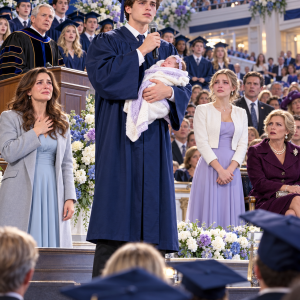
Owen walked onto the stage wearing a simple dark suit.
He thanked the organizers.
Then he paused.
“Medicine has taught me something important,” he said. “You cannot treat a condition accurately if you hide the history.”
The room became quiet.
“Recently, two people publicly described themselves as grandparents who had been unfairly separated from me.”
I saw my mother stiffen.
“So I think the history matters.”
The screen behind Owen displayed a certified copy of the old family-court document.
No dramatic music.
No shouting.
Just words.
Dates.
Signatures.
Facts.
Owen continued.
“Before I was born, these two people voluntarily chose permanent separation from my mother and from the child she was carrying.”
My father stood.
“Owen, this is inappropriate.”
Grant rose from our table.
“The record is certified.”
My mother looked around the ballroom.
“Claire put him up to this.”
For the first time that evening, I spoke.
“No. Owen is an adult. That’s something you never allowed me to become before deciding who I was.”
Then the old recording played.
My father’s voice filled the room.
“We do not intend to have further involvement with Claire or the child she is expecting.”
My mother’s followed.
“We believe permanent separation is best for everyone.”
Nobody applauded.
Nobody needed to.
The silence was more powerful.