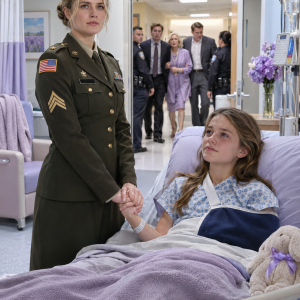
Rebecca began recording his symptoms and carefully reviewing the visible bruising according to hospital procedures.
She asked whether he felt safe returning home.
Andrew avoided her eyes.
“My wife has been overwhelmed since the accident, and Patrick has been helping with everything around the house.”
Rebecca waited.
Andrew continued.
“He can get impatient when things don’t happen quickly enough, but I don’t want to create trouble for my family.”
She didn’t pressure him to make an accusation.
Instead, she explained the hospital’s patient-safety resources and his right to discuss concerns confidentially.
Andrew admitted that some injuries predated the reported ladder fall.
Before he could say more, Patrick knocked and opened the door.
Andrew immediately stopped talking.
Patrick looked from the nurse to the patient.
“Are we finished with the questions yet? Andrew needs rest, not another interrogation.”
Rebecca finished documenting the examination.
She noticed Sophie sitting very still near the doorway, watching her uncle rather than the television.
Later, Rebecca contacted the hospital’s safeguarding team to request guidance about the concerning pattern.
She also arranged for the clinical team to reassess Andrew’s worsening chest discomfort.
At that moment, no one had confirmed what had caused his injuries.
But Rebecca understood one thing clearly.
The absence of a direct accusation didn’t prove that a patient was safe.
And Sophie’s warning deserved more than a dismissive explanation.
Part 4 — The Emergency at 9:47 P.M.
At precisely 9:47 that evening, a medical alarm sounded from room 204.
Rebecca was checking another patient only a few doors away.
She reached Andrew’s bedside almost immediately.
His skin had turned pale, and perspiration covered his forehead.
The monitor showed a dangerously rapid pulse while his blood pressure continued falling.
Rebecca checked his responsiveness and called for urgent medical assistance.
“We have severe hypotension and increasing tachycardia. Activate the rapid-response team and bring emergency resuscitation equipment immediately.”
A young resident entered with another nurse.
Rebecca described Andrew’s recent chest injuries and the concerning findings she’d observed.
His neck veins appeared distended, and his heart sounds were difficult to hear.
Those features raised concern for a life-threatening problem involving pressure around the heart.
“We need an immediate bedside cardiac ultrasound and emergency physician assessment. Cardiac tamponade is a serious possibility.”
The resident moved quickly to obtain the ultrasound equipment while another clinician contacted critical care.
The examination revealed a significant fluid collection around Andrew’s heart, with findings concerning for impaired cardiac filling.
He required urgent treatment.
The on-call critical care physician arrived and coordinated the emergency intervention with the appropriate specialist team.
Rebecca assisted within her nursing responsibilities, administering ordered treatments, monitoring vital signs, preparing equipment, and maintaining communication between the clinicians.
Her previous law enforcement experience didn’t give her authority to perform invasive cardiac procedures.
Her nursing training and ability to remain composed helped her support the team effectively.
As the physician carried out the necessary emergency treatment, the monitors began showing improvement.
Andrew’s blood pressure gradually recovered.
His breathing became less labored.
Rebecca checked the readings and communicated each change to the medical team.
Beside the doorway, Sophie stood with another nurse who had moved her safely away from the emergency equipment.
The little girl watched the adults working to save her father.
When Andrew finally opened his eyes more fully, he looked toward Rebecca.
“You stayed calm through all of that. Have you worked in emergencies like this before?”
Rebecca adjusted the monitor lead.
“I’ve worked in difficult situations before, Sergeant Bennett, but right now our priority is making sure you’re stable.”
He studied her.
“You called me Sergeant without looking at my chart. Something tells me nursing wasn’t your first career.”
Rebecca smiled faintly.
She didn’t answer.
The emergency team transferred Andrew for closer monitoring and additional treatment.
His immediate crisis had passed, but the questions concerning the origin of his injuries remained unresolved.
In fact, those questions had become more urgent.
Part 5 — The Physician Who Didn’t Want Questions

By the time Dr. Harper returned from the fundraising gala, news of Andrew’s emergency had spread through the hospital.
He found Rebecca completing her documentation at the nurses’ station.
His evening clothes were still visible beneath his hastily fastened white coat.
“I understand there was an emergency procedure involving my patient while I was away. Why wasn’t I contacted before the intervention?”
Rebecca explained that the rapid-response team had followed the emergency escalation procedures and contacted the available physicians without delay.
“Sergeant Bennett was critically unstable, Doctor. The treating team acted within the emergency protocol, and the assessment and treatment are documented.”
Harper examined the notes.
For a moment, he looked more concerned about the circumstances surrounding the emergency than the possibility he’d underestimated Andrew’s condition.
Rebecca reminded him that the earlier bruising still required evaluation.
She also repeated Sophie’s statement, carefully distinguishing the child’s actual words from her own observations.
“We have a vulnerable patient, injuries requiring clarification, and a six-year-old witness who appears frightened around one particular family member.”
Harper frowned.
“You are a nurse, Rebecca, not a criminal investigator. You cannot conclude that someone committed assault merely because a child seems uncomfortable.”
Rebecca agreed that an accusation would require evidence.
But she refused to confuse uncertainty with a reason for inaction.
“I’m documenting clinical findings and reporting a safeguarding concern, not deciding anyone’s guilt. The patient deserves an assessment free from outside pressure.”
She requested formal involvement from the safeguarding team and appropriate outside authorities.
Harper eventually stopped arguing, although he remained visibly unhappy.
Near the hallway entrance, Patrick had been listening.
When Rebecca noticed him, he quickly looked away.
Something about his expression suggested that Sophie’s warning had reached the person she feared most.
Part 6 — The Badge Inside the Fireproof Box
After completing her shift, Rebecca returned to her modest apartment and opened a fireproof box she’d avoided for three years.
Inside were photographs, training records, and her expired federal identification.
The card still displayed the title Deputy United States Marshal.
She studied the photograph of her younger self, remembering a woman who had believed that recognizing danger was always enough to prevent it.
Then she contacted a former colleague, explaining that she had serious safeguarding concerns involving a hospital patient.
She didn’t ask anyone to search restricted law enforcement systems for her personal benefit.
Instead, she provided information that could lawfully be forwarded to authorized investigators and asked how to submit her observations properly.
With guidance, she reviewed publicly accessible court records relating to Patrick Lawson.
Those records revealed a troubling history.
Patrick had previously faced allegations involving relatives who depended on him for housing or financial assistance.