PART 1 — THE CHECK THEY HANDED ME AFTER THE FUNERAL
Six days after my husband died, his older brothers handed me a cashier’s check for half a million dollars and explained that my twelve-year-old daughter and I would have to leave the farmhouse where we’d spent nearly twenty years.
They chose the church luncheon following his funeral to deliver that news.
My name is Nora Bennett, and I was sitting in the basement of Grace Lutheran Church in Humboldt, Iowa, surrounded by relatives eating ham sandwiches, cheesy potatoes, and homemade desserts.
My husband, Adam, had died at forty-seven, leaving behind a daughter who couldn’t understand why her father wasn’t coming home and a wife who still expected to hear his pickup pulling into the driveway.
His oldest brother, Grant Bennett, fifty-two, pushed a white envelope across the table.
“We’ve arranged the partnership buyout, Nora, and the bank helped us finish everything this week so you won’t have to worry about the business anymore.”
Inside was a cashier’s check for $500,000.
Paul, the middle brother, was forty-nine and usually allowed Grant to make the family’s difficult decisions.
“The farmhouse belongs to the partnership, so we’ll need you and Sophie to move out before planting begins this spring.”
I stared at the check.
It was the middle of March, leaving approximately seven weeks before the planting season.
That meant seven weeks to remove nearly two decades of marriage, family photographs, furniture, and memories from the only home Sophie had ever known.
Across the room, my daughter sat beside my sister Claire, silently breaking apart a lemon dessert with her plastic fork.
Sophie hadn’t cried during the service.
But she’d gripped my hand so tightly during the final hymn that my fingers still ached.
I folded the check and placed it inside my handbag.
“I understand the partnership agreement, Grant, and I won’t make an argument about something Adam already signed.”
He visibly relaxed.
That expression stayed with me longer than the conversation itself.
Grant wasn’t trying to cheat me financially, and that almost made the situation harder to explain.
He simply believed that removing us from the family business was a practical problem requiring an efficient solution.
Adam was the youngest of three brothers who operated Bennett Brothers Farms, an eleven-hundred-acre corn-and-soybean operation in north-central Iowa.
Their father had established the partnership before retiring, hoping to prevent the land from being divided into farms too small to operate efficiently.
The agreement gave surviving partners the right to purchase a deceased brother’s interest according to an established valuation formula.
It also identified the original farmhouse as partnership property.
I knew those details because I’d maintained the company’s bookkeeping for twenty years.
Every seed invoice, equipment payment, quarterly tax calculation, and operating-loan statement passed across my kitchen table.
After Adam’s death, I checked the formula myself.
The calculated amount was slightly less than $500,000.
Grant and Paul had rounded it upward.
Their timing was cruel, but the valuation wasn’t dishonest.
Adam had died on a cold Tuesday evening after going outside to inspect a hydraulic leak on the planter.
He kissed my forehead, grabbed his familiar green cap, and promised he’d return in twenty minutes.
When he hadn’t returned by nine, I took a flashlight to the machinery shed.
I found him collapsed beside the equipment, a wrench still resting in his hand.
The doctors said a sudden heart attack had taken him almost immediately.
Now his brothers expected me to accept the check, move into town, and leave the fields that had defined our marriage.
But I knew something they hadn’t considered.
Across the gravel road stood an abandoned white farmhouse and eighty acres of dryland that had been for sale since the previous autumn.
And Adam had once told me exactly what he dreamed of doing with that property.
PART 2 — THE EIGHTY ACRES ACROSS THE ROAD
That evening, Sophie sat at our kitchen table wearing the black dress she’d chosen for her father’s funeral.
“Mom, are we supposed to move into Aunt Claire’s house now that Uncle Grant and Uncle Paul own everything?”
I sat beside her.
“The partnership owns this house, sweetheart, and your uncles have purchased Dad’s share according to the agreement he signed.”
Sophie looked toward the window.
Beyond the yard lights, Adam’s fields stretched along the eastern side of the gravel road.
“But I can still see Dad’s fields from my bedroom, and I used to count every time his tractor turned around after dark.”
She went upstairs without asking another question.
I remained at the table, looking toward the old Patterson farm across the road.
Its eighty acres were mostly dryland, and the small white house needed repairs, but Adam and I had always admired the place.
The former owner had moved into assisted living three years earlier, and her grandchildren eventually listed the property for sale.
The asking price had recently fallen to $430,000.
Adam used to joke that if he ever won the lottery, he’d buy the land and give it to Sophie for her eighteenth birthday.
I found an old seed-company calendar and began calculating.
Eighty acres of land and an existing farmhouse for $430,000 would leave approximately $70,000 from the buyout.
That money would have to cover machinery, seed, fertilizer, repairs, and our living expenses until harvest.
It was a frighteningly narrow margin.
Two consecutive drought years had strained the partnership’s finances, and I knew how unpredictable an Iowa growing season could be.
But I also knew farming.
I’d grown up on a farm and spent nineteen harvest seasons driving grain trucks, maintaining records, checking equipment, and helping Adam whenever he needed another operator.
My husband had never treated my work as something less important simply because my name wasn’t on the partnership documents.
The following Monday, I drove to the bank in Fort Dodge and met loan officer Nathan Brooks.
He was in his early thirties, wearing a pale-blue shirt and a tie decorated with tiny tractors.
When he saw the check, his expression softened.
“I’m very sorry about Adam, Mrs. Bennett, because he was one of the first farmers who made me feel welcome when I started here.”
I thanked him and asked him to deposit the funds.
Then I explained that I wanted to purchase the Patterson property.
He studied my face.
“You’re planning to purchase farmland immediately after leaving the family partnership?”
I nodded.
“I want my daughter to keep living across from her father’s fields, and I intend to farm those eighty acres myself.”
That afternoon, I called real-estate agent Diane Foster and offered the full asking price in cash.
The Patterson grandchildren accepted the following morning.
Before closing, I consulted Andrew Miller, the attorney who had prepared the original partnership agreement.
He confirmed that the buyout released me from the business’s operating debt and loan obligations.
The farmhouse would remain partnership property, but my new purchase would belong to me.
We completed the sale on April twenty-second.
I received two keys, one for the white farmhouse and another for its weathered red barn.
For the first time since Adam died, I felt that I had made a decision about our future instead of merely accepting decisions somebody else made.
PART 3 — THE TRACTOR, THE GREEN CAP, AND THE FIRST DAY ALONE

Buying the land was only the beginning.
At a farm-equipment auction outside Webster City, I purchased a used John Deere 6420 tractor for $32,500 and an eight-row John Deere 7000 planter for $9,000.
Related Posts
I Lost My Fifth Baby After My Husband Left Me for My Younger Sister, Yet My Parents Still Urged Me to Support Their Wedding—So I Stayed Home With Our Three Younger Children, Until Our 9-Year-Old Daughter Walked Into the Ceremony Carrying Her Aunt’s Old Journal and Opened to a Page Neither of Them Expected Her to Find
“HEY, GRANDMA! WHAT WAS YOUR RANK BACK IN THE STONE AGE?” A Young Army Sergeant Mocked Me in Front of 200 Soldiers. I’m 81, and He Ordered Me to Remove the Old Military Pin From My Coat. I Refused. Then I Asked Him to Read the Name Painted on the Dining Hall Wall. His Face Went White. But What Happened Afterward Was Something Neither of Us Could Have Imagined.
Three Days After Giving Birth, I Was Diagnosed With a Serious Heart Condition. My Husband Handed Me Divorce Papers and Said, “I’m Not Paying to Keep You Alive. Take the Baby and Get Out!” His Mother Even Called My Parents to Come Get Me. But Just 30 Minutes Later, Three Black SUVs Arrived at the Hospital. My Parents Stepped Out With Two Lawyers—and My Father’s First Words Wiped the Smile Off My Husband’s Face: “Let’s Start With the House.”
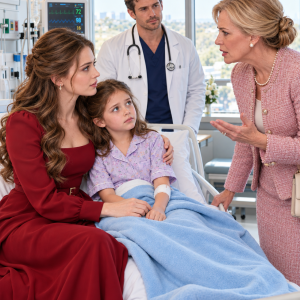
While I Was Away on Military Duty, My Stepmother Treated My 8-Year-Old Daughter So Harshly That She Ended Up in the Hospital. When the Doctor Called, He Said, “Your Little Girl Is Terrified of Going Back Home.” I Rushed Back Without Warning, Only to Discover My Father Had Suffered a Stroke and My Stepmother Was Secretly Planning to Take His House. Then My Daughter Told Me About an Old Phone Her Grandfather Had Hidden for Her—and What I Heard on That Recording Left Me Speechless