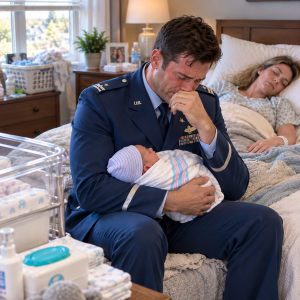
I was taken to the hospital, where the medical team monitored my condition and prepared for delivery.
Gabriel remained outside the delivery room.
No relative could reach California quickly enough.
And after everything that had happened, Gabriel was the person I trusted most to be nearby.
Nine hours after consistent contractions began, my daughter arrived.
It was 5:17 in the morning.
She weighed six pounds and one ounce.
The moment she was born, she let out a powerful cry.
I began laughing through my tears.
“Good, sweetheart. Keep making noise.”
After spending so many hours terrified that I would never hear her breathe, that cry was the most beautiful sound in the world.
The nurse smiled and asked whether I had chosen a name.
Nathan had always preferred Elizabeth.
He said it sounded appropriate for the Mercer family.
He liked its formality.
Its connection to the kind of legacy he believed our daughter should represent.
But I had always preferred another name.
Lily.
Every year, wild lilies returned to the cliffs below Ravenswood.
They survived storms.
They endured dry seasons.
And when conditions seemed impossible, they bloomed again.
I looked down at my daughter.
“Lily Mercer.”
Not Nathan’s surname.
Mine.
I held her against me.
For the first time since the fire, I could imagine a future without hearing Nathan’s voice behind every decision.
The criminal case continued long after Lily’s birth.
Evelyn eventually pleaded guilty to conspiracy.
Investigators reconstructed her communications with Nathan.
The messages confirmed that the service corridor had been deliberately sealed.
Staff had been cleared from the western grounds.
And the gate chain was intended to delay firefighters by six to ten minutes.
Those minutes might have been enough to kill us.
Nathan went to trial.
Gabriel testified.
He described the emergency wildfire alert.
The locked gate.
The SOS signal I created with Ravenswood’s exterior lights.
The emergency release points built into the fire-resistant glazing.
And his decision to drive his armored SUV through the estate entrance.
During questioning, one attorney suggested that Gabriel had risked his life because we were romantically involved.
Gabriel answered immediately.
“No.”
The attorney continued.
“Then why did you enter a burning building?”
Gabriel glanced briefly toward me.
Then he answered.
“Because gates can be replaced. Caroline cannot.”
The sentence appeared in newspapers the following morning.
Later, it was my turn to testify.
I expected describing the fire to be the hardest part.
It wasn’t.
The most painful memory was breakfast.
Only hours before trying to kill me, Nathan had knelt beside my chair.
He had kissed my pregnant stomach.
He asked whether our daughter was kicking.
He smiled.
He acted like a loving husband eagerly awaiting the birth of his child.
That ordinary tenderness was harder to reconcile with the attempted murder than any photograph of gasoline containers.
The prosecution presented the physical and financial evidence.
The antique brass key.
The steel plate installed across the service passage.
The chain securing the gate.
The forged voting proxies.
Nathan’s succession memorandum.
My stolen telephone.
Evidence of the accelerant used to start the fire.
The altered maintenance schedule.
And the messages exchanged between Nathan and Evelyn.
Each item supported a different part of the same plan.
Together, they revealed how carefully the attack had been prepared.
After nine hours of deliberation, the jury returned guilty verdicts on the major charges connected to the planned attack and the corporate fraud.
I had imagined that hearing the verdict might make me feel triumphant.
Instead, I felt something quieter.
Release.
Nathan had constructed his crime gradually while I was still calling him my husband.
He planned it while sharing meals with me.
While discussing our daughter’s arrival.
While living inside the home he intended to destroy.
The verdict did not undo any of that.
But it meant I no longer had to carry uncertainty alongside the truth.
The facts had been examined.
The evidence had been heard.
And Nathan could no longer control the story simply by insisting his version was the correct one.
PART 6 — THE HOME THAT FINALLY BELONGED TO MY FUTURE
Several months later, I returned to Ravenswood carrying Lily against my chest.
The western wing was still being repaired.
The music room had been stripped back to its structural framing.
Workers were replacing fire-damaged glass and removing the steel obstruction Nathan had ordered installed inside the old service corridor.
I asked them not to close the passage.
I wanted to see it.
When I stepped inside, the corridor seemed smaller than I remembered.
During my nightmares, it stretched endlessly.
A dark tunnel filled with smoke.
A place where every movement had seemed to demand more strength than I possessed.
But standing there in daylight, I could see its actual dimensions.
The narrow walls.
The old pipes.
The junction box.
Everything that had once seemed enormous because I was terrified.
The emergency irrigation control remained where I had opened it with my wedding ring.
Eventually, I arranged for the ring to be placed inside the restored box beneath protective glass.
Not as a memorial to my marriage.
And not as a reminder of Nathan’s betrayal.
I wanted it there because its meaning had changed.
Nathan gave me that ring as a symbol that I belonged beside him.
On the night of the fire, I used it as a tool to escape him.
The same object had become evidence of my survival.
Ravenswood reopened the following spring.
But I refused to restore it exactly as it had been.
Every major window now had clearly visible emergency releases.
The gates had mechanical overrides accessible from both sides.
No interior room required a key for emergency exit.
Multiple independent wildfire alerts had been installed.
I wanted the estate to be beautiful again.
But beauty was no longer enough.
It needed to be safe.
Gabriel reviewed the new protective systems.
At one point, he described the number of redundancies as excessive.
I looked at him.
“Add another one.”
He did.
Despite what newspapers repeatedly suggested, Gabriel and I did not secretly begin a romance after the fire.
What developed between us during that year was quieter.
And, at that stage of my life, more valuable.
Trust.
Gabriel never behaved as though helping rescue me gave him ownership over my future.
He never demanded emotional closeness because he had risked his life.
He never treated my survival as something I owed him.
Whenever someone introduced him as the man who saved Caroline Mercer, he corrected them.
“Caroline survived long enough for us to reach her.”
He was right.
Gabriel broke through the glass.
Firefighters entered the building.
Investigators uncovered the conspiracy.
The jury eventually delivered its verdict.
But I had found the hidden passage.
I had opened the independent circuit.
I had activated the water system.
I had sent the SOS signal.
And I had continued moving when Nathan had designed every part of that night around the assumption that terror would leave me helpless.
On the first anniversary of the fire, I stood alone on the Ravenswood terrace after Lily had fallen asleep upstairs.
The Pacific Ocean stretched beyond the cliffs.
The sky was dark.
The air carried the familiar scent of the coast.
For a moment, I could almost see Nathan reflected in the patio glass.
His tuxedo.
The silver cuff links.
The brass key between his fingers.
And the expression on his face as he told me not to make things more difficult than necessary.
Nathan had believed that resisting him was what made the situation ugly.
He had expected me to accept the future he chose.
In his mind, screaming, fighting, surviving, and exposing the truth were undignified acts.
Now I understood how completely wrong he had been.
Survival was not ugly.
Neither was telling the truth.
In the end, the voting shares were not the most important thing.
Neither was Ravenswood.
Even the verdict, as necessary as it had been, eventually became secondary.
Nathan had designed everything around preventing one event.
My daughter taking her first breath.
He had forged documents.
Sealed a wall.
Disabled alarms.
Chained a gate.
Spread gasoline.
Locked a door.
And stood outside waiting for our future to disappear.
But that future arrived anyway.
From upstairs, Lily began crying.
I smiled immediately.
“I’m coming, sweetheart.”
Then I turned away from the terrace.
I walked back inside my home.
Every door stood open.
THE END