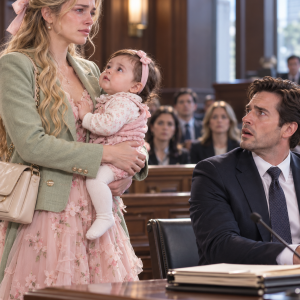
The forensic auditor continued.
Money had moved into personal accounts.
Hidden real-estate holdings.
Intermediary entities.
The destinations were enough to make the pattern clear.
Serena looked toward Julian.
“You told me those registrations were normal compliance paperwork.”
He answered:
“I gave you a career. I gave you a life.”
Her voice shook.
“You gave me a future criminal charge.”
I asked the question that had bothered me since morning.
“Why did you support my appointment as CEO?”
Before Julian could answer, Marcus Hale spoke.
“He proposed your candidacy three months ago.”
Part 4 — The Voting Trust
Julian opened his briefcase.
“None of this changes who controls the company.”
He removed a legal document.
“I control fifty-one percent of the family voting trust. The incapacity provision became active after Mother submitted her medical evaluation.”
He looked at me with the confidence of someone convinced he had reached the final move.
Eleanor laughed softly.
Then she opened her handbag and removed a blue envelope.
Eight months earlier, she had discovered that an older draft of the trust contained language allowing control to shift under carefully phrased medical conditions.
She had revoked it.
More importantly, at nine o’clock that morning—just before the board formalized my appointment—she had transferred primary voting authority over the family shares.
To me.
Julian read the documents twice.
“This is invalid.”
I turned toward Eleanor.
“Why did you choose me?”
Her eyes stayed on Julian.
“Because this family spent ten years encouraging you to make yourself smaller, and you still built your career without using the family name as a weapon. I trust you with this company because you understand responsibility. I no longer trust him.”
Julian shot to his feet.
“That is my inheritance.”
Eleanor’s expression changed.
“No. It was never yours alone.”
Then she revealed something nobody else in the room knew.
Serena—Elena—was Eleanor’s only biological child.
After being forced to surrender her daughter, complications from the birth had left Eleanor unable to carry another pregnancy.
Years later, she and her husband adopted a baby boy.
They gave him their surname.
Their home.
Their education.
Eventually, they gave him access to the corporation.
That boy was Julian.
His face became completely still.
“You’re saying I’m adopted?”
Eleanor nodded.
“We loved you as our son. Adoption never made you less our child. What you chose to do afterward was yours.”
Julian looked toward Serena.
For years, he had convinced her that secrecy protected Eleanor.
In reality, secrecy gave him control over both women.
The daughter Eleanor believed she had lost forever became a hidden employee whose identity could absorb suspicious corporate transactions.
And the wife he repeatedly encouraged to stay away from headquarters became the future executive whose credentials could be copied and blamed.
Part 5 — The Audit That Changed Everything

That afternoon, the board voted to suspend Julian’s executive authority until the forensic investigation was complete.
I did not celebrate.
Instead, I instructed Compliance to preserve all records.
Cooperate fully with outside investigators.
Protect employees who came forward.
And remove Serena from any systems where her compromised identity might create additional legal exposure.
Serena voluntarily resigned from her executive-secretary position while the company arranged independent legal counsel for her.
Before leaving my office, she stopped at the doorway.
“I treated you terribly this morning.”
I looked at her.
“You did.”
Her eyes dropped.
“I thought being close to Julian made me untouchable.”
I answered:
“That belief hurt people who had nothing to do with your family.”
She nodded.
“I know.”
“Then start there.”
During the months that followed, forensic teams reconstructed years of transactions.
They carefully separated what could be proven, what remained under investigation, and what employees had been manipulated into signing without understanding.
The board ultimately removed Julian from the chairmanship.
Outside authorities received the relevant evidence.
And after ten years of marriage, I filed for divorce.
Part 6 — A Different Kind of Leadership
One year after my first morning as CEO, the executive elevator looked exactly the same from the outside.
What changed was who was allowed to use it.
Junior analysts.
Assistants.
Auditors.
Visiting engineers.
Directors.
Executives.
They rode according to where they needed to go.
Nobody climbed five unnecessary flights because another employee had decided status should determine physical access.
Eleanor and Serena began the much slower process of trying to become mother and daughter.
There was no miraculous reconciliation.
Too many years had been lost.
Too much grief.
Anger.
Unanswered questions.
They had awkward meetings.
Difficult conversations.
Both had to accept that loving someone did not erase what secrecy had done.
Serena eventually rebuilt her professional life outside Whitmore Global.
The company continued operating under stronger board oversight.
I remained CEO under a governance structure designed specifically to ensure that practical control could no longer be concentrated inside one family office.
On the anniversary of my first day, Eleanor invited me to lunch.
She was not wearing the white ceramic watch.
The original had remained locked away as evidence until investigators released it months earlier.
Eventually, Eleanor gave it back to me.
“You chose it,” she said. “You decide what it should mean now.”
I never gave it to anybody.
I kept it inside a drawer in my office.
Not because of its rarity.
Not because of its price.
Not because it was beautiful.
I kept it because it reminded me how easily symbols can be mistaken for truth.
That watch had looked like proof of an affair.
Serena had looked like nothing more than an arrogant secretary.
Julian had looked like a respected chairman protecting a family legacy.
I had looked like an underdressed intern who wandered into the wrong elevator.
Every first impression from that morning had been incomplete.
Once the facts arrived, only behavior mattered.
The most important lesson of my first year as CEO had very little to do with power.
Real authority is not the ability to decide who enters an elevator.
Who receives an expensive gift.
Who gets promoted.
Or whose name appears on a corporate seal.
Real authority is the responsibility to make sure systems do not become private weapons for the people standing closest to them.
On my first morning, Serena told me that interns belonged in the service elevator.
She believed hierarchy meant some people deserved easier passage than others.
Julian had built his entire private world around the same idea.
Some people were protected.
Some were useful.
Some were disposable.
The day I became CEO was the day that system finally stopped working.
And the moment that changed everything was not when the board gave me a title.
It happened earlier.
It happened when I stepped into an elevator someone had told me I was not allowed to use, looked at the watch on her wrist, and decided to keep asking questions.
THE END