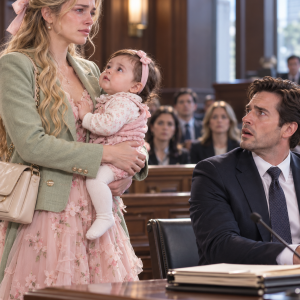
When Andrew finally confronted him, the brothers immediately turned against each other.
“This entire disaster started because I kept cleaning up your debts!” Andrew shouted during one confrontation.
Bradley shouted back.
“You were the executive approving everything! I couldn’t move money without your authorization.”
Margaret instinctively defended her younger son.
That finally broke something in Andrew.
“You have protected Bradley his entire life. Elena paid lawyers for him. She paid debts for this family. She kept fixing problems even while she was pregnant. She lost our baby, and you still expected her to keep cleaning up Bradley’s disasters.”
It was the first time I had ever heard Andrew openly acknowledge what I had carried.
It was also far too late.
Madison created a different kind of chaos.
She had married Bradley partly because she believed he belonged to an extremely wealthy Wall Street family.
When she discovered the luxury home belonged to a corporate trust and Andrew’s career had been supported by investments connected to me, her panic turned into open contempt.
During one argument, she called Bradley a failure.
Margaret immediately defended him.
“You are carrying this family’s child, so show some respect.”
Madison laughed bitterly.
“This family’s child? I don’t even know whether Bradley is the father.”
According to everyone who heard it, the room became completely silent.
Madison admitted that she had been seeing another man shortly before becoming involved with Bradley.
She had been impressed by the expensive cars.
The large house.
Bradley’s exaggerated stories about family wealth.
Bradley had inflated his status to attract her.
Madison had stayed because she believed she had married into money.
Two dishonest people had effectively sold each other incompatible fantasies.
After the baby was born, DNA testing confirmed that Bradley was not the biological father.
Their marriage collapsed almost as quickly as mine.
Part 5 — The Prenup Margaret Once Celebrated

Andrew hired an aggressive divorce attorney.
He tried to claim substantial interests in my companies by arguing that some business growth had occurred during our marriage.
My attorney responded with the very documents Margaret had once demanded.
The prenuptial agreement was extraordinarily clear.
Most of my major holdings, investment structures, and trusts had existed before the wedding.
They were carefully identified as separate property.
The Westchester residence had never belonged to Andrew.
It had never belonged to Margaret.
It had never even belonged to me personally.
The property was held by a structure created before the marriage.
Ironically, the agreement Margaret had demanded to protect Andrew’s “promising future” became the strongest barrier preventing him from reaching mine.
He left the marriage with his personal savings.
His clothing.
Assets that actually belonged to him.
And the legal consequences connected to the corporate audit.
One afternoon outside the courthouse, Andrew confronted me.
“You planned this from the beginning.”
I shook my head.
“If I had wanted to destroy you, I would never have helped you reach a position where you could build an independent career.”
His voice became quieter.
“Then why did you hide who you really were?”
I thought about that carefully.
“Because I loved you incorrectly. I thought making myself smaller would protect your confidence, and protecting your confidence would protect our marriage.”
Three months later, the corporate matter reached a settlement.
Andrew liquidated valuable personal assets and repaid substantial sums in order to avoid far more severe consequences.
His Wall Street career ended.
He was barred from holding comparable financial-management responsibilities.
Eventually, he found a sales job at a smaller retail company.
For the first time, his professional identity depended almost entirely on what he could accomplish without hidden support.
Bradley filed for bankruptcy.
He finally faced his creditors without anyone rescuing him.
Margaret returned to her old house in Newark.
Part 6 — An Apology Without Reconciliation
Almost a year later, Margaret asked me to meet her.
We chose a quiet café in Manhattan.
She looked noticeably older.
The designer jewelry that had once accompanied nearly every appearance was gone.
She looked at me.
“I came to apologize. I understand that forgiveness isn’t something I’ve earned, but I finally see what I refused to see.”
I waited.
She continued.
“I bragged about Andrew constantly without ever asking where the opportunities around him came from. Whenever you quietly solved a problem, I treated your help as an obligation instead of generosity.”
Her eyes filled with tears.
“What I said about the baby you lost was unforgivable.”
I let several seconds pass.
Then I answered.
“I forgive you because I don’t want to carry anger for the rest of my life. That does not mean I want you back in my life.”
Margaret nodded.
She did not argue.
On the day our divorce became final, Andrew sent me one message.
I understand now that I did not lose you the night you walked out with the suitcase. I lost you slowly, every time I allowed you to feel alone while I was standing beside you. I am sorry.
I read it once.
Then archived it without replying.
Part 7 — A Home Where Nobody Gives Orders

Eventually, I sold the Westchester property.
Not because I hated the house.
I simply no longer needed an enormous residence to symbolize achievement.
I bought a bright Manhattan penthouse instead.
Floor-to-ceiling windows.
Enough space for the life I actually wanted.
On my first evening there, I made truffle pasta.
Opened an expensive bottle of wine.
Then watched the city light up beneath me.
Nobody told me to carry dinner upstairs.
Nobody criticized what time I came home from work.
Nobody used the loss of my pregnancy as evidence that I should be grateful anyone tolerated my presence.
The silence did not feel lonely.
It felt unrestricted.
Several months later, I created a nonprofit initiative through Hartwell Capital to help women return to the workforce after divorce, bereavement, or major family disruption.
I did not create it because I believed every woman needed to become extremely wealthy.
I created it because financial independence can provide something more important than luxury.
Options.
Money can buy homes.
Cars.
Titles.
Travel.
Beautiful objects.
But money cannot force someone to respect you.
And if somebody only starts respecting you after discovering how much money you control, then they never respected you in the first place.
For years, I believed making myself smaller was proof of love.
I believed peace required swallowing insults.
Hiding success.
Rescuing irresponsible relatives.
Allowing my husband to feel larger because admitting how much I had built might make him uncomfortable.
That was not peace.
It was self-erasure.
The night Margaret ordered me out of what she called her son’s house, she believed she was taking something away from me.
Instead, she accidentally returned something I had surrendered gradually over the years.
My self-respect.
Property can be sold.
Titles can disappear.
Careers can collapse.
Money can be earned.
Lost.
Rebuilt.
Inherited.
But once I finally understood the value of my own dignity, I decided it would never again become an asset managed by somebody else.
THE END