Emily closed her eyes.
“Mom, this sounds dangerously close to an ambush.”
“It’s an intervention involving synchronized truth.”
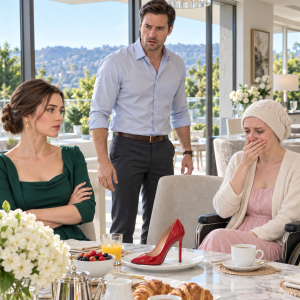
By six o’clock, everyone was seated around the dining table.
Vivian ate lasagna comfortably inside the house she had already mentally inherited.
Eventually, Stephen stood and tapped his spoon against a wineglass.
“I want to say something. The past few weeks reminded me how fragile life is. Sometimes you only understand what matters when you almost lose it.”
My father stared at his plate.
Stephen placed one hand on the back of my chair.
“So I’d like to toast my extraordinary wife, Allison, to her recovery and to second chances.”
Everyone lifted their glasses.
I waited until Stephen drank.
Then I said:
“Second chances are exactly why I invited everyone.”
I reached beside my chair and placed the brown hospital envelope in the center of the table.
Stephen’s smile vanished.
“What is that supposed to mean?”
I looked at him.
“Explain the documents to everyone.”
His sister Laura frowned.
“What documents?”
I answered.
“The comprehensive financial authorization Stephen brought to my hospital room while I was heavily medicated, asking me to give him access to personal accounts, separately owned assets, and business interests.”
Stephen immediately raised his voice.
“You were critically ill. I was trying to manage our finances.”
“You were trying to manage a future in which I was no longer alive to object.”
Then I turned toward Vivian.
“Have you decided whether you still want the downstairs suite?”
Her fork stopped halfway to her mouth.
“I don’t know what you mean.”
I repeated what she had said in the hospital.
“Three days. Fine. I want the house.”
Laura stared at her mother.
“You actually said that while Allison was lying in intensive care?”
Vivian started stammering.
Stephen slammed both hands on the table.
“She was medicated and hallucinating. None of this happened the way she says.”
I met his eyes.
“I could barely move, Stephen. My hearing worked perfectly.”
Then I mentioned Rachel.
Every muscle in Stephen’s body tightened.
Laura looked confused.
“Who is Rachel?”
Stephen answered quickly.
“A pharmaceutical representative I know through work. Allison has become paranoid since the hospital.”
Under the table, I sent one message.
Now.
Several seconds later, the front door opened.
Heels crossed the hardwood floor.
Rachel Monroe appeared in the dining-room doorway.
Stephen shoved his chair backward.
“What are you doing here?”
Rachel remained calm.
“Visiting the house you promised would belong to us after your wife died.”
Vivian gasped.
Rachel opened her phone and read one of Stephen’s messages aloud.
“Once everything settles, the house will be ours, and Mom can use the downstairs suite.”
Then she looked toward Vivian.
“Apparently he was assigning the same property to multiple women at once.”
Stephen pointed at me.
“You planned this entire humiliation.”
My father finally spoke.
“Nobody needed to trap you, Stephen. Everyone simply stopped protecting you from the consequences of your own words.”
Stephen looked around the table for someone willing to defend him.
Eventually, his gaze settled on Emily.
“Em, you know me. Tell them I’m not the monster they’re making me out to be.”
Emily began crying.
“Dad, I love you because you’re my father. But I honestly don’t know who you are anymore.”
For the first time all evening, Stephen had no prepared response.
He grabbed his keys and walked out.
The door slammed behind him.
I expected to feel triumphant.
Instead, I felt exhausted.
Seventeen years of love do not disappear simply because betrayal finally becomes impossible to deny.
Part 5 — What Freedom Actually Cost

The divorce lasted seven months.
It contained none of the dramatic satisfaction of Sunday dinner.
Instead, there were financial disclosures.
Endless emails.
Property appraisals.
Settlement discussions.
Arguments over renovations.
Expensive attorneys debating who had paid for improvements to a house that had always been titled solely in my name.
Caroline had warned me from the beginning.
“The deed is in your name, but marital money was used for renovations. The final outcome may be legally reasonable without feeling emotionally fair.”
Stephen’s attorney aggressively pursued reimbursement for improvements.
We used the nearly thirty-eight thousand dollars he had spent around Rachel as leverage during settlement negotiations.
Eventually, I kept my company.
I kept my home.
I also wrote Stephen a settlement check large enough to make me angry every time I remembered it.
One morning, I complained to my father while we sat on the back porch with coffee.
“I basically paid him to leave a house that belonged to me before I married him.”
Thomas shook his head.
“No, Allison. You purchased finality. Sometimes peace has a price that doesn’t feel fair.”
Emily remained the most complicated part of everything.
She continued seeing Stephen occasionally because he was still her father, even though he had failed badly as my husband.
Once, she helped him choose an inexpensive sofa for his small apartment.
I had to learn that supporting her relationship with him did not require me to forgive what he had done to me.
Slowly, Emily and I rebuilt something more honest than the family image we had protected for years.
Rachel almost completely disappeared from my life.
Four months after the dinner, she sent one brief message saying she hoped I had found peace.
I replied that I was beginning to.
We did not become friends.
We simply stopped occupying the same chapter.
Exactly one year after my hospitalization, I returned to St. Anne Medical Center for follow-up testing.
Dr. Foster reviewed the results.
Then smiled.
“Everything looks excellent, Allison. Your numbers are completely normal.”
Those words felt better than anything revenge could ever have offered.
On the drive home, I stopped at a nursery and bought a young red maple tree.
My father came over that afternoon to help me plant it in the center of the backyard.
At seventy-three, his definition of helping mostly consisted of supervising my digging technique while offering unsolicited commentary.
After I packed fresh soil around the roots, we both stepped back.
Thomas narrowed his eyes.
“It leans slightly to the right.”
I wiped dirt from my hands.
“So do I sometimes. Give it time to establish its roots. It’ll find its balance.”
For most of my adult life, I had confused strength with keeping everyone comfortable.
Do not upset Stephen.
Do not challenge Vivian.
Ignore the passive-aggressive comments.
Absorb the tension so nobody else has to.
Stephen learned to weaponize that tolerance because he assumed my desire for peace meant I would never defend myself.
Looking back, the defining moment was not Sunday dinner.
Not Rachel walking through the door.
Not Vivian’s humiliation.
Not Stephen leaving.
The real turning point happened inside that hospital room while I was weak, terrified, and uncertain whether my body would survive seventy-two hours.
I reached for my phone.
I called my father.
And after seventeen years of protecting everyone else from uncomfortable truths, I finally chose to protect myself.
THE END