“I wanted to leave. But by then I realized my feelings had become real.”
I responded quietly.
“Loving somebody does not give you the right to use that person as part of an investigation.”
Sabrina nodded.
“I understand that now.”
Her eyes filled with tears.
“Understanding it does not undo what I did.”
She admitted transferring the one and a half million dollars by using my electronic signature.
Her purpose was to create a false financial trail dramatic enough to frighten Martin into contacting Raymond.
The money had never been spent.
It remained protected inside a restricted trust account and could be returned.
But Sabrina did not pretend that returning it made the method lawful.
Then I asked about Rachel.
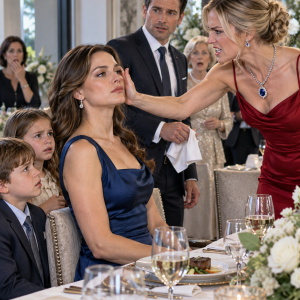
“Why did you hit my daughter if you claimed you were trying to protect her?”
Sabrina lowered her eyes.
“Rachel said I had become cruel like my father.”
She took a breath.
“I wanted to silence her.”
Her voice shook.
“I lost control and proved she understood me better than I understood myself.”
I looked toward Caleb.
“My grandson watched you hit his mother.”
Tears moved openly down Sabrina’s face.
“Knowing that disgusts me more than whatever punishment I receive.”
For the first time, she did not disguise guilt as sacrifice.
She explained that Raymond raised her to believe harm became acceptable if the person causing it claimed to be protecting someone.
I did not forgive Sabrina.
But I also refused to turn her into the only villain because doing so would allow me to avoid examining my own failures.
She deceived me.
That was true.
But Rachel had warned me repeatedly.
And I dismissed her.
I had threatened her role inside our own company.
I had allowed attention from a younger woman to outweigh my daughter’s fear.
The wedding was officially canceled.
Guests received a short message stating that a family emergency had occurred.
No one opened the champagne.
The five-tier cake remained untouched.
For weeks, newspapers published rumors.
I no longer cared about embarrassment.
My attention belonged to repairing the family I had nearly sacrificed to appearances.
The federal investigation continued for fourteen months.
Financial specialists authenticated recordings.
Electronic signatures.
Hotel payments.
Overseas transactions.
Martin and Raymond were charged with money laundering, extortion, financial fraud, conspiracy, and participation in Catherine’s unlawful death.
The medical examiner who had taken money to alter the original findings accepted a plea agreement.
He admitted concealing evidence showing Catherine’s injuries were inconsistent with an ordinary accidental fall.
Sabrina returned the full one and a half million dollars.
She surrendered every recording.
Then she testified against both Raymond and Martin.
Her cooperation helped prosecutors secure convictions.
But it did not erase her own crimes.
Sabrina pleaded guilty to unauthorized computer access.
Electronic forgery.
And misdemeanor assault.
The court imposed probation.
Community service.
And a permanent restraining order preventing her from contacting Rachel or Caleb.
I removed Martin permanently from the company.
Then I created an independent governing board.
Finally, I transferred my own shares into an irrevocable trust.
No future marriage or romantic relationship would ever determine Rachel or Caleb’s financial security.
Changing the corporation was difficult.
Repairing my relationship with Rachel was much harder.
Part 5: Learning That Listening Is Not the Same as Controlling

One afternoon, I visited Rachel’s condominium in Back Bay.
She opened the door.
She did not invite me inside.
For most of my life, I would have considered that disrespectful.
Now I understood that access to her home was not something I was entitled to demand.
I spoke first.
“I did not come here to ask you to forget what happened.”
Rachel looked at me.
“Good, because forgetting is impossible.”
I nodded.
“You were right about Sabrina.”
She remained silent.
“You were right about Martin.”
Another pause.
“You were right about the money.”
Then I forced myself to say the part that mattered.
“I failed you as your father because I treated your fear like disobedience.”
Rachel’s face remained guarded.
“I never needed the satisfaction of being right.”
Her voice was controlled.
“I needed my father to believe me before a courtroom proved it.”
There was no apology capable of repairing that immediately.
So I asked something different.
“Tell me what I can do without asking you to forgive me.”
Rachel answered.
“Listen.”
I waited.
“Without defending yourself.”
Another pause.
“Without buying me anything.”
She looked directly at me.
“And without explaining what you think I should feel.”
I followed the instruction.
Even when silence became uncomfortable.
At first, Rachel allowed me to see Caleb only during supervised visits in public parks.
Later, she agreed to family counseling.
Some sessions were filled with anger.
Others contained long stretches of cold restraint.
Gradually, I learned something I should have understood decades earlier.
An apology does not obligate another person to forgive.
Trust returns only when consistent behavior proves that the conduct causing the injury has actually changed.
Eleven months later, Rachel gave me a copy of Catherine’s final letter.
Investigators had found it among Sabrina’s evidence.
Catherine wrote that I loved intensely.
But she also said I sometimes confused protecting people with making decisions for them.
If Catherine did not survive, she wanted one thing from me.
Listen to Rachel.
Especially when the truth threatened everything I believed about myself.
I read those sentences until tears made the handwriting difficult to see.
After the legal process ended, Sabrina left Massachusetts.
We never resumed our relationship.
Before leaving, she mailed me a four-page letter.
Most of it faded from my memory.
One sentence did not.
She asked me not to remember her as the woman who bravely saved me.
She wanted me to remember her honestly.
As a person who performed courageous acts and still deliberately harmed my daughter.
There was no request that I wait for her.
No attempt to transform accountability into romance.
On the twelfth anniversary of Catherine’s death, Rachel, Caleb, and I visited the cemetery together.
Caleb was four now.
He carried the stuffed elephant that had hidden the decisive memory card.
He placed it beside Catherine’s memorial stone.
Then he looked up at me.
“Was Grandma Catherine brave?”
I knelt beside him.
“Very brave.”
I looked toward the grave.
“Especially when everyone around her wanted her to remain silent.”
Caleb thought about that.
Then he asked something harder.
“Was Sabrina completely bad even though she helped Grandma?”
I looked toward Rachel before answering.
“Sabrina made some courageous choices.”
Caleb listened carefully.
“And she made some terrible choices.”
I continued.
“Sometimes both things can exist in the same person.”
Then I added what mattered most.
“Doing something brave does not erase the harm someone causes through cruelty.”
Caleb considered the answer with the seriousness children sometimes bring to questions adults avoid for decades.
Then his expression changed.
“Are you going to marry somebody else soon?”
I smiled slightly.
“I have no plans to do that.”
Caleb nodded.
“Then you can come eat soup with Mommy and me tonight.”
I looked toward Rachel.
For the first time in a long time, her mouth lifted into a genuine, cautious smile.
It was not complete forgiveness.
It was something more valuable.
Trust beginning to return without being forced.
As we walked away from the cemetery, I finally understood everything Caleb’s USB drive had accomplished.
It stopped a dangerous wedding.
It exposed what really happened on Catherine’s final night.
It uncovered millions stolen from my company.
It prevented the planned murder disguised as an elevator accident.
But it revealed another judgment no courtroom could issue.
For years, I demanded loyalty from Rachel without offering her the dignity of being heard.
I called control protection.
I treated disagreement as betrayal.
I once believed love meant finding someone young enough to make aging, grief, and loneliness disappear.
Catherine’s final message gave me a much harder definition.
Love meant listening when the truth threatened the flattering story I preferred to believe about myself.
Caleb placed his small hand inside mine as we followed Rachel toward the cemetery gate.
The wedding that should have begun a glamorous new chapter ended with police vehicles, federal charges, and one hundred twenty empty chairs.
Yet from those ruins came something I had nearly lost forever.
A chance to become the father Rachel actually needed.
And the grandfather Caleb still believed I could become.
Eleven years earlier, I lost Catherine and accepted a convenient explanation because grief made questioning painful.
I nearly lost Rachel afterward because pride made listening equally difficult.
This time, the courage of one frightened three-year-old boy gave me enough time to stop walking toward another beautifully decorated disaster.
THE END