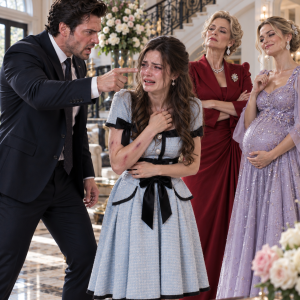
Margaret had returned quietly and now stood beside the library entrance without Sienna. Something changed in her expression as she listened.
Charles placed the final document before Eleanor. It was a letter dated eighteen months earlier and sent to an independent law firm.
The letter requested immediate review and notification if Julian attempted to dilute, transfer, dispose of, or damage Eleanor’s ownership without her fully informed written consent.
“You suspected he might do this?” Eleanor asked.
“I did not know about Sienna, but I feared Julian had begun viewing the company as exclusively his.”
Julian laughed bitterly.
“It is my company because I built it through years of work.”
Charles answered quietly.
“A business does not become yours alone because you worked the longest hours. A marriage does not become your possession because your spouse trusted you. A family does not belong to you merely because everyone loves you enough to excuse your mistakes.”
Julian accused his father of controlling the entire family. Charles considered the criticism instead of rejecting it.
“For much of your childhood, I believed providing financially entitled me to decide what was best for everyone,” he admitted. “I was wrong, and I tried not to repeat that mistake with Eleanor.”
Charles looked toward his daughter-in-law.
“I protected your interest but did not warn you earlier because suspicion was not evidence. I refused to become another man deciding what information you should receive supposedly for your own protection.”
His three minutes ended, although nobody moved.
Eleanor finally noticed Sienna’s absence. Margaret explained that Sienna had asked whether Julian would lose his inheritance. When Margaret admitted she did not know, Sienna said she needed fresh air and immediately drove away.
Julian called repeatedly, but she never answered.
Margaret ended the dinner, and guests collected their coats without argument. Several relatives embraced Eleanor, while others offered quiet words of support.
After everyone departed, snow covered the dark lake outside. Eleanor stood among the remains of a celebration she had spent two days creating.
Charles showed her an old email Julian had sent, claiming he had repaid Eleanor one hundred fifty thousand dollars and that she happily surrendered any business interest.
“He never repaid me,” Eleanor said.
Charles looked deeply uncomfortable.
“I believed my son.”
“I believed him too.”
Their trust had been exploited differently, Charles through business and Eleanor through love.
Margaret entered without her pearls or high heels, appearing less like a demanding hostess and more like an exhausted sixty-seven-year-old woman confronting the truth about her child.
“I owe you an apology,” she said. “Julian told me you chose domestic life and wanted nothing to do with business.”
Eleanor remembered every question Julian had explained until she felt foolish for asking.
“I was uncomfortable with several decisions, but he always made my concerns sound uninformed.”
Margaret lowered her eyes.
“I believed you distracted him from becoming another Charles, and I treated his ambition as proof of our family’s worth.”
Near midnight, Julian returned to the dining room after failing to locate Sienna.
“What do you want now, Eleanor? Money, divorce, ownership, or revenge?”
“I want you to stop turning every human problem into a negotiation,” she replied. “Tonight, I learned about your affair, your attempt to erase my ownership, and your lie that you had repaid me.”
Julian admitted that he intended to reimburse her later, after cash flow improved and expansion ended. There had always been another delay.
“You planned to tell me about Sienna later as well, didn’t you?”
He looked toward the floor.
“After New Year’s.”
Eleanor finally recognized his most destructive habit. Julian stored every truth inside a future called later, where he never had to confront it.
Before she left the room, he apologized because Sienna struck her.
“I care more about the fact that you stood there and watched.”
Part 3: The Forged Repayment

Eleanor drove to San Francisco alone the following morning. Their apartment looked unchanged, but she no longer viewed it as home. Every room seemed like evidence of a life she had inhabited passively.
Inside the closet, she found an old denim jacket stained with paint. Five years earlier, she wore it daily inside her Oakland studio, where she had lived modestly but independently.
Charles referred her to Dana Brooks, an attorney specializing in complex marital and business assets. Dana reviewed the formation documents before examining an alleged repayment of one hundred fifty thousand dollars deposited into Eleanor’s account three years earlier.
Two days after the deposit, the entire amount moved into a company called J.M. Family Holdings.
“Did you authorize this second transfer?” Dana asked.
“I do not remember seeing it.”
A banking authorization carried Eleanor’s name, but the signature tilted too sharply. She had signed thousands of paintings and knew the shape of her own hand.
“That signature is not mine.”
J.M. Family Holdings had two owners: Julian with sixty percent and Margaret with forty percent.
Margaret came to the apartment that evening. Eleanor placed the documents before her.
“What did this company purchase?”
Margaret closed her eyes.
“A warehouse building in Oakland, including the floor where your former studio was located.”
Julian had told Margaret that he intended to renovate the upper floor and surprise Eleanor with a permanent studio after Hawthorne Summit became successful. Margaret believed the one-hundred-fifty-thousand-dollar payment represented part of the building’s down payment, never realizing the money belonged to Eleanor.
“Does Julian still own the property?”
Margaret hesitated.
“Six months ago, he asked me to transfer my interest into a new company called S.V. Creative Properties, but I refused because something felt wrong.”
The initials carried an obvious meaning.
Sienna Vaughn.
Julian had planned to transfer the warehouse purchased with Eleanor’s money into a company connected to his mistress. Shame disappeared beneath a sharper emotion.
Purpose.
Three days later, Eleanor visited the brick warehouse with Dana and Samuel Price, the building manager. Her former fifth-floor studio had remained vacant for two years at Julian’s request.
The floor had been renovated into an ideal creative space with tall northern windows, pale walls, storage rooms, and restored hardwood floors.
Julian had once intended to return the studio to his wife. Later, he postponed the promise and prepared to hand the property to Sienna because he assumed Eleanor would never paint again.
Eleanor leased the fifth floor immediately and purchased new canvases before asking Julian to meet her there.
He admitted that he had used her money for the down payment but insisted that his original intention had been romantic.
“Why did you later prepare to transfer the building to Sienna?”
Julian stood beside the windows without answering.
“Because I convinced myself you would never paint again,” he finally admitted. “When you closed the old studio, I enjoyed knowing you were always available for my dinners, family obligations, and professional events.”
Eleanor felt the truth settle inside her.
“You did not believe I had lost interest in art. You preferred a version of me who revolved around your success.”
“I was under extraordinary pressure.”
“Pressure did not force you to forge my signature or give my property to another woman.”
Julian looked around the restored studio.
“I truly intended to bring you here one day.”
“You always intended to do the right thing later.”
She stepped toward him.
“I never belonged to your life, Julian. I shared my life with you, and you treated that gift as ownership.”
He asked whether she could forgive the affair if he ended it permanently.
“The affair is not the deepest betrayal,” Eleanor replied. “You erased my work, my money, my art, and my identity from the story you told everyone.”
Two weeks later, she filed for divorce.