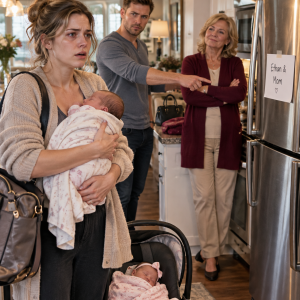
She stopped when she saw me.
“Are you satisfied now?”
Susan whispered her name.
I raised one hand.
“Let her ask.”
Olivia’s chin trembled.
“You always get to be the good one. The brave one. Everybody looks at you and sees sacrifice, while I am still the helpless child you saved.”
There it was.
Not all of the truth, perhaps, but enough of it.
My scars had become more than reminders of my suffering.
To Olivia, they were permanent evidence of the moment when she had been powerless and I had been strong.
She had spent years trying to escape that imbalance.
Instead of telling me, she tried to hide the evidence whenever it threatened the version of herself she wanted others to see.
I looked at her carefully.
“I never asked you to repay me.”
Her eyes dropped.
“I know.”
“I do not think you do.”
She became still.
“I rescued you because you were my ten-year-old sister trapped inside a burning house. I never asked you to introduce me as heroic, thank me every birthday, or carry permanent guilt.”
I removed my gloves.
The scarred skin across my hands caught the afternoon light.
“I only expected you not to treat the body that resulted from saving you as something ugly that needed to disappear.”
Olivia looked away.
She did not apologize that afternoon.
I was glad.
An apology delivered while her wedding was collapsing would have contained too much panic to mean anything useful.
Part 8 — What Happened After the Flowers Died
Andrew did not marry Olivia that day.
He also did not announce that their relationship was permanently finished.
He told her they needed time apart and that anything decided next should happen privately, after anger, embarrassment, and family pressure stopped controlling the conversation.
I respected him for that.
He did not turn me into the reason for his decision.
He took responsibility for his own doubts.
The decision I made afterward belonged entirely to me.
For the first time since the fire, I stopped automatically absorbing discomfort so the rest of my family could function smoothly.
When my mother called repeatedly, I answered only when I had emotional energy.
When my father apologized again, I allowed him to sit with the discomfort instead of immediately telling him he had always been a wonderful father.
When relatives asked what happened at the wedding, I gave the simplest accurate explanation.
Olivia asked me to move out of the visible seating area because my wheelchair and scars conflicted with the wedding photographs she wanted. Eleanor overheard enough to question it, our parents confirmed parts of the conversation, and Andrew stopped the ceremony after learning the history behind my injuries.
I did not insult Olivia.
I also stopped lying to protect her.
That difference felt enormous.
Two weeks later, my parents came to my apartment for lunch.
Olivia did not attend.
That was fine.
Some family wounds need distance before they need conversation.
My father carried coffee while my mother brought sandwiches.
As Robert approached the dining table, he noticed a chair blocking the space where my wheelchair normally fit.
He did not make a speech.
He simply lifted the chair, moved it against the wall, and cleared enough space for me.
Then he set my coffee beside my bare hand.
The gesture was ordinary.
That was why it mattered.
Part 9 — Olivia Comes Back Without an Audience
Nearly four months passed before Olivia asked to see me alone.
We met in a quiet café near the James River because neither of us wanted our parents translating the conversation.
She looked different without wedding makeup, bridesmaids, schedules, or photographers.
More importantly, she looked tired.
“Andrew and I are not together right now.”
I nodded.
“I’m sorry you’re hurting.”
She studied me.
“You mean that?”
“Your pain does not become entertaining because you hurt me.”
Her eyes filled with tears.
For several minutes, she said nothing.
Then she admitted she had spent years resenting the way relatives reacted to the fire.
People praised me.
People protected her.
The combination made her feel both guilty and infantilized.
As she grew older, my wheelchair became a visible object she associated with that story.
“Sometimes I would walk into a room with you and immediately wonder who already knew.”
I listened.
“Why didn’t you ever tell me?”
She wiped her cheek.
“Because it sounded horrible.”
“It was horrible. Feeling something horrible does not make it disappear.”
She nodded.
Then she finally said the words I had refused to demand.
“I am sorry I asked you to hide.”
I waited.
She continued.
“Not because Andrew stopped the wedding. Not because everyone heard me. I am sorry because I looked at you and thought about whether you fit into photographs instead of remembering you were my sister who had every right to sit there.”
That apology was different.
It did not ask me to make her feel better immediately.
So I accepted it without pretending everything had been repaired.
“Thank you.”
She looked surprised.
“That’s all?”
“For now.”
Healing did not require dramatic reconciliation on schedule.
Part 10 — A Place at the Table

A year after the canceled wedding, our family gathered at my parents’ home for Thanksgiving.
Olivia and Andrew had eventually separated permanently.
Their decision belonged to them, and neither discussed the details with me.
Olivia had spent much of the year in therapy.
So had my mother.
My father never announced that he had changed, but I noticed he stopped allowing family comfort to depend automatically on my silence.
When I arrived for dinner, Olivia opened the door.
She looked at my chair and then toward the crowded dining room.
For a brief moment, the old instinct returned inside me.
I searched automatically for the least disruptive place.
Olivia noticed.
“Your place is beside me.”
I looked toward the table.
One chair had been removed beside hers, leaving enough room for me without squeezing against anyone.
No special announcement.
No heroic story.
No discussion about the fire.
Just space.
During dinner, my aunt asked Olivia about a new apartment.
My father complained about football.
My mother burned one tray of rolls.
For almost three hours, nobody mentioned my scars.
Nobody praised me for surviving.
Nobody looked at Olivia with pity.
We simply ate together.
After dessert, Olivia helped clear the table while I moved toward the kitchen.
She stopped beside me.
“I used to think normal meant nobody noticing what happened to us.”
I looked at her.
“What does it mean now?”
She considered the question.
“Maybe normal is not needing anyone to disappear so everyone else can feel comfortable.”
I smiled.
“That sounds better.”
The fire had changed my body permanently.
It had changed Olivia in ways none of us understood at ten years old.
For years, our family responded by protecting her feelings and praising my resilience, never realizing both habits prevented us from talking honestly about what remained underneath.
The wedding did not destroy our family.
It exposed a pattern that had already been hurting us.
I had spent twelve years believing love required me to make myself smaller whenever my existence complicated somebody else’s comfort.
Olivia had spent those same years believing she could escape her shame by controlling which parts of our shared history other people were allowed to see.
Neither belief could survive honesty.
That Thanksgiving evening, I sat beside my sister without gloves covering my hands and without a pillar hiding my wheelchair.
Nobody stared.
Nobody applauded.
Nobody needed to.
For the first time since the fire, being fully visible did not feel like becoming the center of the room.
It simply felt like having my rightful place inside it.
THE END