“If three years of work depend on falsified ownership records and manufactured defaults, they deserve to be destroyed.”
Her jaw tightened.
“You think everything began with Camden Ridge.”
“Then tell me where it began.”
She walked toward the windows.
“It began when your father died and this place started falling apart.”
I said nothing.
“Claire called you constantly during the first year. Roof damage, insurance problems, vendors leaving, unpaid maintenance. You sent money through assistants.”
The accusation hurt because it was true.
Caroline continued.
“I was still married to you then, Daniel. I watched you spend eighteen hours negotiating a warehouse acquisition in Virginia while refusing to drive ninety minutes to sit with your sister.”
“That does not justify what you did.”
“I did not say it did.”
For the first time, her confidence cracked.
She explained that the foundation originally intended to stabilize Harbor Row by attracting private capital. Camden Ridge provided financing, but its conditions became more aggressive as surrounding property values increased.
Caroline had convinced herself that redevelopment was inevitable and that controlling the process would preserve at least part of the market.
Then money entered.
Her investment in Shoreline Account Management transformed professional compromise into personal conflict.
“Did you know they were reclassifying payments?”
She looked away.
That was enough.
“When did you know?”
“Three months ago.”
I felt something inside me settle.
“And you continued.”
“By then everything was committed.”
“No. By then admitting the truth had become expensive.”
Caroline closed her eyes.
She had once accused me of believing money could solve absence.
She had eventually made the opposite mistake.
She believed momentum could excuse wrongdoing.
Part 9 — Monday Without a Transfer
Monday arrived without bulldozers, title transfers, or celebratory redevelopment announcements.
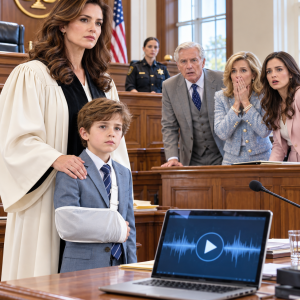
Instead, county officials convened an emergency administrative hearing.
Rebecca Morgan presented discrepancies in historic cooperative records.
Independent accountants presented evidence of payment reclassification.
Attorneys for affected vendors challenged default notices.
Camden Ridge denied intentionally manufacturing delinquencies and blamed a software migration for posting irregularities.
That explanation became difficult to defend when Daniel Cho demonstrated that delayed postings disproportionately affected accounts whose default provisions offered the most valuable acquisition rights.
Caroline’s ownership interest in Shoreline was disclosed publicly.
She resigned from the redevelopment committee before the hearing ended.
The county suspended the transfer indefinitely pending civil review and referred the payment irregularities to appropriate regulators.
Nobody went to jail that afternoon.
No miraculous judge handed me the market.
Real consequences moved more slowly.
Several contracts entered litigation.
Camden Ridge withdrew from the project months later after lenders reconsidered their exposure.
Shoreline reimbursed disputed penalties under a settlement without admitting intentional wrongdoing.
Caroline stepped down from leadership of her foundation while its independent board reviewed conflicts of interest.
Harbor Row survived.
But survival created another question.
What happened next?
Part 10 — The Market Could Not Live on Memory
Saving Harbor Row from a predatory redevelopment deal did not fix its leaking roofs.
The market still needed nearly two million dollars in infrastructure work.
Insurance costs were rising.
Several refrigeration systems required replacement.
So we did something less dramatic than defeating Caroline.
We rebuilt the cooperative properly.
Each vendor received independent legal counseling before voting.
The cooperative approved a modernization plan financed through a combination of municipal preservation grants, member contributions, and a transparent loan from Meridian Freight at below-market interest.
I recused myself from votes involving my company.
Claire became chair of the cooperative board.
Walter received corrected account records removing the manufactured defaults.
Margaret replaced her roof.
Tyler and Emily bought energy-efficient refrigeration equipment without surrendering their stall rights.
I also changed something that never appeared in the redevelopment documents.
I returned every month.
Sometimes I attended meetings where nothing important happened.
Sometimes Claire complained about parking.
Sometimes Walter argued about delivery times for forty minutes.
I learned that presence was inefficient.
That was exactly why it mattered.
Part 11 — What the Brass Token Was Actually Worth

A year later, Harbor Row held its annual autumn festival beneath a restored wooden pavilion.
No luxury apartments stood behind it.
No glossy lifestyle development had swallowed the produce stalls.
The market looked newer without becoming unrecognizable.
Claire found me near Stall Eleven, where my father’s old brass token now sat inside a small display case explaining the cooperative’s history.
“You know Dad would hate having his old token inside a museum box.”
I smiled.
“He would probably take it out and use it to level a table.”
Claire laughed.
Across the courtyard, Noah and Grace helped Walter arrange pumpkins while Margaret argued cheerfully with a customer over chrysanthemums.
Claire became quiet.
“I was wrong about one thing.”
“Only one?”
She ignored that.
“I thought you came back because you discovered the land was valuable.”
I looked around the market.
“I came back because I thought Caroline was stealing Dad’s property.”
Claire raised an eyebrow.
“That is not much better.”
“I know.”
The real answer had taken longer.
I had returned intending to defend an inheritance.
I stayed because an inheritance was not a brass token, a deed, or a percentage on a cooperative ledger.
It was responsibility.
My father had not preserved Stall Eleven so one of his children could someday leverage the land.
He preserved it because hundreds of ordinary Saturdays had created relationships worth protecting.
The token merely proved his ownership.
It could not prove mine in any meaningful sense.
That required showing up.
Before sunset, Walter brought me a box of tomatoes.
“These are for you.”
“How much?”
He frowned.
“After everything, you’re going to ask me what they cost?”
I laughed and accepted the box.
Across the courtyard, Claire was helping Grace close one of the folding tables while Noah carried empty crates toward the storage room.
For years, I had believed support meant ensuring nobody needed to ask me twice for money.
Now I understood why Claire had hated that version of generosity.
Money could repair roofs.
It could replace refrigeration equipment, refinance debt, hire attorneys, and stop a struggling business from disappearing.
But money could not know when Walter opened a frightening letter.
It could not sit beside Claire after Dad died.
It could not walk from stall to stall asking frightened vendors what they believed they had signed.
It could not recognize the silence that follows when someone realizes a contract has taken more than they understood.
Those things required a person.
I had spent a decade funding Harbor Row from a distance and calling that loyalty.
The redevelopment fight taught me something my father probably understood without needing lawyers, accountants, land records, or an old brass token to explain it.
Ownership might be recorded on paper.
Belonging had to be renewed every time you chose to return.
THE END