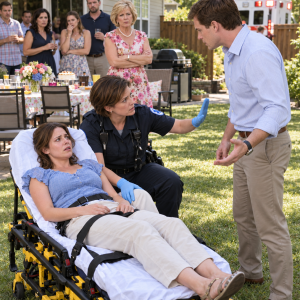
Under Rebecca’s guidance, I continued playing the role of a wife persuaded by his devotion. I thanked him for meals, allowed him to push my wheelchair, and listened while he described vacations we might take after my recovery.
The more trust I performed, the more confident he became.
One evening, he placed a bowl of soup beside me and suggested combining our bank accounts again.
“It would simplify everything before your second surgery. I could manage bills while you are under anesthesia and during the first week afterward.”
“The surgeons said I would probably be discharged the same day.”
“General anesthesia always creates risks. Infection, blood clots, cardiac complications, unexpected bleeding. We should prepare for every possibility.”
The words were medically reasonable, but his interest had become too specific.
At appointments, he repeatedly asked how long I would remain unconscious, whether embolisms could occur after orthopedic procedures, and how quickly the hospital would notify a spouse during an emergency.
The surgeon eventually looked at him with visible discomfort.
“Mrs. Bennett is recovering well. The operation is routine, and we have no current reason to expect a serious complication.”
Nathan smiled.
“I prefer preparing for unlikely outcomes.”
So did I.
Several days later, the family tablet displayed a message while Nathan showered. His phone was connected to the same cloud account, allowing notifications to appear across both devices.
The sender was a man named Marcus.
The message read: The beneficiary confirmation must be finished before she goes into surgery.
I photographed the screen and sent the image to Rebecca.
Her investigator uncovered Nathan’s financial crisis within forty-eight hours.
He owed approximately one hundred eighty thousand dollars. A house-renovation project in Aurora had failed after structural problems made the property impossible to resell. The bank had begun foreclosure proceedings, and two private lenders were demanding repayment.
Marcus Keller was not merely a business partner. He had personally guaranteed part of the loan and had begun threatening legal action.
Nathan’s apartment in Denver had never represented a thoughtful separation. It had been a place where he hid financial records, creditor notices, and evidence of the collapsing investment.
The five-hundred-thousand-dollar insurance payment would clear every major debt and leave him with enough money to restart.
Police obtained a warrant after the insurance company referred the suspected fraud. Deleted messages recovered from Nathan’s phone revealed the full calculation.
Marcus had written: Are you planning to cause something during the operation?
Nathan replied: I am not stupid enough to touch her. If the surgery goes badly, I will not let half a million dollars go to Olivia while I am left with nothing.
Another message was worse.
She believes the crash brought us back together. Once she signs the financial authorization before surgery, the rest becomes simple.
Nathan might not have planned to kill me, but he had returned home expecting that my body could fail without his assistance.
Every meal, every blanket, and every night spent beside my bed had been part of an investment strategy.
The Daughter He Intended to Remove
Keeping Olivia uninformed became impossible once police involvement expanded.
Rebecca and I arranged a private call while Nathan believed she was still studying for examinations.
My daughter listened silently as I described the forged signature, the beneficiary request, and the recovered messages.
“He tried to remove me from your policy while pretending to care for you?”
“Yes.”
“Why did you let me believe you were reconciling?”
The question hurt because she deserved an answer.
“I had not decided anything when he said it. You looked relieved, and I did not want to take that relief away while you were finishing the semester.”
“Silence still allowed him to lie to me.”
“You are right.”
Olivia wiped her face.
“I do not care about the insurance money. I care that he was waiting to see whether you survived.”
That sentence stripped away every technical term surrounding the crime.
This was not merely insurance fraud, forgery, or abuse of authorization. Nathan had transformed my medical vulnerability into a financial opportunity and attempted to steal from his own daughter while presenting himself as the family’s protector.
Olivia wanted to confront him immediately, but Rebecca advised against it.
Instead, she returned home quietly and stayed with my sister at a nearby hotel. Her presence would become important when Nathan’s deception finally collapsed.
Rebecca planned a recorded conference call three days before my surgery. The stated purpose was to discuss marital reconciliation, account management, and temporary authority during hospitalization.
Before beginning, Rebecca spoke clearly.
“This conversation will be recorded for legal documentation. Mr. Bennett, do you consent?”
Nathan believed the recording would help prove that I intended to restore his authority.
“Yes, I consent.”
Rebecca started with general questions regarding household expenses, then shifted toward the insurance policy.
“Mr. Bennett, did your wife instruct you to remove Olivia as beneficiary and designate yourself?”
A pause followed.
“We discussed the matter while Caroline was hospitalized.”
I entered the conversation.
“When did that discussion occur?”
“You were receiving medication, but you understood that I needed protection if I became your full-time caregiver.”
“Was I alert enough to make a legal decision?”
Nathan hesitated.
“You were overwhelmed, which is why I handled the administrative process.”
Rebecca responded immediately.
“If Mrs. Bennett lacked the capacity to make the decision, why does the request contain a signature represented as hers?”
Nathan’s breathing changed.
“I signed on her behalf because the deadline was approaching.”
“What deadline applies to changing a life insurance beneficiary?”
“The surgery created urgency.”
“Why?”
His voice rose.
“Because surgery carries risk, and I had abandoned my apartment and work obligations to care for her. If she died, I deserved financial protection.”
I gripped the phone.
“You returned without asking whether I wanted our marriage restored.”
“You obviously needed me.”
“Needing physical assistance did not mean I surrendered my legal decisions.”