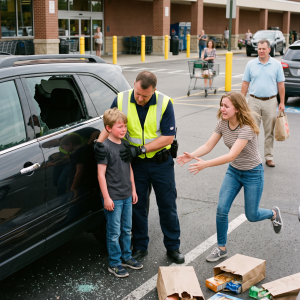
Daniel had been dismissed after a workplace injury prevented him from completing a delivery schedule. The company denied responsibility and attempted to characterize him as careless despite maintenance reports proving that his truck possessed defective braking equipment.
The third witness was Melissa Grant, a former Keller accountant. She preserved invoices, payment records, and correspondence revealing shell companies used to inflate prices for public-school meal contracts.
Those companies supposedly provided inspection and transportation services, although they had no employees, vehicles, or real offices. Money moved through them before returning to accounts connected with Gregory’s private investments.
Carter’s attorneys submitted the evidence to appropriate food-safety authorities, labor investigators, tax auditors, and federal financial-crime officers. Every referral included original records, witness statements, and independent verification so that the investigation could never be dismissed as retaliation arising from a failed engagement.
The Collapse Behind Polished Doors

Within ten days, investigators inspected Keller warehouses across Oregon and Washington. They seized mislabeled inventory, copied shipping databases, and interviewed current employees outside management’s presence.
Two hotel groups suspended Keller contracts after learning that temperature records might have been falsified. Several restaurant chains followed, while the company’s primary bank froze an expansion credit line pending examination of its financial statements.
Gregory publicly described the investigation as a personal attack orchestrated by a billionaire offended during a private disagreement. He never addressed the warehouse photographs, falsified invoices, or testimony from former employees.
One month later, Gregory attended a regional food-industry summit at the Oregon Convention Center. He entered expecting to reassure suppliers and discovered my father listed as the keynote speaker.
A business partner quietly explained what Gregory should have researched before insulting him.
Charles Carter had started as a flour-delivery driver, purchased a struggling grain warehouse, and gradually built an integrated agricultural network employing thousands of workers. His old suit and public transportation had reflected his origins rather than financial limitations.
During his speech, Dad never mentioned the Keller family or our canceled engagement.
“A food business earns trust every time a worker refuses to conceal a dangerous shortcut,” he told the audience. “Profit obtained by risking employees and customers is not success, because it is simply theft wearing respectable clothing.”
Gregory left before the presentation concluded.
According to records uncovered later, he returned home furious and blamed Dad for humiliating his family through deception. Lorraine insisted that we had intentionally dressed poorly to provoke them, as though their cruelty became reasonable when directed toward people they considered beneath them.
Rather than cooperating with investigators, Gregory contacted Victor Sloan, owner of a small freight company previously accused of transporting unregistered loads. Gregory wanted information about Dad’s travel routes between Portland and Carter distribution centers.
“I need something to happen that looks like an ordinary highway collision,” Gregory said during a recorded conversation. “Afterward, Carter’s lawyers will become too distracted to keep destroying my company.”
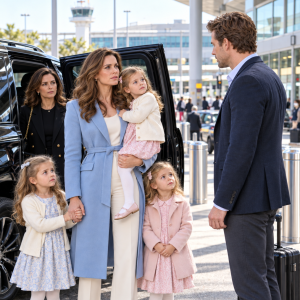
Victor contacted a truck driver named Owen Marks and promised him one hundred thousand dollars to force Dad’s vehicle from Interstate 84 near the airport corridor.
Owen followed Dad’s sedan for nearly twenty miles before steering a heavy freight truck toward its passenger side. Dad’s experienced driver recognized the movement early and turned toward a flexible median barrier rather than allowing a direct impact.
The sedan struck the barrier and rotated across the shoulder. Emergency responders transported Dad to a hospital with two fractured ribs, a mild head injury, and several painful marks caused by the seat belt.
I received the call while removing trays of rosemary rolls from the bakery oven. Without changing my flour-covered apron, I drove directly to the hospital.
Dad attempted to reassure me from the bed.
“The physicians expect a complete recovery, so this incident should not control your imagination,” he said.
Raymond entered with state investigators and two federal officers before displaying footage from the sedan’s dashboard camera. The truck had followed Dad, matched every lane change, and accelerated immediately before forcing him toward the barrier.
“This was not an ordinary traffic mistake,” Raymond explained. “The driver used a false delivery manifest and abandoned the truck outside Salem.”
Dad watched the recording twice before looking toward me.
“If my driver had reacted several seconds later, you might have lost your remaining parent because another man feared accountability,” he said.
His calmness frightened me more than anger would have.
“Promise that you will not pursue revenge outside the law,” I said.
Dad reached for my hand.
“Revenge would make this personal, while justice requires evidence, restraint, and institutions capable of protecting everyone,” he replied.
The Conspiracy Unraveled
Investigators located Owen inside a roadside motel near Boise, Idaho, where he had registered under a false name while preparing to travel farther east.
His burner phone contained messages from Victor, partial payment records, and photographs identifying Dad’s vehicle. Faced with overwhelming evidence, Owen admitted accepting the assignment and provided access to an encrypted account containing the remaining instructions.
Victor surrendered shortly afterward. He delivered a recording in which Gregory described the intended collision and insisted that everything appear accidental.
“Do not create witnesses, and make certain the highway handles the rest,” Gregory said on the recording.
Two days later, investigators entered the Keller family’s estate outside Lake Oswego. Lorraine shouted that powerful competitors had corrupted law enforcement, while Gregory attempted to contact attorneys using a phone already covered by a preservation warrant.
Brandon stood inside the foyer as officers escorted his father toward an official vehicle. His expression suggested that he was witnessing the consequences of choices he had spent years pretending not to notice.
Gregory faced charges involving the planned highway attack, financial fraud, falsified food records, witness intimidation, and conspiracy. Victor and Owen entered cooperation agreements while providing detailed testimony concerning their roles.
The court froze substantial Keller assets to preserve funds for employees, injured workers, customers, and public institutions. Keller Culinary Distribution entered bankruptcy after lenders withdrew support and several remaining clients terminated their contracts.
Independent administrators assumed control of usable facilities so innocent employees could continue receiving wages while the company’s assets were evaluated. Dad insisted that the legal strategy distinguish workers from executives who had authorized misconduct.
“A warehouse employee should not lose rent money because an owner treated regulations like obstacles,” he told Raymond. “Protect payroll before collecting any amount owed to Carter companies.”
Food-safety investigators traced several complaints previously dismissed as unrelated restaurant incidents. School districts received refunds, while affected businesses gained access to a restitution process funded through seized corporate assets.
Lorraine sold jewelry and luxury vehicles after the family’s accounts became restricted. She continued blaming us publicly until her attorney advised that further statements could damage her credibility.
Brandon resigned from the company before administrators removed him. Although investigators found no evidence connecting him to the highway conspiracy, they discovered that he had received internal warnings concerning warehouse conditions.
He had forwarded those warnings to Gregory without demanding corrective action and then continued collecting bonuses generated through reduced disposal expenses.
His silence inside the restaurant had not been an isolated weakness. It was the same habit that allowed him to remain comfortable while warehouse workers, drivers, and customers carried risks created by his family.
The Apology Outside My Bakery

Brandon appeared outside the bakery on a cold afternoon six months later. He looked thinner, wore a plain coat, and waited until my shift ended without entering the business.
“I am not asking you to resume our engagement, because I understand that possibility disappeared before we left the restaurant,” he said.