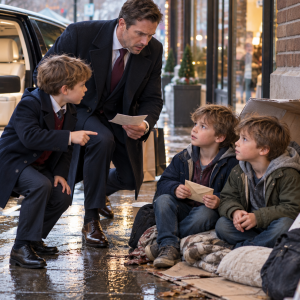
My mother looked at me from the driveway.
“You will regret treating us like strangers.”
“Strangers would have shown more concern while I was in intensive care.”
They left without the casserole dish, which remained on the porch until Daniel threw it away.
Part 5: The Story Behind The Money

The confrontation should have ended there, but two days later, Luke contacted me from a new number.
His message was different from the others.
“I need to tell you what the money was really for.”
I agreed to meet him in a public café with Daniel sitting nearby and my phone recording openly on the table.
Luke arrived wearing yesterday’s clothes and carrying the folder from our porch. He looked exhausted rather than angry.
“Mom does not need surgery,” he said before sitting down. “Dad owes money to a private lender.”
The debt came from an investment scheme involving renovated rental properties in Duluth. My father had convinced several relatives to contribute, promising guaranteed returns. The properties did not exist, and the man managing the supposed investment had disappeared with most of the funds.
My father had covered early repayments using money borrowed from other people. When the arrangement began collapsing, he decided I could rescue everyone quietly.
The requested $14,500 represented the first urgent payment, not the entire debt.
“Why use Mom’s surgery?” I asked.
Luke looked down.
“Because he said you would never refuse if you thought she might die.”
The cruelty of that calculation silenced me for several seconds.
My father had watched me nearly die, refused to visit, and then used the possibility of my mother’s death as leverage because he understood exactly which wound remained open.
Luke pushed the folder toward me. Inside were messages between him and my father, payment schedules, and a handwritten list of relatives who believed their money remained invested.
“Why are you giving me this?”
His eyes filled with shame.
“Because he wants me to tell everyone you took the money. He said your job in payroll would make the accusation believable.”
The false police report had not been an emotional outburst. It had been the beginning of a cover story.
I contacted my attorney and provided the documents to investigators. The case quickly expanded from a family dispute into a fraud inquiry involving multiple victims. My father had not created the original scheme, but he had knowingly repeated false claims and redirected funds to conceal losses.
My mother admitted that she knew there was no scheduled surgery. She insisted she participated because she feared losing the house.
Luke cooperated with investigators and avoided charges after proving he had been misled about several transactions, although our relationship did not repair simply because he finally told the truth.
Honesty delivered late can still matter, but it does not erase everything that came before it.
Part 6: The Difference Between Need And Love
My father eventually accepted a plea agreement involving fraud, false reporting, and attempted financial coercion. The court ordered restitution to several relatives, and my parents sold their house to satisfy part of the judgment.
He never offered an apology without attaching an explanation. According to him, pressure had made him desperate, fear had confused his judgment, and my refusal to help had forced him to act quickly.
Responsibility always remained nearby, but never close enough for him to hold.
My mother moved into a small apartment and continued sending messages through relatives about reconciliation. Every request began with the language of healing and ended with something she needed.
I maintained no contact.
Luke attended counseling and began repaying money he had borrowed from me over the years. I did not restore the relationship we once pretended to have, but I allowed brief communication because he respected the conditions I established.
Recovery continued in quieter ways.
I returned to work part-time, then gradually resumed full responsibility. Hannah decorated my desk with a banner reading, “WELCOME BACK, PAYROLL EMPRESS,” and I laughed hard enough to become dizzy.
Marisol sent a card through the hospital’s patient-services department after I wrote to thank her. Her message said that survival was sometimes measured less by the body’s strength than by the willingness to believe care should not have to be earned.
Daniel and I spent our first holiday without my family making pancakes, watching old movies, and ignoring our phones. I expected guilt to suffocate me, but peace arrived instead.
At first, peace felt suspicious because I had mistaken chaos for belonging for so many years.
By spring, I could discuss the hospital without hearing the monitor in my dreams. By summer, I drove past the medical center without gripping the steering wheel. By autumn, I could say no without providing three explanations and a carefully worded apology.
The police reports remained inside a locked file. So did the hospital call logs, bank statements, voicemails, and doorbell recordings. I rarely opened them because I no longer needed evidence to convince myself.
I remembered the truth.
My family left the chairs empty.
Daniel filled the room.
Hannah brought clean clothes and patience. Marisol documented what others hoped could be forgotten. The police officers listened when evidence replaced accusation.
I finally stopped confusing someone’s need for me with their love for me.
Part 7: The Life I No Longer Owed Anyone

Two years after my collapse, I volunteered with a financial-literacy program supporting patients recovering from serious illness. Many participants had discovered that medical crises attracted relatives who treated insurance payments, disability benefits, or savings as shared family property.
During one workshop, a woman asked how I stopped feeling guilty for refusing money to people who raised me.
I considered the question carefully.
“I learned that gratitude and surrender are not the same thing,” I told her. “You can appreciate what someone once gave you without allowing them to take whatever they want forever.”
After the workshop, Daniel and I walked along the Mississippi River beneath trees beginning to turn gold.
“Do you ever miss them?” he asked.
“I miss the family I kept expecting them to become.”
He nodded because he understood the difference.
I did not miss the demands, accusations, or emergency messages. I mourned the imagined mother who would sit beside my hospital bed, the father who would protect my name instead of using it, and the brother who would call because he cared rather than because an account was empty.
Grief became easier when I stopped directing it toward people who still believed they had done nothing wrong.
The last message my father sent arrived through a distant cousin. It contained no apology, only a statement that families should not keep score.
I deleted it after saving one final screenshot.
For years, I had not kept score at all, which was why they continued taking.
Boundaries were not revenge. Documentation was not cruelty. Refusing manipulation was not abandonment.
The night the police first appeared, I stood in our living room with weak legs, flashing lights moving across the wall, and my hospital folder open on the table. I remember pressing play on my father’s voicemail and hearing his own voice reveal what years of arguments could never prove.
For once, I allowed the truth to speak without translating it into forgiveness.
Nearly dying taught me that a person can owe honesty, kindness, gratitude, and accountability. Nobody owes their future to people who notice them only when money is missing.
I did not become heartless after the hospital.
I became unavailable for exploitation.
Those are not the same thing.
The monitor beside my bed once counted every second as though my survival were uncertain. My family treated those seconds as less important than their convenience.
Now I measure life differently.
I measure it by the people who arrive, the peace inside my home, and the freedom to answer a demand without fear.
The empty chairs taught me who they were.
The life afterward taught me who I could become.
THE END