Part 1 — The Apartment That Stopped Feeling Like Mine
When I opened the door to our condo at six-thirteen on a Tuesday evening, the first thing I smelled was camphor. Not dinner, not detergent, not the lemon cleaner I used every Sunday after my daughter spilled juice on the kitchen tiles. Camphor. Sharp, old-fashioned, and stubborn, the kind of smell that clings to cedar chests, attic quilts, and people who believe the past can be preserved if you wrap it tightly enough.
My daughter, Lily, was sitting on the living room rug with her knees pulled to her chest, crying in small broken breaths. She was three years old, usually loud enough to make the neighbors smile through the wall, and I had never seen her look afraid inside her own home.
My husband, Mark, sat on the sofa with his phone in both hands. He was not scrolling. He was not typing. He was simply holding the phone as if it could become a shield if the room turned against him.
Behind him, the kitchen cabinets stood open.
That was how I learned something had already happened.
Earlier that morning, Mark had called me at work using the careful voice people use when they know they have already done the wrong thing and want permission afterward. He said his mother, Ruth Keller, had arrived unexpectedly from Ohio. She had fought with his older brother’s wife, needed somewhere calm to stay, and had already let herself into our apartment because Mark had given her our spare key. He begged me not to make it difficult.
I had said very little. I was at my desk in a pediatric billing office, surrounded by insurance codes and unpaid claims, and I told myself what reasonable women tell themselves before they discover how unreasonable a situation has become. It was only a few days. She was his mother. Families were complicated. Boundaries mattered, but emergencies mattered too.
On the subway home, I practiced patience like a foreign language.
Then I came home and found my life rearranged.
My kitchen was no longer my kitchen. Pots had been moved to the upper shelves, coffee mugs were stacked where the plates belonged, and spices were lined up alphabetically on the counter, as if paprika had been waiting for military discipline all along. I opened three drawers before finding a spoon. The small plastic cups Lily used were gone from the low cabinet where she could reach them.
In our bedroom, my underwear had been dumped on the bed because Ruth needed drawer space. Not a corner. Not one spare drawer for a brief visit. Drawer space. Her dresses hung in my closet, pressed neatly between my work blouses and Mark’s shirts, smelling faintly of cedar and a floral powder I did not recognize.
Then I walked into Lily’s room.
A thick knitted blanket lay across her toddler bed. It was cream and pale yellow, handmade, heavy, and saturated with that same camphor smell. Her stuffed animals had been rearranged along the pillow. Her books were sorted by height. The little night-light shaped like a moon had been unplugged and moved because, apparently, Ruth thought the outlet was unsafe.
My daughter had not stopped crying.
Ruth came out of the kitchen wearing an apron I had never seen before and a smile bright enough to pretend nothing was wrong.
“Sweetheart,” she said, “I just made things easier around here. Honestly, the kitchen layout did not make much sense before.”
I looked at Mark.
He looked at his phone.
Ruth continued, lifting a bottle of detergent from the counter.
“And I changed the laundry soap. The one you use is too strong for Lily’s skin. Mark had eczema as a boy, you know. When you are older, you learn these things.”
That was the sentence that lit the match.
Not because she mentioned detergent. Not because she meant to help. Because she had entered my home without asking, changed the way I cared for my child, touched my clothes, moved my daughter’s room, and stood there calling the invasion experience.
I went to Lily first. I knelt on the rug, wiped her cheeks, and held her until her breathing slowed against my shoulder.
“Nobody is angry with you,” I whispered. “This is grown-up trouble, baby. You did nothing wrong.”
Then I carried her into my bedroom, placed her on the bed beside her favorite stuffed fox, and closed the door halfway so she could still see the hallway light.
I walked back into the living room.
Ruth was still smiling, though the edges had begun to fail. Mark had finally looked up.
I went to the closet, took Ruth’s old blue suitcase from the corner where she had left it open, and returned to my bedroom. I folded every dress, blouse, cardigan, and nightgown she had hung in my closet. I placed her toiletries in a side pocket. I tucked her shoes into a plastic bag. I zipped the suitcase carefully and rolled it to the front door.
Then I opened the ride-share app and ordered a car.
Eight minutes.
When I turned around, Ruth’s smile was gone.
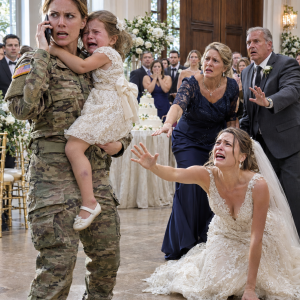
“Mrs. Keller,” I said, my voice calm enough to frighten even me, “you entered my home without my permission. You rearranged my kitchen, touched my personal belongings, changed my child’s room, and frightened my daughter. I respect you as Mark’s mother, but this is my home. I ordered you a car. It will be here in eight minutes, and your suitcase is ready.”
The silence that followed was enormous.
Ruth looked at me, then at Mark.
“I thought there might be a place for me here,” she said quietly.
At the time, I heard manipulation. I heard guilt. I heard the old script of a mother-in-law who believed motherhood gave her permanent keys to other people’s houses.
Mark stood, but I lifted one hand before he spoke.
“If you want to go with your mother and help her find a hotel, you can. But no one gets to enter this home without asking first. That includes your mother.”
Ruth picked up the suitcase. Her face was red with humiliation, but she did not argue. She walked out without another word.
Mark followed her downstairs.
I stayed behind with Lily and told myself I had protected our home.
Part 2 — The Three Nights I Did Not Know About
Mark came back an hour later and said I had humiliated him. He said his mother had only wanted to help. He said real family did not treat one another like strangers in a lobby. I asked him one question.
“Did you ask me before giving your mother our spare key?”
He said nothing.
That silence became the only answer I needed.
I spent the night putting the kitchen back. I washed Lily’s sheets twice to remove the camphor smell. I found her moon night-light and plugged it back into the wall. I moved the plastic cups down where she could reach them again because small independence matters to children, especially after adults make them feel powerless.
By midnight, I felt victorious in the tired, brittle way people feel victorious when they are too angry to admit they are shaken.
For three days, Mark barely spoke to me. He said Ruth had checked into a hotel near the bus terminal. He said she was fine. He said I had made my point and should be satisfied. I was not satisfied, exactly, but I was proud of myself. I believed I had been firm, modern, and clear. I believed I had drawn a line that needed drawing.
On Friday afternoon, pride began to rot.
I called the hotel Mark had mentioned. I told myself I was trying to be generous. I would apologize for my tone, not for the boundary. I would let Lily say hello to her grandmother. Perhaps we could meet somewhere neutral, like a diner, where Ruth could see us without touching the cabinets.
The hotel had no guest named Ruth Keller.
I called again, thinking I had misheard the location. No Ruth Keller. No reservation. No recent checkout. No room paid under Mark’s card.
I sat at my desk with the phone in my hand and remembered the suitcase. All her clothes. The way she had hung them in my closet as if she had not packed for a visit but for an ending. I remembered the sentence I had dismissed.
I thought there might be a place for me here.
That evening, I waited until Lily fell asleep. Mark was in the kitchen, standing in the exact layout his mother had created and I had undone.
“Where is your mother?” I asked.
He did not turn around.
“At the hotel.”
“No, she is not.”
His shoulders stiffened.
“I called.”
He gripped the counter with both hands.
“Anna.”
My name sounded like a warning.
“Where is she, Mark?”
For a long time, he did not answer. Then the man I had married folded in front of me. He covered his face with both hands and cried in a way I had never seen from him, not when Lily was born early, not when his father died, not when he lost his job during the first year of our marriage and pretended optimism could pay rent.
“She slept at the Greyhound station,” he said. “On a metal bench. For three nights.”
The floor seemed to tilt.
The Greyhound station downtown was not dangerous in the dramatic way people imagine from films. It was worse because it was ordinary. Fluorescent lights, diesel fumes, vending machines, plastic seats, people guarding bags between their knees, security guards too tired to distinguish between waiting and despair.
Ruth had slept there with her old suitcase for three nights.
While I slept in a warm bed, proud of myself for defending my boundaries.
“What is going on?” I whispered. “There was no fight with your brother’s wife, was there?”
Mark shook his head.
“Why did you lie to me?”
He wiped his face with the heel of his hand, but tears kept coming.
“Because Mom made me promise not to tell anyone.”