The Two Suitcases on My Porch
When I came home from Sunday service, two suitcases were sitting at the bottom of my front steps.
Mine.
Rain had darkened the fabric, and water was dripping from the zipper of the larger one.
For a few seconds, I simply stood beside the sidewalk, holding my purse against my coat and staring at them.
Then I noticed the sign planted beside the driveway.
SOLD.
My name is Margaret Hollowell. I was seventy-two years old, and I had lived in that two-story house outside Richmond, Virginia, for more than forty years.
My late husband, Arthur, and I had bought it when we could barely afford groceries.
He repaired heating systems. I altered wedding dresses, school uniforms, curtains, and anything else people brought to my sewing room.
We raised our daughter there.
We celebrated birthdays there.
Arthur spent his final Christmas there.
So when I saw my suitcases outside my own house, my first thought was that there had been some terrible misunderstanding.
Then my son-in-law stepped onto the porch.
Brent Mercer held a coffee mug in one hand and looked strangely relaxed.
“You’re finally back.”
I looked at the suitcases.
“Why are my things outside?”
He nodded toward the SOLD sign.
“Because the house isn’t yours anymore.”
For a moment, even the rain seemed to disappear.
“What did you say?”
Brent leaned against the porch railing.
“We sold it.”
The Daughter Behind the Window
I looked toward the living-room window.
The curtain moved.
My daughter, Allison, was standing behind it.
She was forty-one years old.
I had paid for her college education by taking alterations long after my regular workday ended. When Brent’s business failed, I had opened my home to both of them.
That was supposed to last six months.
They had been living with me for nearly three years.
“Allison?” I called.
She slowly came outside.
She couldn’t quite look at me.
“Mom, please don’t make this harder.”
I almost laughed because I couldn’t understand what she meant.
“You packed my clothes.”
Her eyes dropped toward the wet suitcases.
Brent answered for her.
“A senior living community has a room available. They’ll pick you up this afternoon.”
I stared at him.
“You arranged somewhere for me to live?”
“Somewhere safer,” he said. “You’re seventy-two. This house is too much for you anyway.”
Then came the explanation he had apparently rehearsed.
The property was valuable.
They needed money.
Allison needed stability.
I needed “care.”
According to Brent, selling my home solved everyone’s problems.
There was only one problem with his plan.
He had never truly understood what I owned.
The Papers I Should Have Read
Brent smiled when he saw the confusion on my face.
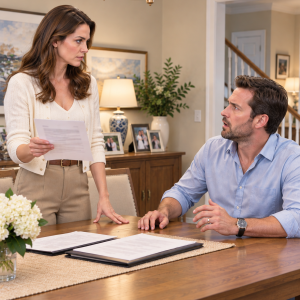
“You signed the authorization yourself.”
That sentence brought back a memory from the previous week.
Allison had placed a stack of documents on the kitchen table while I was making tea.
She told me they concerned insurance records, medical paperwork, and household matters.
I signed where she pointed.
I didn’t study every page.
That was careless.
But it wasn’t because I couldn’t understand paperwork.
It was because the person handing me the papers was my only child.
Trust can make intelligent people stop asking necessary questions.
“You used those documents to sell my house?”
Allison finally looked at me.
“Brent said it was the only way.”
“The only way to do what?”
Her lips trembled.
“He owes people money.”
Brent immediately interrupted.
“Enough. The buyer will be here soon.”
Then he pointed toward the driveway.
“Your ride should be here in about thirty minutes.”
I looked at my wet suitcases again.
Something inside me changed.
Not loudly.
Not dramatically.
I simply became very calm.
“Then you’d better hope your buyer is late.”
Brent frowned.
“Why?”
I walked toward the front door.
“Because I need ten minutes.”
The Black Folder
Brent tried to block the doorway.
“You can’t just walk back in.”
I looked directly at him.
“Move.”
Maybe it was my voice.
Maybe it was my face.
Whatever it was, he stepped aside.
Inside, my home barely looked like mine.
Boxes filled the hallway. Family photographs had been removed from the shelves. My mother’s china was wrapped carelessly in newspaper.
I walked upstairs.
Brent followed.
“What are you looking for?”
I entered my sewing room and opened an old cabinet beneath my cutting table.
Behind a removable wooden panel was a narrow compartment.
Inside it sat a dark navy document folder.
Brent laughed when he saw it.
“What is that supposed to be?”
I brushed a little dust from the cover.
“The reason you should have asked more questions before selling someone else’s future.”
His smile weakened.
Years earlier, after Arthur passed away, I had met with an estate attorney named Miriam Caldwell.
I wanted to make certain that I could remain in my home for the rest of my life while ensuring the property eventually benefited a local nonprofit that provided transitional housing for older women.
The legal arrangement was carefully documented.
I retained the right to occupy and use the property for my lifetime.
The future interest had already been transferred under the estate arrangement.
The point was simple.
No relative could someday pressure me into surrendering my home.
At the time, I thought I was preparing for an unlikely possibility.
Standing in my bedroom with Brent watching me, I realized Arthur and I had prepared for exactly this day.
“Your paperwork doesn’t give you what you think it gives you,” I said.
Brent’s face changed.
The Buyer Arrived
The doorbell rang downstairs.
A man named Douglas Rainer entered carrying a leather portfolio.
He was in his fifties and clearly impatient.
“I’m here for the keys.”
Brent hurried downstairs.
“Everything’s ready.”
“No,” I said from behind him. “It isn’t.”