Part 1 – The Letter at Mount Auburn
The threat arrived before dinner, delivered in the same calm voice Monica Bennett used whenever she wanted cruelty to sound like responsibility.
“If you mention Oxford one more time, Caleb, I will withdraw every document connected with that application, and next month you can start working full-time at the warehouse.”
Caleb Bennett was seventeen years old, and he had learned that arguments about money inside his aunt’s cramped Boston apartment always ended with something disappearing. Sometimes it was dinner. Sometimes it was access to his laptop. Sometimes Monica reminded him that she had taken him in after his parents died and therefore deserved obedience more permanent than gratitude.
That evening, Caleb said nothing.
Three hours later, during a cold October rain, he took two buses and the Red Line across Cambridge before walking through the darkened paths of Mount Auburn Cemetery.
He stopped beside the grave of Daniel Bennett, the father whose face he remembered mostly through photographs.
From inside his jacket, Caleb removed a damp envelope.
“Dad, Oxford accepted me. They offered enough scholarship support that tuition is not the impossible part anymore, but I still need a passport, visa expenses, travel money, and enough to survive when I arrive.”
For three years, Caleb had studied before sunrise using borrowed textbooks, library databases, and free internet from the community center where he volunteered.
“Mom told me you left something for me. Whenever I ask Aunt Monica about it, she says there was nothing except debt. Today she told me that even after I turn eighteen, whatever I earn will still belong in an account she controls.”
Several yards away, a seventy-two-year-old man stopped beneath a black umbrella.
Thomas Caldwell had founded Caldwell Grand Hotels nearly forty years earlier and turned a single struggling waterfront property into an international luxury hospitality company headquartered in Boston.
Beside him stood his wife, Evelyn.
They had come to visit the grave of their only son.
Daniel Caldwell had broken with his parents after Thomas fiercely opposed his marriage to Rachel Bennett, a young woman Thomas considered socially unsuitable for the family he had spent decades building.
Daniel took Rachel’s surname when they married.
Months later, after another bitter argument with Thomas, he stopped answering his parents altogether.
Then Daniel died in a highway accident.
Thomas and Evelyn carried the consequences of that pride for sixteen years.
When Caleb rose from the grave, Thomas saw Daniel’s face at seventeen.
“Young man, please wait. What is your name?”
Caleb looked at the tailored coat, the waiting car, and the stranger staring at him with inexplicable intensity.
“I have not done anything wrong, sir, and I need to leave.”
He hurried away.
A plastic document sleeve slipped from beneath his arm.
Evelyn picked it up.
Inside were Caleb’s Oxford admission letter, a copy of his birth certificate, and an old photograph showing Daniel holding an infant while Rachel leaned against his shoulder.
On the back, Rachel had written:
Caleb, eight months old. Someday I want you to know how completely your father loved you.
Evelyn began trembling.
“Thomas, this boy is our grandson.”
Thomas called family attorney James Holloway before they reached the cemetery gate.
“Find out who has legal responsibility for him, and find out what happened to anything Daniel and Rachel left for their child.”
By midnight, James had uncovered enough to make Thomas wish he had asked those questions sixteen years earlier.
A trust existed.
So did a life-insurance policy and an investment account designated for Caleb.
Monica Bennett, Rachel’s younger sister, had been appointed guardian and later given fiduciary authority over several accounts while Caleb remained a minor.
The records also showed unexplained withdrawals, casino payments, resort travel, jewelry purchases, and personal debt repayments.
Even worse, several medical visits documented injuries that had never triggered any meaningful outside review.
Thomas looked at the photograph again.
For sixteen years, he had believed grief was the punishment for losing his son.
He was beginning to understand that pride had left another person paying the bill.
Part 2 – The Plan to Keep Him Seventeen Forever
Caleb returned home shortly after eleven.
Monica was waiting.
She grabbed the Oxford letter from his hand and tore it through the middle.
“Next month, you start at the distribution warehouse. You need a realistic life, not fantasies about England.”
Caleb stared at the pieces.
“The money Dad and Mom left was supposed to help with college.”
Monica’s expression hardened.
“That money has supported you for sixteen years.”
“Then show me the statements.”
Her smile disappeared.
“This obsession with money is exactly why you are not ready to manage anything yourself.”
She walked toward her bedroom while Caleb gathered the torn letter.
The door did not close completely.
He heard her making a call.
“Tonight is safer. The psychiatrist already prepared the evaluation describing fixation, paranoia, and financial delusions. If we wait until he turns eighteen, we lose leverage.”
Caleb froze.
Monica continued.
“Once there is a record of incapacity, we petition for adult guardianship and keep control of the accounts while the court reviews everything.”
Someone knocked twenty minutes later.
Two employees from a private behavioral-health transport company stood outside with paperwork associated with an emergency psychiatric evaluation.
Monica told them Caleb had become aggressive, paranoid, and convinced that relatives had stolen an imaginary inheritance.
Caleb backed toward the kitchen.
“I am not imagining anything. She is trying to create a guardianship case before I turn eighteen.”
One transport employee hesitated.
Monica produced a report bearing the signature of a private psychiatrist.
Caleb reached for his phone.
She took it first.
The situation escalated quickly enough that neither frightened teenager nor poorly supervised adults made good decisions. Caleb was restrained, transported for evaluation, and given medication after staff were told he had become combative.
By the time Thomas, Evelyn, James, and Boston police reached the apartment with an emergency court order preserving Caleb’s assets and seeking his location, the transport vehicle had already left.
Then James received something unexpected.
An old friend of Rachel’s had kept a voicemail from the months before Rachel died.
Rachel’s exhausted voice asked Monica to call a doctor because medication Monica had been giving her was making her dangerously ill.
Monica’s reply remained audible in the background.
“As long as Caleb depends on me, nobody can take control of his inheritance away from this family.”
The recording did not prove every allegation.
It was more than enough to make the investigation urgent.
State police located the transport vehicle outside a highway service area west of Boston after the driver stopped because Caleb had become sick.
Caleb had regained partial awareness and moved toward the rear door while the employees argued about whether he required emergency medical care.
He stumbled outside.
Thomas’s car arrived behind a police cruiser less than a minute later.
Caleb collapsed beside the curb.
Around his neck hung half of a small silver heart.
Thomas stopped breathing.
For sixteen years, Evelyn had kept the matching half inside a velvet box because Daniel had carried it from childhood until the day he cut ties with them.
Caleb opened his eyes briefly.
“Are you really my grandfather?”
Thomas knelt beside him.
“Yes, and I am sorry it took me sixteen years to answer that question.”
Part 3 – What Was Already Inside His Blood

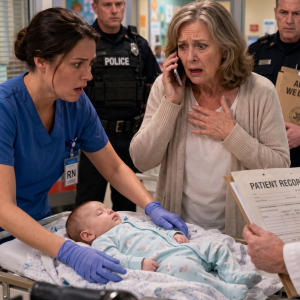
At Massachusetts General Hospital, physicians found more than the expected sedatives from that evening.