“Mom… Please Come Get Me.”
“Mom… please come get me.”
Those were the only five words my daughter Abigail managed before the call ended.
I was still in my Army dress uniform when I left Fort Liberty and drove toward Charlotte. I called her every fifteen minutes.
She never answered.
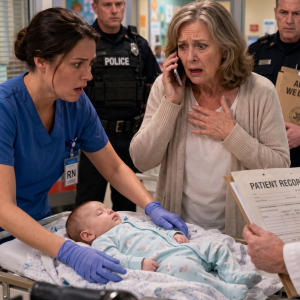
At the hospital, I found Abigail sitting upright in Room Twelve with a gray blanket pulled to her chest. Her left eye was swollen. Her lip was split. There were dark marks around both arms.
But what I remember most was her right hand.
She was gripping the plastic hospital identification band so tightly her fingers had turned white.
“Mom.”
I crossed the room and held her carefully.
Then someone spoke behind me.
“Colonel Gardner.”
I turned.
My son-in-law, Nicholas Ferguson, stood in the doorway beside his mother, Patricia, and his younger brother, Gregory.
Patricia stepped forward.
“I’m glad you’re here. Abigail had an accident.”
I looked at Nicholas.
“What happened?”
He sighed.
“She got emotional. She’d been drinking and tried to leave. She fell.”
Abigail’s hand closed around my sleeve.
“No.”
Nicholas barely looked at her.
“She’s confused.”
My daughter shook her head.
“They locked me in the guest house.”
The room went silent.
“They took my phone,” she continued. “Nicholas said if I tried to leave him, nobody would believe me.”
Nicholas moved toward her.
I stepped between them.
He stopped.
Patricia’s expression tightened.
“Abigail has been under tremendous stress.”
I looked at my daughter’s arms.
“Who did that?”
Nobody answered.
Gregory finally spoke.
“Colonel, this is a family matter.”
“Then explain it.”
He gave me a small smile.
“Your uniform doesn’t change what this is.”
I didn’t argue.
I took out my phone.
Nicholas straightened.
“Who are you calling?”
“No one.”
I opened the camera.
The First Thing I Saved
The Fergusons were wealthy.
Their family owned commercial property throughout North Carolina. Patricia sat on charity boards. Nicholas appeared in business magazines. Gregory worked in political consulting.
They knew important people.
More importantly, they were accustomed to other people knowing that.
Patricia lowered her voice.
“You have an impressive career, Colonel, but this isn’t Fort Liberty.”
“I’m aware.”
“People know our family here.”
I photographed Abigail’s arms.
Then her face.
Then the torn shoulder of her dress.
Patricia stared at me.
“Is that necessary?”
“Yes.”
I photographed the identification band around Abigail’s wrist.
Nicholas stepped forward.
“Stop treating this like evidence.”
The nurse near the doorway looked at him.
“Your wife requested that her injuries be documented.”
“She’s my wife.”
“She’s my patient.”
Nicholas stepped back.
I asked Abigail one question.
“Do you want to leave with me?”
She answered immediately.
“Yes.”
I folded her dress into the hospital belongings bag.
Patricia gave a short laugh.
“And where exactly are you taking her?”
“Somewhere she can sleep.”
“Colonel, you’re making a mistake.”
I picked up Abigail’s bag.
“Then it’s mine to make.”
I didn’t threaten them.
I didn’t mention my rank again.
I simply walked my daughter out.
We checked into a small hotel near the interstate.
Abigail sat on the edge of the bed while I closed the curtains.
The hospital band remained around her wrist.
“Want me to cut that off?”
She looked at it.
“Not yet.”
I sat across from her.
“Tell me what you can.”
For nearly a minute, she said nothing.
Then she told me about the guest house.
Three days earlier, Nicholas had taken her there after an argument about their marriage. He said she needed time to calm down.
The door locked from the outside.
Her phone disappeared.
“How did you get out?”
“Rosa.”
Rosa Alvarez had worked for the Fergusons for years.
“She opened a side door and gave me an old phone.”
“Where is she now?”
Abigail looked down.
“I don’t know.”
Then she rubbed her thumb over the hospital band.
“She told me something before I left.”
“What?”
“She said if something happened to her, I shouldn’t believe it was an accident.”
I sat very still.
“Anything else?”
Abigail nodded.
“She said she had proof.”
That was when I made my first call.
Not to a general.
Not to military police.
I called a federal investigator I had worked with years earlier and gave him only what I could support.
My daughter reported being confined against her will.
Her injuries had been documented.
A household employee had helped her escape and was now unreachable.
He listened.
Then he said:
“Don’t go back to that house.”
Rosa Left a Key
The next morning, Abigail remembered Rosa putting something into the pocket of her dress.
We checked the hospital belongings bag.
Inside the pocket was a small brass key attached to a numbered plastic tag.
Investigators traced it to a storage facility outside Charlotte.
The locker contained one cardboard box.
Inside were copies of household records, photographs and a flash drive.
One video file showed Rosa sitting at a kitchen table.
She looked exhausted.
“If Abigail is watching this, I’m sorry.”
My daughter covered her mouth.
Rosa continued.
“The Ferguson family knows things they shouldn’t know.”
She listed dates.
Private conversations.
Travel schedules.
Then she mentioned me.
My deployment dates.
A training rotation that had never been publicly announced.
Periods when Abigail would be alone.
I leaned closer to the screen.
Rosa said Nicholas sometimes knew those details before Abigail herself knew them.
Then came the sentence that changed the investigation.
“Someone connected to Colonel Gardner has been giving them information for years.”
The investigator paused the recording.
“Who knew your schedule?”
“Pieces of it? Plenty of people.”
“Who also knew your family?”
That list was shorter.
I started writing names.
Then my pen stopped.
Major Thomas Whitfield.
Thomas had served beside me for almost twenty years.
He had eaten at my table.
He sent Abigail birthday cards in college.
His wife, Eleanor, had even introduced Abigail to the social circle where she eventually met Nicholas.
I didn’t accuse him.
But Abigail suddenly looked at me.
“Mom, remember my wedding?”
“What about it?”
“Major Whitfield introduced me to that woman.”
“Which woman?”
Abigail hesitated.
“Nobody ever used her real name.”
The investigator leaned forward.
“What did they call her?”
Abigail looked at Rosa’s frozen face on the laptop.
“The Broker.”
The investigator’s expression changed.
“You’re certain?”
“Yes.”
He closed the laptop.
“That name is connected to an active federal investigation.”
What Was Beneath the House
By late afternoon, investigators had obtained authority to search parts of the Ferguson property.
Abigail and I waited several blocks away.
Then smoke appeared above the trees.
An agent received a call and stepped from the vehicle.
“What happened?” I asked.
“There’s a fire at the residence.”
Abigail grabbed my arm.
“Mom.”
I turned.