The Volunteer Who Looked Out of Place
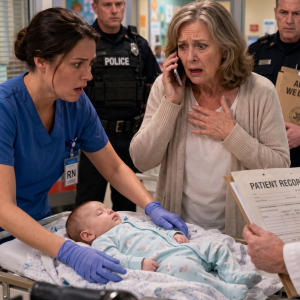
The first time Michael Brennan entered our neonatal intensive care unit, I assumed somebody from hospital security had accidentally directed him to the wrong floor.
I had worked as the charge nurse in the NICU at Riverside Children’s Medical Center in Des Moines, Iowa, for eleven years, which meant I had become familiar with nearly every kind of person who walked through those doors. Terrified first-time fathers usually moved too quickly and asked too many questions, grandparents carried grocery bags full of things premature babies could not yet use, and volunteers often arrived with the careful enthusiasm of people determined not to disturb anything fragile.
Michael looked like none of them.
He was in his mid-fifties, nearly six feet four, with the square shoulders of someone who had spent most of his adult life carrying equipment heavier than some of our patients’ fathers. Pale burn scars stretched from both wrists toward his elbows, disappearing beneath the sleeves of a black T-shirt. The fingers of his right hand trembled continuously, while the left shook only when he tried to hold it still.
His volunteer badge identified him simply as MICHAEL BRENNAN.
The background file attached to his approval said more.
Retired United States Army captain.
Decorated combat veteran.
Permanent nerve damage caused by injuries sustained during an armored-vehicle fire overseas.
Completed infant-contact training, infection-control certification, psychological screening, and every additional assessment required by our hospital’s neonatal comfort program.
On paper, he was qualified.
Standing in front of me, he looked like a man whose body still expected explosions.
“Nurse Matthews?” he asked.
“That is me.”
“They told me you assign volunteers.”
His voice was low and deliberate, as though he had learned to make every sentence smaller than the room.
“Usually I do.”
His eyes moved beyond me toward the rows of incubators.
“I am not asking for special treatment. Just tell me where I am useful.”
Before I could answer, the infant in Bed Twelve began crying.
Every member of the unit knew that cry.
The chart still listed her as Baby Girl Dawson because no family member had completed paperwork beyond the mother’s surname.
She had arrived at twenty-nine weeks gestation, weighing barely three pounds, after an emergency delivery in a county hospital forty miles away. Her mother, twenty-seven-year-old Megan Dawson, left shortly after transfer and had not returned.
The toxicology screen told part of the story.
The social-work notes told the rest.
There was no father listed.
No grandparents had responded.
No relatives had called.
The baby had entered the world carrying withdrawal symptoms from substances she had never chosen.
Her nervous system seemed unable to settle. She startled violently, slept poorly, cried in sharp bursts, and struggled to tolerate ordinary handling. Every intervention had to balance stimulation against medical necessity.
That morning had been especially difficult.
We had already adjusted the lighting, reduced sound, changed positioning, reassessed medication, wrapped her more securely, and minimized unnecessary contact.
Still, she cried.
Michael turned toward the sound.
The expression on his face changed so quickly that I noticed before I could stop myself.
Not pity.
Recognition.
“Does she need someone to sit with her?”
I glanced at his hands.
He noticed.
People who live with visible injuries become experts at noticing where other people look.
“They shake,” he said calmly.
Heat rose into my face.
“I was reviewing safety.”
“You were wondering whether I could hold her.”
I could have denied it.
Instead, I nodded.
“She weighs less than three pounds, and she has trouble regulating herself when overstimulated.”
Michael looked through the incubator wall.
“Then I will not do anything unless you tell me exactly how.”
There was no wounded pride in his answer.
That mattered.
I led him to the scrub station.
He washed for the required length of time, but nerve damage made each movement uneven. Water struck the sink in irregular splashes as he worked soap between scarred fingers.
When he finished, I brought him beside Bed Twelve.
“We are not lifting her yet,” I said. “Start with containment. One hand near the head, one supporting the trunk. Gentle pressure, no stroking.”
Michael nodded.
The moment the incubator ports opened, the baby’s crying intensified.
Then a monitor alarm sounded behind us.
Michael froze.
His pupils widened.
His shoulders locked.
The right hand trembled violently.
For one second, the NICU disappeared from his eyes.
I had seen veterans with trauma reactions before, but never while their hands were inches from a premature infant.
“Michael, step back.”
He did not move.
His breathing became shallow.
“Michael Brennan, look at me.”
His eyes found mine.
“You are in Iowa,” I said. “You are inside Riverside Children’s Hospital. That alarm belongs to a monitor. Nobody is attacking you.”
His jaw clenched.
“I know.”
“Then step back until your hands settle.”
He looked toward the baby.
“Give me ten seconds.”
I almost refused.
Then I watched him deliberately press both feet into the floor.
He inhaled slowly.
Held it.
Exhaled.
Again.
The tremor reduced.
Not completely.
Enough.
“One hand only,” I said. “Your left. Place it over her shoulders and upper back.”
Michael obeyed.
His scarred palm covered nearly half the baby’s body without applying more pressure than the weight of a blanket.
She screamed once.
Then again.
Michael closed his eyes.
He did not pick her up.
He did not rub her.
He simply stayed.
That was the first surprise.
The second came when a metal chain slipped from beneath his shirt.
Two military identification tags rested against his chest.
One carried his name.
The other did not.
I saw the engraving when he leaned closer.
SGT. BENJAMIN DAWSON.
My attention snapped toward the chart.
Baby Girl Dawson.
I looked back at the tag.
“Michael.”
He opened his eyes.
“Who was Benjamin Dawson?”
His face went completely still.
For several seconds, he said nothing.
Then he looked toward the baby.
“Her uncle.”
The Soldier Who Never Came Home
We moved into the family consultation room after another nurse took over Bed Twelve.
Michael sat across from me with both hands resting on his knees.
The tremor had returned.
“You knew who she was before you volunteered?”
“Not when I applied.”
He looked at the floor.
“I had been trying to find Benjamin’s family for years. Three weeks ago, an old Army contact told me his younger sister had been admitted somewhere in Iowa during pregnancy. I found out about the baby after social services began searching for relatives.”
“Why did you not tell the volunteer coordinator?”
“Because I did not know whether she was the same child until yesterday.”
I waited.
Michael removed the second identification tag and placed it on the table.
“Benjamin Dawson saved my life eleven years ago.”
The official version was simple.
An Army convoy overseas had been struck during a roadside attack. Michael’s vehicle caught fire after overturning. He suffered burns, crushed nerves in both forearms, and injuries that left him trapped inside.
Sergeant Benjamin Dawson went back for him.
Benjamin pulled Michael far enough from the vehicle for other soldiers to reach them.
A second explosion followed.
Michael survived.
Benjamin did not.
“He was twenty-six,” Michael said. “He had a sister named Megan who was still in high school. He talked about her constantly.”
Michael smiled for the first time, though there was no happiness in it.
“He said she could argue with a brick wall and make the brick apologize.”
I looked toward the hallway.
“Did you meet her after he died?”
“Once.”
Michael had attended Benjamin’s funeral in Missouri after months of surgeries. Megan was sixteen, furious at the Army, furious at Michael for surviving, furious at a brother who had promised to come home.
Michael understood.
He did not return.